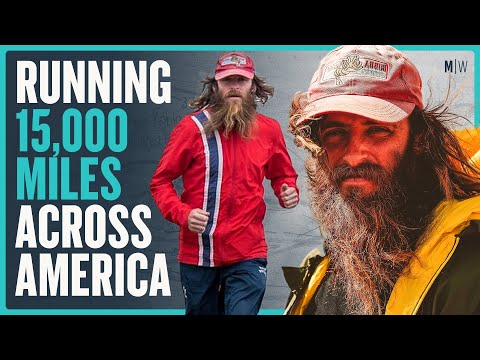
The Man Who Ran Across America 5 Times - Rob Pope
Rob Pope (guest), Chris Williamson (host), Narrator, Narrator
In this episode of Modern Wisdom, featuring Rob Pope and Chris Williamson, The Man Who Ran Across America 5 Times - Rob Pope explores forrest Gump-Inspired Runner Crosses America Five Times for Purpose Rob Pope recounts his 15,600+ mile, Forrest Gump-inspired run across America, which he completed five times over 422 days while averaging roughly a marathon and a half per day.
Forrest Gump-Inspired Runner Crosses America Five Times for Purpose
Rob Pope recounts his 15,600+ mile, Forrest Gump-inspired run across America, which he completed five times over 422 days while averaging roughly a marathon and a half per day.
He explains how the project evolved from an athletic curiosity into a deeply personal mission honoring his late mother and raising money for WWF and Peace Direct, financed largely by sacrificing his and his partner’s house savings.
Pope describes the brutal physical toll, near-death encounters, financial stress, and emotional lows, as well as the unexpected kindness and community he found across the U.S.
The conversation closes with his challenges reintegrating into normal life, the impact of becoming a father, and his plans for a symbolic “closure” run and possible future expeditions in America and Australia.
Key Takeaways
Massive endurance feats are built by routine and micro-goals, not constant heroics.
Pope focused on getting from one small waypoint to the next—breakfast, lunch, a state line, a couchsurf stop—rather than the full 15,000+ miles, using structure and small rewards to make each day psychologically manageable.
Get the full analysis with uListen AI
Recovery “on the job” is essential for multi-month endurance projects.
After overcooking the early miles, he was forced to incorporate walking breaks and accept slower paces so his body could repair while still moving, demonstrating that sustainable effort beats maximal effort over long durations.
Get the full analysis with uListen AI
Support systems and sacrifice behind the scenes make individual achievements possible.
His partner Nadine acted as driver, navigator, psychologist, and logistics manager, gave up their house deposit, and later left to have their baby—illustrating that extreme personal goals often rely on invisible, shared sacrifice.
Get the full analysis with uListen AI
Motivation is strongest when tied to identity, relationships, and purpose—not ego.
Pope anchored his commitment in honoring his mother’s wish to “do one thing that makes a difference” and in fundraising for WWF and Peace Direct, which became his internal “tough boss” on days when quitting felt tempting.
Get the full analysis with uListen AI
Adventures dramatically shift your sense of risk once you’re responsible for others.
After learning he would become a father, Pope’s previously casual attitude to danger flipped; traffic and near misses suddenly felt existential because any accident would now affect his partner and unborn child.
Get the full analysis with uListen AI
Post-expedition comedowns are real and can resemble depression.
Despite a euphoric finish and a new baby, he later realized he was irritable, disengaged, and struggling to adjust to normal life—highlighting the need to plan for psychological reintegration after major peak experiences.
Get the full analysis with uListen AI
Media narratives of division often misrepresent how people actually behave on the ground.
Running through the U. ...
Get the full analysis with uListen AI
Notable Quotes
“If you'd have put a suitcase, $10,000, a thousand miles down the road and said, 'Go on, just another thousand,' I'd have just gone, 'No, I'm just beat. I'm done.'”
— Rob Pope
“If you’d have asked me at the very end… when Forrest turns around and he says, 'I’m pretty tired, I think I’ll go home now,' I just knew exactly what he felt like.”
— Rob Pope
“I wasn’t fighting fires that were started, there was just a fire and I was just having to stop it going out of control.”
— Rob Pope
“It wasn’t about making America great again. It’s about stopping America going down the tubes… America has got infinite potential.”
— Rob Pope
“There’s one thing that will make you get out of bed and that’s not wanting to let your mum down.”
— Rob Pope
Questions Answered in This Episode
How do you practically prepare—physically, logistically, and financially—for an endurance project that almost no one has ever completed?
Rob Pope recounts his 15,600+ mile, Forrest Gump-inspired run across America, which he completed five times over 422 days while averaging roughly a marathon and a half per day.
Get the full analysis with uListen AI
What specific mental techniques or self-talk patterns did Rob rely on during his darkest, most painful stretches on the road?
He explains how the project evolved from an athletic curiosity into a deeply personal mission honoring his late mother and raising money for WWF and Peace Direct, financed largely by sacrificing his and his partner’s house savings.
Get the full analysis with uListen AI
How should someone planning a big life-defining challenge also plan for the psychological “crash” that may come afterward?
Pope describes the brutal physical toll, near-death encounters, financial stress, and emotional lows, as well as the unexpected kindness and community he found across the U.S.
Get the full analysis with uListen AI
In what ways did the kindness (or hostility) of strangers change Rob’s perception of America and of people in general?
The conversation closes with his challenges reintegrating into normal life, the impact of becoming a father, and his plans for a symbolic “closure” run and possible future expeditions in America and Australia.
Get the full analysis with uListen AI
How do you balance extreme personal goals with responsibilities to partners, children, and long-term financial security?
Get the full analysis with uListen AI
Transcript Preview
If you'd have asked me at the very end, if you'd have put a suitcase, $10,000, a thousand miles down the road and said, "Go on, just another thousand," I'd have just gone, "No, I'm just beat. I'm done." That point where Forrest turns around and he says, "I'm pretty tired, I think I'll go home now," I just knew exactly sort of what he felt like. (laughs)
Rob Pope, welcome to the show.
Cheers. Thanks for having me, man.
It's a very, very pleasant reminder to hear that accent while I'm out here in Texas.
(laughs) Yeah, same as well, man. I hope you, uh, hope you spread the Geordie love over there. When, when I was actually in the States, nobody actually thought I was English, by the way. Most people thought I was Australian.
Well, it's just such a strong accent, right? It's not exactly... When people think about Britain, especially Americans, they think about, like, "Pip, pip, tally ho. What, what?"
(laughs)
"Cup of tea, governor." And then-
Oh, £%$#. Yeah.
... you come in, "Fucking hell. All right, mate."
(laughs)
"What's the fuck, what the fuck is going on there, love?" (laughs) Like, it's not-
Well, I was relying on the Scouse accent to get me out of trouble if I ever got into a, i- i- i- if I ever (laughs) got into some real shit, you know? And it sort of actually almost got me into trouble once, but, uh, (laughs) I'm sure we'll get to that later. Tell you what, a funny, um, a funny story about my accent. In 2006, right, I did my first ever Boston Marathon. And if anybody's, like, done a marathon sort of in the UK or elsewhere in the world, they've not done Boston, you've got to do it. It's, like, the best. Mile 13, you run past Wellesley College, which is the biggest all-girl university in, like, the United States, probably the world. And when you go down it, it's like what it was like being in The Beatles. So, everybody's screaming and there's signs that say, "Will kiss any Mexican guy. Will kiss any Japanese dude." And I saw one. I, I wasn't gonna do a PB, and I saw one which said, "Will kiss any Brit," and I thought, "Yeah, I'm gonna have a bit of that." And I just, I just leant in for a peck and it ended up being something a little bit more. And I had to say, "I'm sorry, I've gotta go." And as I ran down the road, I heard a... Just go, "Oh my God, he sounds just like Prince William." (laughs)
(laughs) You've never heard Prince William, have you? You're so confused.
Nope, nope, nope. (laughs)
Fuck. Well, yeah, I mean...
Scouse.
I understand what you mean when you say that you rely on your accent as another layer of defensive armor, because there is something about the Scouse accent which is essentially weaponized. Like, it is-
Install uListen to search the full transcript and get AI-powered insights
Get Full TranscriptGet more from every podcast
AI summaries, searchable transcripts, and fact-checking. Free forever.
Add to Chrome