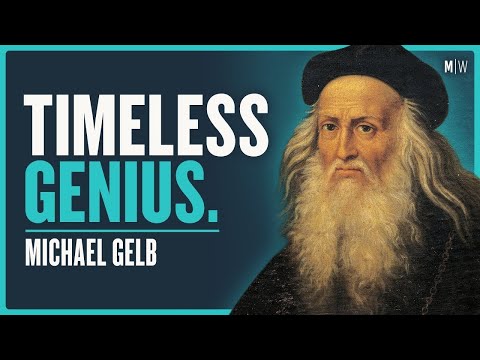
How To Think Like History’s Greatest Genius - Michael Gelb
Chris Williamson (host), Michael Gelb (guest), Narrator
In this episode of Modern Wisdom, featuring Chris Williamson and Michael Gelb, How To Think Like History’s Greatest Genius - Michael Gelb explores unlocking Leonardo: Seven Timeless Principles For Modern Creative Genius Michael Gelb explains how Leonardo da Vinci’s life, work, and notebooks reveal a practical framework for thinking more creatively and living more fully. Through stories about Leonardo’s patrons, art, science, and daily habits, Gelb extracts seven principles—like curiosity, experimentation, sensory refinement, and systems thinking—that anyone can train. He contrasts Leonardo’s love‑driven genius with Michelangelo’s guilt‑driven intensity, emphasizing the role of purpose, joy, and ambiguity tolerance in great work. The conversation closes by connecting these Renaissance ideas to modern challenges: distraction, cynicism, overwork, and the desire to be paid for the quality of our thinking.
Unlocking Leonardo: Seven Timeless Principles For Modern Creative Genius
Michael Gelb explains how Leonardo da Vinci’s life, work, and notebooks reveal a practical framework for thinking more creatively and living more fully. Through stories about Leonardo’s patrons, art, science, and daily habits, Gelb extracts seven principles—like curiosity, experimentation, sensory refinement, and systems thinking—that anyone can train. He contrasts Leonardo’s love‑driven genius with Michelangelo’s guilt‑driven intensity, emphasizing the role of purpose, joy, and ambiguity tolerance in great work. The conversation closes by connecting these Renaissance ideas to modern challenges: distraction, cynicism, overwork, and the desire to be paid for the quality of our thinking.
Key Takeaways
Cultivate relentless, childlike curiosity (Curiosità).
Leonardo’s genius started with an obsessive desire to ask better questions; exercises like writing 100 questions in one sitting or using “who, what, why, where, when, how” can break habitual thinking and surface deeper insights.
Get the full analysis with uListen AI
Test ideas through experience instead of accepting authority (Dimostrazione).
Leonardo insisted on demonstrating truth for himself, which means cultivating healthy skepticism—challenging assumptions, running small experiments, and turning cynicism into productive, evidence‑based doubt.
Get the full analysis with uListen AI
Sharpen and savor your senses to fuel creativity (Sensazione).
He trained his senses like an athlete, using focused walks, comparative tastings (wine, chocolate, art, music), and attention to light, color, and sound to make perception richer and thinking more nuanced.
Get the full analysis with uListen AI
Learn to live with ambiguity and uncertainty (Sfumato).
Leonardo’s hazy painting technique mirrors his psychological skill: keeping emotional intelligence, higher principles, and humor intact amid ambiguity instead of demanding instant clarity or control.
Get the full analysis with uListen AI
Integrate logic with imagination (Arte Scienza).
Rather than separating art and science, Leonardo used both to explore truth; tools like hand‑drawn mind maps deliberately combine analytical structure with images and color to unlock more holistic thinking.
Get the full analysis with uListen AI
Align body, health, and poise with mental performance (Corporalità).
Leonardo advocated preserving health through movement, diet, nature, and mood, and embodied grace in how he moved—reminding us that energy, posture, and well‑being directly support creative and intellectual work.
Get the full analysis with uListen AI
Think in systems and align daily actions with your larger purpose (Connessione).
Seeing how “everything connects to everything else” means mapping values, goals, habits, and likely consequences together, then making small, consistent adjustments so your calendar matches your stated purpose.
Get the full analysis with uListen AI
Notable Quotes
“Most people are never really made aware of the phenomenal unlimited potential with which we are all born.”
— Michael Gelb
“He had to do what he had to do in order to continue to do what he really wanted to do, which was to understand the mind of God.”
— Michael Gelb
“Men of genius sometimes work best when they work least.”
— Leonardo da Vinci, quoted by Michael Gelb
“Our birthright is curiosity… you can have a personal renaissance by empowering the questioning process.”
— Michael Gelb
“Everything connects to everything else.”
— Leonardo da Vinci, quoted by Michael Gelb
Questions Answered in This Episode
How could I realistically incorporate Leonardo’s seven principles into my own weekly routine without overwhelming myself?
Michael Gelb explains how Leonardo da Vinci’s life, work, and notebooks reveal a practical framework for thinking more creatively and living more fully. ...
Get the full analysis with uListen AI
In what areas of my life am I currently a cynic, and what would it look like to shift from cynicism to healthy skepticism?
Get the full analysis with uListen AI
What’s one concrete practice I can adopt to sharpen my senses and actually savor daily experiences instead of rushing through them?
Get the full analysis with uListen AI
Where am I currently resisting ambiguity or uncertainty, and how might embracing ‘sfumato’ change my decisions or stress levels?
Get the full analysis with uListen AI
If I made a mind map of my life’s purpose, values, and goals today, where would I discover the biggest misalignments between what I say I want and what I actually do?
Get the full analysis with uListen AI
Transcript Preview
Why would anyone want to think like Leonardo da Vinci?
Why would anybody not want to think (laughs) like Leonardo da Vinci, if you even dreamed that it was possible? Most people... are never really made aware of the phenomenal unlimited potential with which we are all born, the incredible brains that we're gifted with. But they didn't come with a manual, so, (laughs) you know, just like baby ducks learn to walk by imitating their mothers, we learn how to think and how to be by the people we get to imitate, and usually that's a default setting, your mom and dad, the people around you when you grow up, your teachers. But what if you called on history's greatest genius to be your personal mentor in utilizing those amazing capabilities?
What was da Vinci like as a person? What was his demeanor?
He was charming, he was funny. (laughs) He was elegant, uh, he liked to dress really well. He wore the finest clothes that he could afford, the finest fabrics. He was a musician. He had a gift for... making people feel comfortable, for connecting with others, which is part of how he was able to get high-level patrons throughout his career. He charmed them and they, they thought, "Well, we kind of like this guy, let's keep him around and see what he can do." And then he winds up, you know, painting the (laughs) Last Supper and the Mona Lisa and a few other things.
So he was a canny operator, then?
Uh, yeah. I mean, you had to be. To, to get by at- at- at that time, you needed, uh, patronage. You needed a sponsor. Just like I notice you always have these great sponsors on your show (laughs) and I want to buy all those products every time I watch. It's like, "Yeah, I need that backpack."
They're my patrons.
(laughs)
Yeah, exactly, Needman Magic Backpack, shout out. Um, how much... you know, I- I love Italy. I've spent a lot of time in Florence and Rome, uh, recently came back from Venice. Um, you know, the period of time Michelangelo, da Vinci, uh... Politically very interesting in Italy. How much did the sort of political landscape, the cultural landscape of Italy at the time, do you think sort of shape who he was, his opportunities, the way he saw the world, the places that he placed his efforts?
Sure. Well, he had to move because of political turmoil. His, uh, tenure, his original tenure in Florence came to an end when he saw that, uh, he might be better off under the patronage of Ludovico Sforza, the Duke of Milan. So you probably read the most famous employment application letter of all time.
Can you tell people about that- that letter, please?
(laughs) Well, you gotta love it because, "Most illustrious lord," and then he basically says, "Having seen what other people can do, I gotta tell you, I can do way better." (laughs) And then he goes on to say, "I can build you bridges, I can take care of everything in ti- in times of war," because the felt need of despots, like Sforza was, "Build me some cannon, uh, help me get, uh, underwater to blow up the enemy's fortress." So Leonardo goes on and on about how he can help with all this, and then he says, uh, I think it's number 11, he says, "Oh yeah, by the way, I can do a little painting." (laughs) And then he says, "Not only that, I'll come to your palace and I'll prove that I can do all of this," and then he says, "all in most gracious humility." (laughs) He got the job. (laughs)
Install uListen to search the full transcript and get AI-powered insights
Get Full TranscriptGet more from every podcast
AI summaries, searchable transcripts, and fact-checking. Free forever.
Add to Chrome