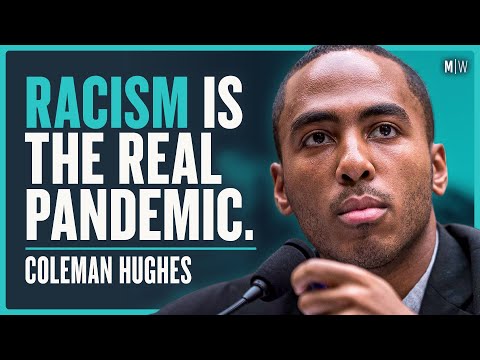
Bringing An End To Race Politics - Coleman Hughes
Chris Williamson (host), Coleman Hughes (guest)
In this episode of Modern Wisdom, featuring Chris Williamson and Coleman Hughes, Bringing An End To Race Politics - Coleman Hughes explores coleman Hughes argues colorblindness beats race-based politics in America Coleman Hughes lays out the case for a colorblind society in which individuals treat one another without regard to race and public policy is based on class and need rather than racial categories.
Coleman Hughes argues colorblindness beats race-based politics in America
Coleman Hughes lays out the case for a colorblind society in which individuals treat one another without regard to race and public policy is based on class and need rather than racial categories.
He traces how America moved away from this ideal after the late-1960s riots and again after George Floyd’s death in 2020, arguing that media dynamics, smartphone-era outrage, and elite incentives produced harmful race-based policies like defund-the-police and neo-racist ‘anti-racism.’
Hughes highlights the disconnect between elite racial narratives and the preferences of ordinary Black Americans, noting that many well‑intentioned policies mainly benefit the Black elite while worsening conditions in poor Black communities.
He concludes that recommitting to genuine colorblindness—both interpersonally and in law—is the most sustainable path for a healthy multiracial society.
Key Takeaways
Adopt ‘treat without regard to race,’ not ‘I don’t see race.’
Hughes argues everyone visibly perceives race, so denying it is dishonest and an easy target for critics; instead, commit explicitly to judging people as individuals and not giving race moral or practical weight in how you treat them.
Get the full analysis with uListen AI
Support policies based on class and need, not race categories.
Following Martin Luther King Jr. ...
Get the full analysis with uListen AI
Interrogate media-driven narratives about racism with hard data.
Because viral videos of police incidents with Black victims spread faster than context or fact-checking, many people vastly overestimate problems like police killings (estimating ~1,000 unarmed Black deaths vs. ...
Get the full analysis with uListen AI
Be wary of ‘luxury beliefs’ that feel compassionate but harm the vulnerable.
Ideas like defunding the police are often championed by affluent people who enjoy private security and safe neighborhoods, yet they contributed to a historic spike in homicides concentrated in poor Black areas, contrary to what most Black residents actually wanted.
Get the full analysis with uListen AI
Reject neo-racist norms that demand deference or different rules by race.
Hughes criticizes anti-racism frameworks that tell white people they must never disagree with Black people on race issues, calling this a racist double standard that undermines mutual learning, shared reality, and adult conversation across groups.
Get the full analysis with uListen AI
Recognize how elite bubbles can misrepresent minority views.
Examples like the term ‘Latinx’—liked by roughly 4% of Hispanics but ubiquitous among activists, media, and politicians—show how elite discourse often drifts far from what ordinary minority communities prefer or even recognize.
Get the full analysis with uListen AI
Advocate for race-neutral law and institutional practices.
Hughes urges rolling back race-based mandates and affirmative action in favor of merit-based selection, with narrow exceptions where racial diversity is functionally necessary (e. ...
Get the full analysis with uListen AI
Notable Quotes
“What you should say instead is, ‘I try to treat people without regard to race.’”
— Coleman Hughes
“This is not a book that's telling you to be naive or to pretend that racism doesn't exist. It's a book that says we should treat people without regard to race, both in our personal lives and in our public policy.”
— Coleman Hughes
“Defund The Police is patient zero for luxury beliefs.”
— Chris Williamson
“It is in fact racist to suggest that different races of people should live by different sets of books.”
— Coleman Hughes
“Diversity is kind of like love—if you force it, you've kind of missed the point. But if it arises naturally, it's awesome.”
— Coleman Hughes
Questions Answered in This Episode
How would a fully class-based, race-neutral policy regime handle persistent racial disparities in outcomes without explicitly using race?
Coleman Hughes lays out the case for a colorblind society in which individuals treat one another without regard to race and public policy is based on class and need rather than racial categories.
Get the full analysis with uListen AI
What practical steps can ordinary people take to push back against neo-racist norms at work or in social circles without being immediately labeled racist?
He traces how America moved away from this ideal after the late-1960s riots and again after George Floyd’s death in 2020, arguing that media dynamics, smartphone-era outrage, and elite incentives produced harmful race-based policies like defund-the-police and neo-racist ‘anti-racism.’
Get the full analysis with uListen AI
Where do you think the line should be drawn between legitimate representation needs (e.g., in policing) and counterproductive diversity quotas?
Hughes highlights the disconnect between elite racial narratives and the preferences of ordinary Black Americans, noting that many well‑intentioned policies mainly benefit the Black elite while worsening conditions in poor Black communities.
Get the full analysis with uListen AI
How can media organizations or platforms redesign incentives so that accurate context about race and policing spreads as effectively as outrage-inducing clips?
He concludes that recommitting to genuine colorblindness—both interpersonally and in law—is the most sustainable path for a healthy multiracial society.
Get the full analysis with uListen AI
If colorblindness became the widely accepted norm again, what changes would you expect to see in interpersonal behavior, especially around sensitive race conversations?
Get the full analysis with uListen AI
Transcript Preview
What do you think about the state of race in America now? What's your meteorological weather report?
Yeah, so, you know, the reason I wrote this book, uh, is that this idea of colorblindness, which means you try to treat people without regard to race. I see obviously that you're a quote unquote "white guy." You see that I'm a quote unquote "Black guy," but I'm gonna treat you like Chris Williamson, knowing everything I know about you as an individual, and I ask you to treat me like Coleman Hughes, knowing everything you know about me. And we don't regard, we don't give weight to each other's races when we treat each other. And my book is, is advocating not just for that, but also advocating for getting race out of public policy. In America, we have all kinds of policies that use racial discrimination, uh, explicitly. And people have various reasons for this, to fight racism, to combat the legacy of slavery, and so forth. And in my book, I wanna argue instead for a colorblind philosophy. Let's get race out of public policy. If we want to correct for disadvantages, let's do that on the base of s- basis of socioeconomics and class. And, uh, uh, i- in my view, this is a much healthier path towards the ideal of a colorblind society. It used to be, you know, common sense on the left and in liberal circles that that's what you wanted to do. In, in the mid '60s, you had Martin Luther King writing t- and speaking to, to this effect, but in the past 50 years, and particularly in the past 10 with the explosion of Black Lives Matter, social justice, wokeness, DEI, critical race theory, whatever you wanna call it, this idea of colorblindness has come under attack as naive at best or as white supremacist, uh, uh, uh, at worst. So, so in the book here, I really try to rescue this idea of colorblindness because I think it's the, uh, the wisest way to actually navigate a multiracial, multiethnic society in the long run.
Explain to me the difference between being colorblind and not seeing race, 'cause that kinda became a meme. "I don't see race-"
Right.
... became a meme. What, is there a difference?
I think there's a huge difference because the truth is, we all see race, right? When someone says, "I don't see race," I understand what they're getting at, but it's actually a lie. It's not true. I could... You know, e- everyone watching this can see that you're white and that, that I'm not, right? So when people say, "I don't see race," they're putting up a very convenient target for the critics of colorblindness to say, "Look, they're just being naive. They're pretending not to see race." Uh, uh, and it allows people to dismiss the deeper philosophy of colorblindness without giving it a fair consideration. So in my book, I, I advocate that people just stop saying that. It, it gives enemies of colorblindness far too easy a target. What you should say instead is, "I try to treat people without regard to race." Now, that doesn't roll off the tongue quite as quickly, but it's, it's, it's much closer to the truth. It's more accurate. And so, um, you know, I think we should all admit that we see ra- race, all admit that we are theoretically capable of being raci- racist. All of us are. So this is not a book that's telling you to be naive or to pretend that racism doesn't exist. It's a book that says we should treat people without regard to race, both in our personal lives and in our public policy.
Install uListen to search the full transcript and get AI-powered insights
Get Full TranscriptGet more from every podcast
AI summaries, searchable transcripts, and fact-checking. Free forever.
Add to Chrome