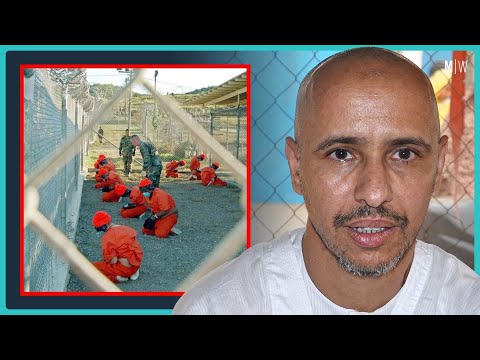
Surviving 14 Years In Guantanamo Bay - Mohamedou Ould Slahi | Modern Wisdom Podcast 322
Mohamedou Ould Slahi (guest), Chris Williamson (host), Narrator
In this episode of Modern Wisdom, featuring Mohamedou Ould Slahi and Chris Williamson, Surviving 14 Years In Guantanamo Bay - Mohamedou Ould Slahi | Modern Wisdom Podcast 322 explores fourteen Years in Guantanamo: Mohamedou Slahi’s Journey to Forgiveness Mohamedou Ould Slahi recounts how a single innocent phone call and loose intelligence links to extremists led to his extraordinary rendition, torture and 14-year imprisonment without charge in Guantanamo Bay.
Fourteen Years in Guantanamo: Mohamedou Slahi’s Journey to Forgiveness
Mohamedou Ould Slahi recounts how a single innocent phone call and loose intelligence links to extremists led to his extraordinary rendition, torture and 14-year imprisonment without charge in Guantanamo Bay.
He details his experiences of interrogation, sleep deprivation, physical and sexual abuse, and the psychological devastation of being held indefinitely despite U.S. agencies knowing he was not involved in terrorism.
Alongside this, he reflects on the film and books about his story, the moral responsibility of individuals within systems, and how he ultimately chose forgiveness and kindness as a means of reclaiming his life.
The conversation closes with his current efforts to rebuild his life, advocate for human rights, and challenge audiences in free societies to appreciate their daily freedoms and let go of petty resentments.
Key Takeaways
Seemingly minor associations can escalate into life-destroying suspicion in security systems.
An innocent money-transfer call from a phone linked to Osama bin Laden and attending the same mosque as another suspect were stacked into a narrative of guilt, overriding multiple investigations that found no evidence against Slahi.
Get the full analysis with uListen AI
Indefinite detention and torture are often driven by institutional incentives, not evidence.
Even after U. ...
Get the full analysis with uListen AI
Torture leaves deep, long-term psychological imprints tied to ordinary bodily functions.
Methods like 70-day sleep deprivation, ‘water diet,’ cold rooms, and constant surveillance reshaped Slahi’s relationship to sleep, using the bathroom, and privacy—triggers that resurface years later with depression.
Get the full analysis with uListen AI
Threats to loved ones can break even the strongest resistance more than physical pain.
The decisive moment in his coerced confession was not beatings or mock executions, but the threat that his elderly mother would be taken to a men’s prison; he then agreed to sign anything, including invented plots.
Get the full analysis with uListen AI
Forgiveness can be a self-interested path to healing, not naïve moralism.
Slahi frames forgiving his tormentors as a way to live in peace and avoid being consumed by hatred, emphasizing that resentment would not punish them or help him but would keep him mentally in Guantanamo.
Get the full analysis with uListen AI
Good people can participate in atrocities through conformity and rationalization.
He describes guards and interrogators as often kind or conflicted individuals who nonetheless enforced torture regimes, prioritizing pay, career, and group norms over conscience—illustrating how systems shape behavior.
Get the full analysis with uListen AI
Shared humanity and overlapping identities are more powerful than narrow labels.
Having been helped largely by non-Muslims, Slahi argues for seeing people first as humans with common desires—family, safety, dignity—rather than through rigid religious or national identities that fuel conflict.
Get the full analysis with uListen AI
Notable Quotes
“The only thing I regretted when I was about to die was not being nice.”
— Mohamedou Ould Slahi
“You are guilty even if you are not guilty, because there is no way out of this.”
— CIA interrogator ‘Michael’ (as recalled by Slahi)
“Democracy dies in darkness.”
— Mohamedou Ould Slahi
“I forgive you not because you deserve forgiveness, but because I want to live in peace.”
— Mohamedou Ould Slahi (quoting a Canadian-Lebanese woman who inspired his outlook)
“Anger is like a virus… it takes an incredibly strong person to be a bookend.”
— Chris Williamson
Questions Answered in This Episode
How can democratic societies build accountability mechanisms that prevent intelligence and military systems from overriding exculpatory evidence in cases like Slahi’s?
Mohamedou Ould Slahi recounts how a single innocent phone call and loose intelligence links to extremists led to his extraordinary rendition, torture and 14-year imprisonment without charge in Guantanamo Bay.
Get the full analysis with uListen AI
What psychological support and ethical training might reduce the likelihood that ordinary guards and interrogators comply with abusive practices?
He details his experiences of interrogation, sleep deprivation, physical and sexual abuse, and the psychological devastation of being held indefinitely despite U. ...
Get the full analysis with uListen AI
How should legal systems treat confessions obtained under torture or threats to family, and what reforms are needed to ensure such confessions are never incentivized?
Alongside this, he reflects on the film and books about his story, the moral responsibility of individuals within systems, and how he ultimately chose forgiveness and kindness as a means of reclaiming his life.
Get the full analysis with uListen AI
In what practical ways can individuals in safe, free societies apply Slahi’s philosophy of radical forgiveness to their own much smaller grievances?
The conversation closes with his current efforts to rebuild his life, advocate for human rights, and challenge audiences in free societies to appreciate their daily freedoms and let go of petty resentments.
Get the full analysis with uListen AI
How does public storytelling through films and memoirs influence public understanding of the War on Terror and shape future policy on detention and torture?
Get the full analysis with uListen AI
Transcript Preview
... then someone start to touch me, and then manhandle me, like touching me everywhere, and then they start to cut open my clothes with scissors, stripped me naked completely, except for my blindfold and my, uh, earplugs. He start to put me in diapers. And then it dawned on me that I was not going home, I was going to prison.
What does it feel like to have a movie made about your life?
It's, it's really, like, so, like, amazing and, uh, I still, I'm still digesting because this is not in my wildest dream. I didn't dream I would have, like, a movie, you know, about me. I mean, how many people have a movie about their lives, you know? I don't know too many people, you know? I don't know anyone in person, you know, are in my surrounding. And it's just a very big blessing to have your story told on the big screen and to reach this big audience, especially in our world now.
And it's not just any movie, right? It's Benedict Cumberbatch and Tamir Rahim and Jodie Foster, and then you were contributing to the set design and the production and all sorts. This is A level, right? A-list stuff.
Absolutely. And, uh, I mean, Kevin also, Kevin won Oscars before. And, uh, yes, uh, I was involved. Uh, I mean, I didn't push myself on anyone. They just kept calling me and asking me questions and I just kept, like, answering them. And yeah, like you said, set also, like, m- I also coached Tahar Rahim on the accent and so on and so forth. It was, it was a lot of fun and pain at the same time.
How accurate would you say the movie is to what happened?
I mean, what we see in the movie is pretty accurate. Uh, you know, except, like, 'cause you cannot put on screen, like, the first 70 days of sleeplessness. You cannot put that on a screen because you just need an actor who stays sleep w- w- without sleep for 70 days, consecutive days. And that's very painful.
Take us through your story then. Why has a Mauritanian man had a movie made about his life?
Uh, so this starts with very innocent phone call. It was, like, in late '98 or early '99. I don't remember, you know, because I only knew about the call years later. So when my cousin called me, and actually it was, like, very innocent call. He asked me to wire some money to his father who was very sick in Mauritania, and then I lived in Germany. It was very easy for me. And of course, I said, "Yeah, of course, I will do that. No problem." And, uh, but there was a problem with the call. So the call was made from the, uh, f- from a phone that belonged to UBL, and my cousin was, uh, a friend of UBL. I mean, they found years later that he was not involved in the, uh, uh, atrocious attack against, uh, the United State on 9/11, but still, back then, this was before 9/11. And everything I did after that was interpreted as a m- as a vile act against the United States of America. Everything I said was interpreted in that way, that I was, quote unquote, "a bad guy." And unbeknownst to me, I was, you know, subject to so many investigations that I didn't know about. And then all the investigation done in Germany and in Canada, they found out that there was no evidence I did really something. And then I was so scared when our imam, that is our priest in the mosque, when he told me that the German police, some kind of police, like, very high level police, you know, like, they came to me and they showed him my picture and then he laughed. He said, "What do you want to know about this guy?" They said, "Yeah, we have some bad report that he is a, he's a bad guy." He was laughing. He said, "No, no, no, I know him in person. He's a very good guy. He wouldn't hurt a fly." They said, "That's what we think too, but there is a country, a country that think that he's a bad..." He told me that and I just, I just panicked. I said, "I cannot stay in this country," so. And I had already my, uh, my, uh, landed immigrant status in Canada and I moved. I said, when I move to Canada, fresh start, no one knows me, nothing. I would, you know, finish college, find job. Not f- I already finished college, but I want to study, like, PhD and that's it. That's what I did. And I was, it was so dumb because I didn't know that the intelligence, you know, agencies were so, like, connected and Canada was very close to the United States. So going there just proved the point of the United States that I was a bad guy. I was coming to Canada to do that. And as luck had it-... I ... One month after my arrival, about one month, a guy decided to cross the border by the name of Ahmed Rassam and kill innocent people. His name is Ahmed Rassam. And he was go- he- they s- they said, uh, they know that he went to the same mosque I did. And this all, like, pointed toward my person, you know? And then, I don't know whether you saw this movie, very old movie called A Man with One Red Shoe by, uh, by, uh, um ... What's his name again? The guy, you know, Cast Away.
Install uListen to search the full transcript and get AI-powered insights
Get Full TranscriptGet more from every podcast
AI summaries, searchable transcripts, and fact-checking. Free forever.
Add to Chrome