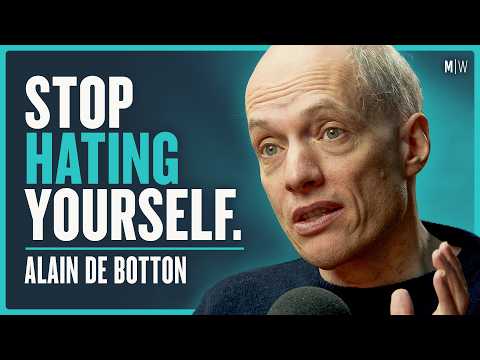
The Cycle You Don’t Realise You’re In - Alain de Botton (4K)
Chris Williamson (host), Alain de Botton (guest)
In this episode of Modern Wisdom, featuring Chris Williamson and Alain de Botton, The Cycle You Don’t Realise You’re In - Alain de Botton (4K) explores alain de Botton Reveals How Childhood Scripts Shape Our Inner Lives Alain de Botton explores how our inner voice is largely an internalized version of how others once spoke to us, especially in childhood, and why changing it is as hard and slow as learning a new language. He explains how language, therapy, and close relationships can give us a richer vocabulary for our emotions, helping us notice, name, and better tolerate what we feel instead of dissociating or acting it out. The conversation dives into attachment styles, people-pleasing, intellectualizing emotions, and why we often sabotage love and happiness when they don’t match our early emotional “diet.”
Alain de Botton Reveals How Childhood Scripts Shape Our Inner Lives
Alain de Botton explores how our inner voice is largely an internalized version of how others once spoke to us, especially in childhood, and why changing it is as hard and slow as learning a new language. He explains how language, therapy, and close relationships can give us a richer vocabulary for our emotions, helping us notice, name, and better tolerate what we feel instead of dissociating or acting it out. The conversation dives into attachment styles, people-pleasing, intellectualizing emotions, and why we often sabotage love and happiness when they don’t match our early emotional “diet.”
Throughout, de Botton emphasizes compassionate self-understanding over shame: our neurotic defenses once made perfect sense in context, but now need to be honored and then updated. He also argues for a more melancholy, humorous realism about the human condition—seeing ourselves as fundamentally foolish and limited, which paradoxically increases confidence, playfulness, and tolerance for ourselves and others.
Key Takeaways
Your inner critic is usually someone else’s voice you absorbed.
The tone and content of our inner monologue often mirror how caregivers and early environments spoke to us; recognizing this as imported rather than innate is the first step to questioning and revising it.
Get the full analysis with uListen AI
Treat emotional change like learning a foreign language: slow, effortful, incremental.
People become discouraged when a few books or therapy sessions don’t transform them; reframing emotional work as akin to becoming fluent in Italian creates more realistic expectations and persistence.
Get the full analysis with uListen AI
Expand your emotional vocabulary to tame and “contain” difficult feelings.
Naming states like anxiety, disappointment, or envy through journaling, conversation, or therapy helps narrow their spread, makes them more bearable, and reduces the need for dissociation or acting out.
Get the full analysis with uListen AI
Use structured prompts to surface hidden beliefs and inner scripts.
Sentence-completion exercises (e. ...
Get the full analysis with uListen AI
See defenses as once-intelligent adaptations that now need updating, not shaming.
Patterns like people-pleasing, emotional numbness, over-intellectualizing, or compulsive productivity often kept us safe in chaotic environments; progress starts by thanking these strategies for their past service before gently replacing them.
Get the full analysis with uListen AI
Attachment patterns can improve if we learn to explain our wounds and reactions.
Anxious and avoidant partners aren’t “broken”; they are shaped by deprivation or disrupted love. ...
Get the full analysis with uListen AI
Melancholic realism and dark humor can be powerful sources of confidence.
Accepting that life is largely tragic, that we are all foolish and half-understood, reduces perfectionism and shame, making it easier to take risks, laugh at ourselves, and relate more gently to others.
Get the full analysis with uListen AI
Notable Quotes
“An inner voice is always an outer voice that got internalized.”
— Alain de Botton
“We live so much and we experience so little; we see so much and we notice so little.”
— Alain de Botton
“The catastrophe you fear will happen has already happened—and the key thing is it’s been forgotten.”
— Alain de Botton (quoting Donald Winnicott)
“We are all so much weirder than we’re supposed to be.”
— Alain de Botton
“In the minds of geniuses, we find our own neglected thoughts.”
— Alain de Botton (quoting Ralph Waldo Emerson)
Questions Answered in This Episode
Which of my automatic sentence completions about myself, others, and life (“I am…”, “Others are…”, “Love is…”) might actually be inherited voices rather than my considered beliefs?
Alain de Botton explores how our inner voice is largely an internalized version of how others once spoke to us, especially in childhood, and why changing it is as hard and slow as learning a new language. ...
Get the full analysis with uListen AI
Where did my main defensive patterns—people-pleasing, emotional shutdown, overthinking, or control—originally make perfect sense, and how might I respectfully retire or update them now?
Throughout, de Botton emphasizes compassionate self-understanding over shame: our neurotic defenses once made perfect sense in context, but now need to be honored and then updated. ...
Get the full analysis with uListen AI
In my closest relationship, am I reenacting an old story from childhood while secretly hoping for a different ending—and have I ever explained that to my partner in plain language?
Get the full analysis with uListen AI
What core emotional problem keeps resurfacing in my life that I’ve tried to manage with clever strategies (meditation, work, fitness), instead of directly exploring its origins in therapy?
Get the full analysis with uListen AI
If I fully accepted the tragic, absurd, and foolish aspects of being human, how might that change the pressure I put on myself and the way I relate to other people?
Get the full analysis with uListen AI
Transcript Preview
Alain de Botton, welcome to the show.
Thank you so much.
Where do bad inner voices come from?
(inhales deeply) Well, (sighs) the way I like to think about it is that an inner voice is always an outer voice that got internalized. You know, we're very porous people. The way in which we're spoken to becomes the way in which we speak to ourselves. I mean, if that d- if that sounds too weird, think of language, right? All of us, um, arrive in the world not speaking any language, and by the age of three, four, five, six, seven, you know, we'll have learned a lot of words. But the fascinating thing about human beings is, um, we don't know we're learning. So we can be doing other stuff, like, you know, doing handstands in the garden or drawing buttercups in the kitchen, and we're becoming expert grammarians. Hundreds of words are entering our minds. Complex, um, grammatical constructions are entering our minds. Now, the way I like to think about it is that that language analogy, um, holds true for emotional life as well. So at the same time as we're learning a language of, you know, words and declensions, we're also learning a language of emotions. Um, we're learning things like, what's a man like? What's a woman like? What happens if you give someo- something to someone? What happens if you're vulnerable? What happens if you want to play? What happens if you say no? What happens if you say yes? All of these are the syntax, th- they comprise the syntax of our emotional lives, and, um, it's an invisible syntax just as our grammatical syntax is invisible. But it's there, and it will operate throughout our lives, and it will be immensely hard to change. I mean, you, you know what it's like if you're. You know, if you grew up speaking English and then you wanna s- learn a foreign language, you suddenly wanna learn Italian, well, good luck to you. You're gonna be- you're learning a long time. It's not impossible, can be done, but I think it's helpful to think of how hard it is because sometimes people get very impatient in their attempts to change things about themselves.
Mm.
They go things like, you know, "I wanna change how I relate to people, um, in relationships," say. "Uh, and I've read a book, and I've, I've been to three therapy sessions, and, um, I'm really annoyed. Nothing works." You wanna go, okay, imagine this was Italian.
(laughs)
So you've, you've, you've, you've looked at a book in Italian, you've taken three classes, and you don't speak fluent Italian, and you're complaining. So, we do need some modesty here, uh, just in order to be properly ambitious. I mean, as you know, you know. The, the, the, the root cause of sort of early despair and early retirement from things is a, a false picture of what success demands in an area, and I think in the area of emotional improvement or maturation, we sometimes let ourselves down by thinking it's gonna have an ease which it won't have.
Install uListen to search the full transcript and get AI-powered insights
Get Full TranscriptGet more from every podcast
AI summaries, searchable transcripts, and fact-checking. Free forever.
Add to Chrome