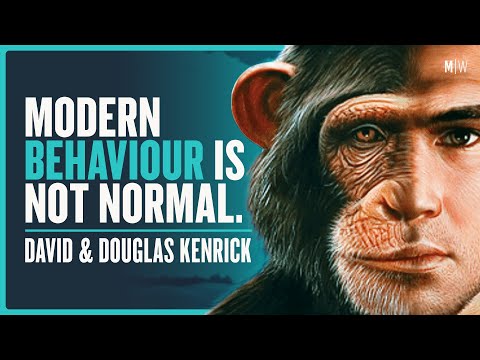
Evolved Psychology Vs The Modern World - David & Douglas Kenrick
Douglas Kenrick (guest), Chris Williamson (host), David Lundberg Kenrick (guest)
In this episode of Modern Wisdom, featuring Douglas Kenrick and Chris Williamson, Evolved Psychology Vs The Modern World - David & Douglas Kenrick explores stone Age Brains, Modern Problems: Evolution’s Grip On Human Behavior Chris Williamson interviews evolutionary psychologists Douglas and David Kenrick about how our “Stone Age” minds are mismatched with the modern world. They present an updated, evolution-based hierarchy of human motives that revises Maslow by putting mating, long‑term pair‑bonding, and kin care at the top. Throughout, they connect ancestral motives—status, affiliation, threat detection, mating, kin investment—to contemporary issues like social media anxiety, obesity, suicide, friendship breakdown, and leadership. They argue that understanding these evolved motives clarifies why we struggle today and how being strategically helpful and prosocial is often the best way to thrive.
Stone Age Brains, Modern Problems: Evolution’s Grip On Human Behavior
Chris Williamson interviews evolutionary psychologists Douglas and David Kenrick about how our “Stone Age” minds are mismatched with the modern world. They present an updated, evolution-based hierarchy of human motives that revises Maslow by putting mating, long‑term pair‑bonding, and kin care at the top. Throughout, they connect ancestral motives—status, affiliation, threat detection, mating, kin investment—to contemporary issues like social media anxiety, obesity, suicide, friendship breakdown, and leadership. They argue that understanding these evolved motives clarifies why we struggle today and how being strategically helpful and prosocial is often the best way to thrive.
Key Takeaways
Ancestral motives still structure our goals more than we realize.
The Kenricks’ updated pyramid keeps basic survival and safety at the base but shows that affiliation, status, mating, mate retention, and kin care are the real long‑term drivers of behavior, not abstract self‑actualization detached from social and reproductive outcomes.
Get the full analysis with uListen AI
The modern environment overstimulates ancient systems, creating chronic stress and comparison.
Phones, news, and social media simultaneously trigger threat detection, status comparison, mate assessment, and social affiliation, turning mechanisms built for small groups into sources of overload, anxiety, and distorted self‑image.
Get the full analysis with uListen AI
Meaning, pleasure, and “fulfilling your potential” come from different motives.
Their research shows that people find hedonic pleasure in sex and relaxation, meaning in caring for family and close others, and self‑actualization in status‑linked, achievement‑oriented activities—so you must match daily activities to the specific kind of well‑being you’re seeking.
Get the full analysis with uListen AI
Status and attraction are about more than raw resources, especially for women.
Women weigh cues of competence, protection, and future potential—like prestigious or “cool” jobs, confidence, and prosocial dominance—often more heavily than current income, whereas men are more directly swayed by physical attractiveness.
Get the full analysis with uListen AI
Risk-taking and suicidal behavior can reflect frustrated social and status motives.
The “young male syndrome” and patterns like “death by cop” are interpreted as extreme attempts by low‑status men to gain status or escape stagnation, mirroring ancestral strategies of high‑risk gambles when other routes to success were blocked.
Get the full analysis with uListen AI
Kinship systems and menopause illustrate deep investments in descendants.
Grandmothering, long post‑reproductive lifespans, and strong kin support networks make sense because older adults can boost their genetic success more by helping children and grandchildren survive than by continuing to reproduce at high risk.
Get the full analysis with uListen AI
Strategic kindness—being genuinely helpful—is an adaptive path to success.
Because humans depend on cooperative groups, people who reliably help others meet core motives (safety, belonging, competence, family) tend to gain trust, status, and reciprocal support, making prosocial behavior a self‑interested long‑term strategy rather than naive niceness.
Get the full analysis with uListen AI
Notable Quotes
“Most people, when you ask them about the most meaningful stuff in their lives, talk about rearing children or taking care of family.”
— Douglas Kenrick
“Now we’re competing with what—seven billion people as opposed to ten.”
— David Kenrick
“An existential crisis might just be loneliness masquerading as a philosophical treatise.”
— Chris Williamson
“Our ancestors were not surrounded by strangers unless they were about to die.”
— Douglas Kenrick
“Being nice to other people is actually, in some level, being nice to yourself because if you're nice to other people, they'll trust you.”
— Douglas Kenrick (citing Mark Schaller’s advice)
Questions Answered in This Episode
How should individuals practically use the updated evolutionary hierarchy of motives to redesign their daily routines and long‑term goals?
Chris Williamson interviews evolutionary psychologists Douglas and David Kenrick about how our “Stone Age” minds are mismatched with the modern world. ...
Get the full analysis with uListen AI
What specific technological or policy interventions could best reduce the mismatch between our Stone Age brains and the modern digital environment?
Get the full analysis with uListen AI
How can young men channel their risk‑taking and status drives into prosocial, constructive outlets rather than self‑destructive ones?
Get the full analysis with uListen AI
Given that meaning often comes from family and close relationships, what can people without children or nearby kin do to satisfy those deep motives?
Get the full analysis with uListen AI
If kindness is strategically adaptive, how do we distinguish between being genuinely helpful and becoming a “doormat” who is easily exploited?
Get the full analysis with uListen AI
Transcript Preview
When people are asked, "Would you want to date this person?" for women, it mattered. They would actually prefer to date the dorky looking guy in the Wall Street clothes to the handsome guy who was working at Burger King. For men, they'd prefer the good-looking woman who worked for Burger King to the less attractive woman who was dressed to the nines.
(wind blowing) Doug, you just mentioned that you'd taken two months away from working, and this is one of your first days back. Talk to me about what it feels like to take such a long break when you're used to doing so much work. Do you ever get the compulsion to go and do stuff? Do you get antsy about the fact that you're not working?
Yes. I, I like having a bit of fun, but, uh, there's only so much of it I can take. I actually feel better, I fe- I feel better when I'm being productive in some way. Although my work is, you know, uh, writing books and being a college professor and talking to students. It's a, it's a pretty cushy job and, um, you know, it's- it- it's in some ways more pleasant than actually being on vacation, although being on vacation was fun.
What do you think that says adaptively about humans, the fact that you can take more pleasure from doing work than from leisure?
What do you think, Dave?
Well, I mean, I think a lot of it is the affiliation factor, right? I- I know for me, one of the things I like about work is the people I work with, um, and getting to see them. And, uh, and that feeling of sort of purpose, right? That it's like, I think we are sort of designed to want to contribute to those around us and, uh, you know, hopefully if someone is in a job that they like, uh, then they'll feel like, "Oh, I'm working with a group of people to improve the world for people." So I think-
Yeah.
I think that's...
That's, I like Dave's answer because I wouldn't have pointed to affiliation right away. I would have thought of status in terms of our little- our hierarchy of motives. Uh, but I like what Dave is saying because it strikes me that in the ancestral environment, if you took two months off, uh, the people in your group might have started to get a little annoyed at you, you know, "When are you gonna start to catch some fish?" and-
Oh.
... when are, you know. Uh, and so, you know, I- I like the fact that Dave connects it to people because it does, uh, I especially like, I do like that as well. In fact, the first thing I- I did after having this- an interview this morning is I went to a- a meeting and our graduate students were there, and my, uh, co-author on a number of papers, Steve Newberg, was there. And it did feel good, felt good to be doing something with the group, uh, and so I guess it- I guess we're sort of wired up to connect those two things.
Install uListen to search the full transcript and get AI-powered insights
Get Full TranscriptGet more from every podcast
AI summaries, searchable transcripts, and fact-checking. Free forever.
Add to Chrome