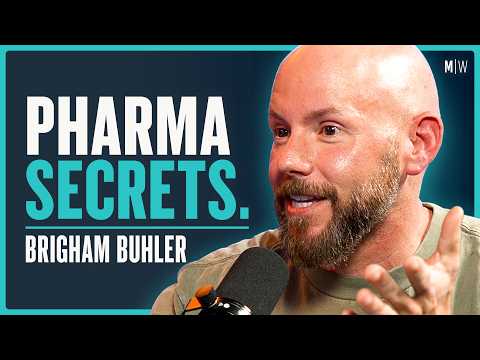
Ex-Pharma Rep: It's Way More Corrupt Than You Think - Brigham Buhler
Chris Williamson (host), Brigham Buhler (guest)
In this episode of Modern Wisdom, featuring Chris Williamson and Brigham Buhler, Ex-Pharma Rep: It's Way More Corrupt Than You Think - Brigham Buhler explores insider Exposes How US Healthcare Profits From Keeping People Sick Former pharma and device rep Brigham Buhler explains how American healthcare incentives are structured to monetize chronic disease rather than prevent it, making it the leading cause of personal bankruptcy. He details how insurance companies and pharmacy benefit managers (PBMs) quietly dominate the system, earning far more than Big Pharma while pushing patients toward more drugs and delayed, restricted care. The conversation covers corporate capture of regulators like the FDA and NIH, suppression of cheaper or safer alternatives (compounding pharmacies, peptides, psychedelics, stem cells), and how perverse incentives contributed to crises like opioids. Buhler argues that true reform requires cash-pay, preventive, metabolically focused care supported by AI-driven, continuous monitoring and strong conflict-of-interest rules for regulators.
Insider Exposes How US Healthcare Profits From Keeping People Sick
Former pharma and device rep Brigham Buhler explains how American healthcare incentives are structured to monetize chronic disease rather than prevent it, making it the leading cause of personal bankruptcy. He details how insurance companies and pharmacy benefit managers (PBMs) quietly dominate the system, earning far more than Big Pharma while pushing patients toward more drugs and delayed, restricted care. The conversation covers corporate capture of regulators like the FDA and NIH, suppression of cheaper or safer alternatives (compounding pharmacies, peptides, psychedelics, stem cells), and how perverse incentives contributed to crises like opioids. Buhler argues that true reform requires cash-pay, preventive, metabolically focused care supported by AI-driven, continuous monitoring and strong conflict-of-interest rules for regulators.
Key Takeaways
US health incentives are designed to profit from chronic disease, not prevent it.
Insurers, PBMs, hospitals, and even oncologists are financially rewarded when patients need more drugs, procedures, and repeat surgeries; there is little economic upside in actually resolving or preventing chronic illness.
Get the full analysis with uListen AI
Insurance companies and PBMs quietly make more from drugs than Big Pharma.
The top five insurers earn roughly 4x the revenue of the top five drug makers, largely by owning PBMs that negotiate upward drug prices via rebates and then pass the inflated costs to employers, incentivizing more prescriptions.
Get the full analysis with uListen AI
Regulatory agencies are deeply corporately captured through revolving doors and royalties.
FDA leaders routinely leave for high-paid roles at the companies they once regulated, NIH-developed drugs funded by taxpayers are patented and monetized by pharma, and HHS helped entrench the PBM/insurance structure—undermining public trust and safety.
Get the full analysis with uListen AI
Many effective or cheaper therapies are attacked to protect entrenched revenue streams.
Compounding pharmacies, peptides, ketamine pain creams, ibogaine, psilocybin, and stem cells are often restricted or smeared—not primarily for safety, Buhler argues, but because they threaten patented products and high-margin chronic prescriptions.
Get the full analysis with uListen AI
Both US and UK systems largely fail at preventive and metabolic health.
In the US, six–ten minute appointments and insurance rules block comprehensive labs and proactive screening; in the UK, overburdened GPs focus on the sickest cases, leaving almost no structural support for people who want to move from ‘okay’ to optimal health.
Get the full analysis with uListen AI
Mental health drugs like SSRIs have modest benefits and serious downsides.
Meta-analyses show much of SSRI efficacy is placebo-level, with high relapse and potential for increased suicidality and violence, while lifestyle interventions—exercise, social connection, even dance—often outperform them without comparable side effects.
Get the full analysis with uListen AI
Patients should exit dependence on insurance for prevention and build their own data.
Buhler recommends using cash-pay or telehealth clinics to get annual comprehensive bloodwork, DEXA, and VO2 max testing, then leveraging wearables and (soon) AI tools to track trends, gamify improvement, and delay the onset of chronic disease.
Get the full analysis with uListen AI
Notable Quotes
“Our healthcare system is not broken. It’s rigged, and we’re the ones footing the bill.”
— Brigham Buhler
“If you show me the incentives, I’ll show you the outcomes.”
— Brigham Buhler
“We spend more on healthcare than any other nation, but we’re one of the fattest, sickest, and most chronically ill societies in the history of the world.”
— Brigham Buhler
“The answer’s not at the bottom of a pill bottle, man. It never has been. It never will be.”
— Brigham Buhler
“This is not Republican versus Democrat. It’s humanity versus corporate capture.”
— Brigham Buhler
Questions Answered in This Episode
If the core problem is incentives, what concrete payment and regulatory reforms would most rapidly realign US healthcare around prevention instead of chronic treatment?
Former pharma and device rep Brigham Buhler explains how American healthcare incentives are structured to monetize chronic disease rather than prevent it, making it the leading cause of personal bankruptcy. ...
Get the full analysis with uListen AI
How can patients realistically assess whether a cash-pay or telehealth clinic is reputable and not just another over-prescribing business model in disguise?
Get the full analysis with uListen AI
What safeguards could enable wider use of psychedelics, stem cells, and peptides without simply recreating the same corporate capture dynamics around them?
Get the full analysis with uListen AI
Given the corporate capture of agencies like the FDA and NIH, what governance or conflict-of-interest rules would restore public trust while preserving needed expertise?
Get the full analysis with uListen AI
How do we scale gamified, AI-driven metabolic and preventive health tools to lower-income or less tech-savvy populations without widening health disparities further?
Get the full analysis with uListen AI
Transcript Preview
The number one cause of bankruptcy in America is healthcare costs.
100%.
Why? How did we end up there?
Oh, it's a long, twisted road. One of the things I've, I've talked about a lot is, you know, in medicine, if you're going to understand or treat a disease state, you, you, you have to find the root cause. And if we go to find the root cause of the broken healthcare system in America, it runs deep, and it's insidious, and it's widespread. So, it's a lot to unpack, but it starts with our food, our diet, diet, our lifestyle, our nutrition, um, our food sources. What you and I were talking about right before we went on the air, is all the contaminants in our food, all the ingredients in our food. Uh, you know, a good friend of mine, Bonnie Harie, has been beating the drum on all these media outlets lately, exposing, like, in the United States, in the '80s, we had 700 approved ingredients in our food. Now, we have 10,000. In Europe, it's still close to 700. Why (laughs) in America do we have 10,000? One set of ingredients for Americans in the same factory, and a different set of ingredients for Canadians, whether it's Froot Loops or whatever it is, but that's one component of the issue. Then we go to the checks and balances, like, if we have a primary care in America that only has six minutes with a patient, and they're controlled by what the insurance companies do, uh, the main message that I have for people is, it comes down to corporate capture, like, if you show me the incentives, I'll show you the outcomes. And our entire incentive systems in this country are based off monetizing and capitalizing off chronic disease. It's all about quarterly earnings, quarterly profits. Nowhere in anyone's business school or any of these executives is their priority to drive health span or to cure chronic disease.
Oddly, it's actually quite an American approach to things. You know, i- profits first, that's very important to us.
It is.
Capitalism.
It, it's wild.
There's a few areas that we maybe should put profits second or third, perhaps.
Yeah. Uh, and, and, and healthcare's definitely one of those. And so, throughout the system, the checks, the balances, all of that has been ripped out, even with the collusion of our three-letter alphabet organizations, you know, whether we're talking about the FDA, the NIH, the CDC. All of these various entities have also been corporately captured. A lot of their funding, a lot of their, uh, like, goals and initiatives are based off of helping these giant institutions that are monetizing these things.
How recently has it been since saying stuff like this didn't sound like crazy conspiracy theories?
You know what's wild, is I was telling Joe this stuff, like, five years ago, uh, and, and one day, Rogan's like, "Come on the podcast." And when I went on there, nobody was talking about some of these things, like, especially the insurance part. The insurance is one of these hidden monsters that people just don't know, and even to this day, they don't know. And even after doing, uh, some of these bigger platforms like yourself, you know, now the message is getting out, and I've had people like Bobby Kennedy reach out, and I went and sat down, and even a guy who's been in the trenches, who's battled big pharma, who's battled, uh, these big corporate captured institutions, when I brought up PBMs, he said, "I don't, what are you talking about a PBM? I don't have a PBM, I have insurance." And that's the feedback most people give me. "I don't know, I don't have a PBM." And so I have to, like, methodically walk them through what a PBM is, how it's hurting America's health. So, if we look back to this whole, uh, profits first model, l- we talk so much about big pharma, big pharma, big pharma. The big five insurance companies made four times the revenue of the biggest five pharmaceutical companies last year, 4X the revenue. They control every surgery, every drug, every treatment, when, where, and how you can ac- access healthcare and treatments and preventative care.
Install uListen to search the full transcript and get AI-powered insights
Get Full TranscriptGet more from every podcast
AI summaries, searchable transcripts, and fact-checking. Free forever.
Add to Chrome