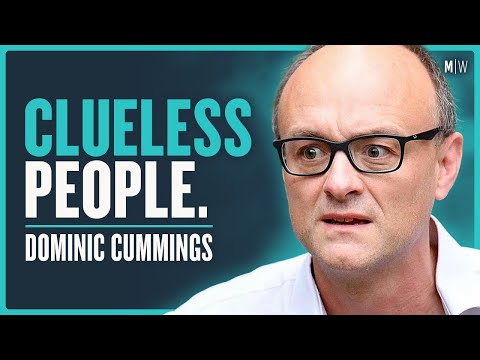
The Hidden Scandals Inside The British Government - Dominic Cummings
Chris Williamson (host), Dominic Cummings (guest), Narrator, Chris Williamson (host)
In this episode of Modern Wisdom, featuring Chris Williamson and Dominic Cummings, The Hidden Scandals Inside The British Government - Dominic Cummings explores dominic Cummings Exposes Britain’s Hollowed State and Political Rot Dominic Cummings argues that Britain’s political class and civil service are fundamentally dysfunctional, more focused on media management and preserving their own power than on competent governance or voters’ interests.
Dominic Cummings Exposes Britain’s Hollowed State and Political Rot
Dominic Cummings argues that Britain’s political class and civil service are fundamentally dysfunctional, more focused on media management and preserving their own power than on competent governance or voters’ interests.
He claims Brexit initially worked as intended on immigration and accountability, but that post‑2020 Conservative governments deliberately abandoned border control and sane policy design, leading to record immigration and electoral collapse.
Cummings describes a Whitehall culture that repels talent, ignores technology, and leaves critical systems—from nuclear deterrence to pandemic response—dangerously degraded and run via archaic tools like faxes and WhatsApp.
Looking ahead, he predicts continued failure from both major parties unless outside elite talent builds a new political vehicle to force structural reform, in parallel with similar anti‑establishment trends in the US.
Key Takeaways
Brexit initially defused immigration as a flashpoint—but Tory policy reversals reignited it.
Cummings says post‑referendum data showed concern about immigration falling, Farage retiring, and attitudes to immigrants improving—until 2021–23, when Conservatives massively expanded legal migration and lost control of Channel crossings, bringing Farage and a new party (Reform) back into contention.
Get the full analysis with uListen AI
Real power in the UK sits with senior officials, not Cabinet ministers.
He argues the Cabinet Secretary and Cabinet Office now make many core decisions, control information flows, and even outrank most ministers operationally in crises, while Cabinet is largely a Potemkin performance for media and MPs.
Get the full analysis with uListen AI
The civil service structurally drives talent out and rewards failure.
Young, capable officials tend to leave by their mid‑30s after encountering ossified hierarchies and perverse HR incentives; those who mismanage crises (e. ...
Get the full analysis with uListen AI
Government systems and data infrastructure are dangerously archaic.
Cummings recounts early COVID briefings relying on faxed numbers, handwritten whiteboards, and personal Gmail accounts for drafting lockdown speeches, contrasting this with the rapid creation—by a small, external team—of a modern AWS‑based NHS dashboard in weeks, illustrating both the existing decay and what’s possible.
Get the full analysis with uListen AI
Media and political elites operate in a ‘kayfabe’ world of scripted narratives.
Borrowing Rick Rubin’s analogy, he argues political news is often faker than pro wrestling, with sudden “narrative whiplash” (e. ...
Get the full analysis with uListen AI
Western institutions systematically under‑prepare for new threats like drones and pandemics.
He warns that the same bureaucratic inertia and secrecy visible in COVID and nuclear maintenance now applies to drone defense, with UK security infrastructure essentially unready for Ukraine‑style FPV drone attacks on domestic targets or VIPs.
Get the full analysis with uListen AI
Lasting reform likely requires a new, outsider‑driven political vehicle.
Cummings is exploring a non‑party campaigning organization to aggregate public frustration, attract elite builders from outside Westminster, and eventually force structural change, arguing the existing parties and Whitehall cannot self‑reform.
Get the full analysis with uListen AI
Notable Quotes
“You go to government and realize there isn’t a door—and there aren’t any ninjas either.”
— Dominic Cummings
“British government now is basically a Potemkin show. The ministers are the clown front; the officials have the real power.”
— Dominic Cummings
“A one‑man start‑up doing a podcast has better tech and tools than the British Prime Minister spending a trillion quid a year.”
— Dominic Cummings
“If Birmingham in 1870 had been told that a 27‑year‑old PPE graduate in the Treasury would decide whether they could build a hospital, they’d have said: then Britain won’t be a world power.”
— Dominic Cummings
“Wrestling is real and it’s the news that’s fake. You should watch political news as if it’s a WWE script.”
— Dominic Cummings (quoting and endorsing Rick Rubin)
Questions Answered in This Episode
If power has shifted so heavily to officials like the Cabinet Secretary, what concrete constitutional or legal changes would be needed to restore meaningful democratic control?
Dominic Cummings argues that Britain’s political class and civil service are fundamentally dysfunctional, more focused on media management and preserving their own power than on competent governance or voters’ interests.
Get the full analysis with uListen AI
How could a new political organization practically attract and protect high‑caliber talent from being neutralized by existing party and civil service structures?
He claims Brexit initially worked as intended on immigration and accountability, but that post‑2020 Conservative governments deliberately abandoned border control and sane policy design, leading to record immigration and electoral collapse.
Get the full analysis with uListen AI
What would a realistic, legally robust plan to regain control of both legal and illegal immigration look like, given human rights constraints and international law?
Cummings describes a Whitehall culture that repels talent, ignores technology, and leaves critical systems—from nuclear deterrence to pandemic response—dangerously degraded and run via archaic tools like faxes and WhatsApp.
Get the full analysis with uListen AI
How can citizens and journalists break out of the ‘kayfabe’ information environment and reliably distinguish between genuine policy shifts and narrative whiplash?
Looking ahead, he predicts continued failure from both major parties unless outside elite talent builds a new political vehicle to force structural reform, in parallel with similar anti‑establishment trends in the US.
Get the full analysis with uListen AI
Given the rapid evolution of drone warfare and AI, what specific defensive capabilities and governance reforms should the UK prioritize in the next five years to avoid a catastrophic wake‑up call?
Get the full analysis with uListen AI
Transcript Preview
Good Morning Britain asked the question, is multiculturalism working? 5% said yes and 95% said no it isn't. What do you make of that?
Um, I guess not surprising given like, you know, months and months of, um, crazy marches, terrorism over the years, um, harassment of MPs. I mean, um, lots of parts of the country go to, they seem kind of like clearly crazy, there's a lot of violence in sto- in, in various towns which is not picked up by the mainstream media. But if you live there, you know, you live with, you, you live with it and you see it all the time. So, um, I'm slightly surprised by the number, but like the, the overall kind of picture is not, not surprising.
Do you think there's a- an irony or a prescience of Brexit being driven by concerns about immigration to now 2024 with the UK facing massive immigration problems and it being such a huge talking point?
Yeah, it's sort of, it's, it's a, it- it- i- it's a crazy situation, right? So you got in, in 2015, 2016 we had the referendum and during the referendum campaign I say, "Well, what's a core reason to, to..." L- l- let's go through a few f- few fundamentals of, uh, o- of why we should leave, right? Number one, free movement of people i- i- is out of control. It's t- it's the number one issue in Britain. Politicians' response to every problem is simply to say, "Well, it's an EU issue so there's absolutely nothing we can do about it." All across Europe you see the problem of free movement driving the growth of extremism. You have votes in places like Austria where you have like a third of the people voting for pretty much actual Nazi parties. I don't mean like fake Nazi parties, like accused by the mainstream media, but like actually basically Nazis. Um, and my- our argument was if you actually take back control of Democratic policy over immigration in Britain, then you'll see the, uh, immigration collapse as an issue. Farage will be retired, UKIP will be gone, and, um, extremists will, will be neutered here and the whole country can, could, can move on and talk about other things. It would be better if Europe did it o- overall, but Europe's not gonna do that. But we should do this ourselves. The whole mainstream media attitude was, "That's completely crazy." The FT and The Economist laughed at this. They, their prediction was if Brexit wins then immigration will become even more of an issue, Farage will be turbo charged, UKIP will be up at a third of the vote, blah, blah, blah. Right, so run the clock forward, um, to 2020, all the predictions that we made were completely correct. Concern about immigration is a straight line down, attitudes towards immigrants is like much more positive. Farage is retired, UKIP is gone, uh, uh, uh, and, uh, uh, basically the Vote Leave position is completely vindicated. And even the mad Remainers who hate me and hate Brexit have to admit, actually the immigration thing has turned out completely differently than what we expected. Right? Meanwhile in eu- in Europe, of course, exactly as Vote Leave predicted, the problem has grown and grown. If I'd said in 2016, "Well, in like eight years time they'll be like close to a Nazi party, neck and neck for leading the polls in Germany," everyone would've completely laughed at the FT and Economist. But that's actually the situation, right? So I think things worked out the way that Vote Leave predicted on the, on that stuff, but then in an amazing plot twist, I fall out with Boris over the summer of 2020, Vote Leave leaves number 10. And then in 2021, 2022, 2023, the Tories actually like give up all immigration control of legal immigration, have unprecedentedly high legal immigration. Then open, like basically like surrender to the fucking insane, stupid, retarded dinghies coming across the channel. So you suddenly have tens of thousands of these ludicrous boats coming over, and Farage is back, a new party's created, Tories lose half their votes. I mean, it's like a sort of, I mean, you can't explain it by any kind of rationality, right? The Tories just sort of completely shoot themselves in the, shoot themselves in the head. Um, but that's, but, but, but the good thing about it is like every- it's clear to everyone what's actually happened, right? Because of Brexit there's democratic accountability. No one can blame the EU anymore. The British government sabotaged border control and sabotaged having a sane immigration policy deliberately. That's what the Tories did, and everyone was clear about it. So it's sort of stupid and insane in one way, but at least now because of Brexit, everyone knows exactly who to blame. And quite rightly, they, they gave the, the Tories the kicking they deserved.
Install uListen to search the full transcript and get AI-powered insights
Get Full TranscriptGet more from every podcast
AI summaries, searchable transcripts, and fact-checking. Free forever.
Add to Chrome