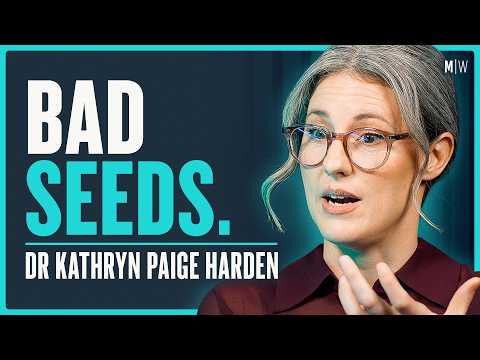
The Genetics of Evil: Are People Born Bad? - Dr Kathryn Paige Harden
Chris Williamson (host), Dr. Kathryn Paige Harden (guest)
In this episode of Modern Wisdom, featuring Chris Williamson and Dr. Kathryn Paige Harden, The Genetics of Evil: Are People Born Bad? - Dr Kathryn Paige Harden explores genetics, deviance, and blame: rethinking punishment, responsibility, and forgiveness today Harden recounts the controversy around her prior work on behavioral genetics and why genetics discussions often provoke moral panic, misrepresentation, and “genetic essentialism.” She explains findings from large-scale studies (millions of genomes) on shared genetic influences across “disinhibition” traits like ADHD symptoms, early sexual behavior, substance use, and self-reported risk-taking, emphasizing that effects are polygenic and probabilistic.
Genetics, deviance, and blame: rethinking punishment, responsibility, and forgiveness today
Harden recounts the controversy around her prior work on behavioral genetics and why genetics discussions often provoke moral panic, misrepresentation, and “genetic essentialism.” She explains findings from large-scale studies (millions of genomes) on shared genetic influences across “disinhibition” traits like ADHD symptoms, early sexual behavior, substance use, and self-reported risk-taking, emphasizing that effects are polygenic and probabilistic.
A major focus is antisocial behavior: early-onset conduct problems—especially with callous-unemotional traits—can be highly heritable (sometimes comparable to schizophrenia), yet harsh punishment often escalates outcomes because these children may be less sensitive to punishment and more responsive to reward/connection. The conversation then shifts to responsibility across development (kids, teens, adulthood), addiction recovery as a model of “both-and” thinking (powerlessness and responsibility), and why free-will debates are less practically useful than redesigning accountability systems.
They explore how genetic explanations can paradoxically increase punitive impulses (via essentialism and perceived dangerousness), why humans derive reward from retribution, and how American punishment often confuses accountability with suffering. The episode closes with epigenetics (what’s real vs hype), prenatal environment studies, motherhood as “luck,” and the ethical/social complexities of embryo selection in a low-solidarity society.
Key Takeaways
Behavioral genetics is often attacked via mischaracterization, not disagreement.
Harden describes a ‘doppelganger’ effect after publishing: critics claimed she said things she explicitly argued against. ...
Get the full analysis with uListen AI
Risk-taking behaviors share a common genetic ‘disinhibition’ component.
In pooled data from ~4M people, variants associated with ADHD symptoms, early sex, number of partners, cannabis use, cigarettes, problematic alcohol use, and self-identified risk-taking overlap—reflecting a broad liability toward rule-breaking/reward-seeking rather than one narrow trait.
Get the full analysis with uListen AI
Early-onset antisocial behavior with callous-unemotional traits can be highly heritable.
Harden notes some heritability estimates near schizophrenia levels for children who show persistent rule-breaking plus lack of guilt/remorse. ...
Get the full analysis with uListen AI
Harsh punishment can worsen antisocial trajectories because some kids don’t learn from punishment.
Parents and even strangers become coercive toward “spooky” callous children, but escalation (removing privileges, shaming, corporal punishment) can sever connection—the key reward channel these kids might respond to—creating a vicious cycle that predicts worsening behavior.
Get the full analysis with uListen AI
Free-will debates don’t help us sort real-world culpability intuitions.
People treat epilepsy, medication noncompliance, trauma-driven panic, and inherited violence differently even if determinism makes them ‘all caused. ...
Get the full analysis with uListen AI
Accountability and punishment are separable; suffering isn’t required for rule enforcement.
She reframes punishment as deliberate suffering for retribution, versus accountability as community rule enforcement and harm-prevention. ...
Get the full analysis with uListen AI
Genetic explanations can increase punitiveness via ‘genetic essentialism.’
Studies suggest jurors who believe violence is inherited sometimes recommend longer sentences. ...
Get the full analysis with uListen AI
Retribution is rewarding and early-developing—so culture can ‘junk-food’ it.
Neuroimaging and behavioral economics show people will pay costs to punish defectors and show reward-system activation when wrongdoers suffer. ...
Get the full analysis with uListen AI
Epigenetics is real within a lifetime; epigenetic inheritance is far less settled.
She distinguishes DNA sequence (stable) from epigenetic regulation (dynamic, cell-type-specific). ...
Get the full analysis with uListen AI
Embryo selection raises a solidarity problem, not just an ethics-of-choice problem.
Harden supports reproductive autonomy and sees clear cases (reducing severe family disease risk), but worries that turning chance into choice shifts blame onto parents for any child’s condition (as seen in some Down syndrome screening contexts). ...
Get the full analysis with uListen AI
Notable Quotes
““I don’t think anyone deserves to suffer… that doesn’t mean that we have no rules, and we don’t hold people accountable.””
— Dr. Kathryn Paige Harden
““The condition of being human on this planet is that none of us chose to be who we are, and we’re responsible for all of ourselves anyways.””
— Dr. Kathryn Paige Harden
““Everything is related to your genetics… both your smoking and your quitting of smoking, both your addiction and your recovery.””
— Dr. Kathryn Paige Harden
““Retribution… is a instinct that emerges very early in childhood development.””
— Dr. Kathryn Paige Harden
““No children are reproduced. Children are produced.””
— Dr. Kathryn Paige Harden
Questions Answered in This Episode
In the 4M-person study, how did you statistically model a shared ‘disinhibition’ factor across the seven behaviors, and what did it predict beyond the original traits?
Harden recounts the controversy around her prior work on behavioral genetics and why genetics discussions often provoke moral panic, misrepresentation, and “genetic essentialism. ...
Get the full analysis with uListen AI
For callous-unemotional kids, what interventions look most promising given low punishment sensitivity—parent training, reward-based systems, multisystemic therapy, pharmacology, or something new?
A major focus is antisocial behavior: early-onset conduct problems—especially with callous-unemotional traits—can be highly heritable (sometimes comparable to schizophrenia), yet harsh punishment often escalates outcomes because these children may be less sensitive to punishment and more responsive to reward/connection. ...
Get the full analysis with uListen AI
What’s your best explanation for why environmental explanations mitigate sentencing while genetic explanations can increase punitiveness (dangerousness, essentialism, fatalism, stigma)?
They explore how genetic explanations can paradoxically increase punitive impulses (via essentialism and perceived dangerousness), why humans derive reward from retribution, and how American punishment often confuses accountability with suffering. ...
Get the full analysis with uListen AI
Where do you draw the line between ‘accountability’ and ‘punishment’ in practice—what does a non-retributive but safety-focused justice system actually do day-to-day?
Get the full analysis with uListen AI
In cases like adolescent shooters, how would you design a framework that avoids the contradiction of blaming both the parents and treating the teen as fully adult?
Get the full analysis with uListen AI
Transcript Preview
What happened after the publication of your last book?
[laughs] Oh, it was a wild time. I, I... There was a lot of controversy. There was a lot of pushback. Um, the conversations that I had with real people, not with other academics, but with just people who wrote me, people who, you know, happened to encounter the book in some way. That was fantastic.
Mm.
Um, people wrote me and they said, "I've always wondered why I'm so different from my parents or why I'm so different from my siblings, and your work has given me a new way of understanding that." They, um, wrote to me about their decision to have kids or their decision not to have kids, and how thinking about genetics has shaped that. So that part of the conversation, which is the dialogue between an author and their readers, was fantastic. I loved that.
Mm-hmm.
And then there was another part of the dialogue, which was me with other academics, and that was really surprising to me, um, in part because I felt like they n- some people needed to turn me into a villain in order to get their own message out. Um, and I was kind of caught off guard by that whole process, so. Um, I wish I could say that I had a thicker skin now, but I, but I don't in many ways. I, I really do care what people think. I care about getting it right. Um, so it took me a bit to think about how to get myself back out there in terms of the ideas in the wake of that.
Especially if you're doing something that you think is trying to educate people about what is true.
Yes.
I'm trying to emancipate you from ignorance and explain things that make you feel less broken and alone, and then someone comes in and says, "Well, actually, what she's trying to-"
[laughs] What she's really saying-
Dude, don't try and fucking imbue me with your perspective of who you think I am or what you think my work is. And that's where we get indignant. There's that line, right, that the only insults that hurt are the ones that we believe. I don't think that's true. I think the only insults that hurt, or the insults that hurt most, are the ones that we think other people might believe about us.
I think the insults that hurt worst are the ones in which I didn't recognize the person they were insulting. So when you write a book, you have ideas and they're literally, you know, in black and white, they're on the text.
Mm.
You can point and you can say, "Look, I wrote this." And then when someone says, "She said X," when I literally had said the exact opposite of that.
Mm.
There's something very alienating and disorienting about feeling like you are talking, but people are deliberately not hearing you.
Surely part of that must be a sense that other people could pattern match it as truth, though. Because if not... I- if, if I call you fat, you're not fat. So you go, "Well, I..." It's funny, if I, if I, if I say that you're too tanned, you've got too much fake tan on, you go, "I'm not wearing any fake tan."
Install uListen to search the full transcript and get AI-powered insights
Get Full TranscriptGet more from every podcast
AI summaries, searchable transcripts, and fact-checking. Free forever.
Add to Chrome