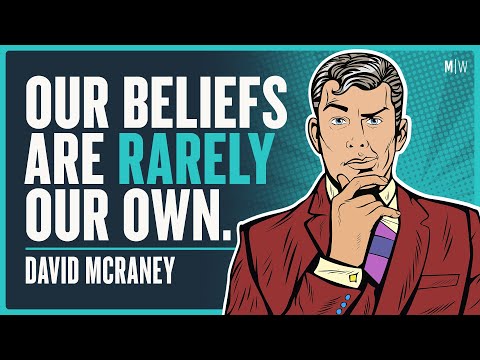
Where Do Our Beliefs Come From? - David McRaney
David McRaney (guest), Chris Williamson (host)
In this episode of Modern Wisdom, featuring David McRaney and Chris Williamson, Where Do Our Beliefs Come From? - David McRaney explores why Minds Resist Change: Beliefs, Belonging, and Better Arguments Explained David McRaney and Chris Williamson explore where beliefs come from, why they’re so hard to change, and how modern information environments amplify polarization. McRaney explains that what we call “beliefs” are often bundles of facts, attitudes, values, and emotions, and that feelings frequently drive our search for justifying evidence rather than the other way around. They discuss motivated reasoning, social media’s role in rapid group formation, pluralistic ignorance, and the primacy of social belonging over factual accuracy—even to the point of death. McRaney then outlines research-backed methods, such as motivational interviewing and deep canvassing, that can genuinely help people reconsider their views.
Why Minds Resist Change: Beliefs, Belonging, and Better Arguments Explained
David McRaney and Chris Williamson explore where beliefs come from, why they’re so hard to change, and how modern information environments amplify polarization. McRaney explains that what we call “beliefs” are often bundles of facts, attitudes, values, and emotions, and that feelings frequently drive our search for justifying evidence rather than the other way around. They discuss motivated reasoning, social media’s role in rapid group formation, pluralistic ignorance, and the primacy of social belonging over factual accuracy—even to the point of death. McRaney then outlines research-backed methods, such as motivational interviewing and deep canvassing, that can genuinely help people reconsider their views.
Key Takeaways
Beliefs are not just facts; they’re emotional, social, and value-laden constructs.
What we call a ‘belief’ typically combines factual information with emotional certainty, attitudes, values, and identity. ...
Get the full analysis with uListen AI
Feelings often come first, and we then search for justifications.
In cases like anti-vaccine sentiment, people usually start with anxiety or distrust (of authority, medicine, loss of agency) and later find evidence that seems to rationalize those feelings. ...
Get the full analysis with uListen AI
Simply adding more information rarely fixes false beliefs.
The ‘information deficit’ model assumes people are wrong because they lack facts, but studies show the same evidence can be interpreted in opposite ways depending on prior motivations, identities, and group loyalties. ...
Get the full analysis with uListen AI
We live in a post‑trust more than a post‑truth environment.
With collapsed gatekeepers and high anxiety, people modulate their beliefs based less on objective truth and more on who they trust. ...
Get the full analysis with uListen AI
Group belonging can override personal judgment, even to lethal extremes.
Phenomena like pluralistic ignorance and the fear of social death explain why people uphold norms they secretly dislike (e. ...
Get the full analysis with uListen AI
Most online platforms reward argument production, not argument evaluation.
Human reasoning evolved to be biased and lazy when generating arguments but careful when evaluating others’ arguments in small, trust-rich groups. ...
Get the full analysis with uListen AI
Effective mind-changing relies on empathy, safety, and guided self-reflection.
Approaches like motivational interviewing, deep canvassing, and street epistemology work by building rapport, avoiding shame, asking people to rate their confidence, and gently probing how they arrived at their views. ...
Get the full analysis with uListen AI
Notable Quotes
“Often when someone asks you why you feel a certain way, you present the thing that you think led you to the feeling, when really it was the feeling that led you to the thing.”
— David McRaney
“We’re not in a post‑truth world any more than we have ever been. I think we’re in a post‑trust world.”
— David McRaney
“The fear of social death is greater than the fear of physical death.”
— David McRaney, citing Brooke Harrington
“Most of the people in the group believe that most of the people in the group believe something that, in fact, very few of the people in the group believe.”
— David McRaney on pluralistic ignorance
“We’re very good at producing biased and lazy arguments, but we’re very good at evaluating other people’s arguments.”
— David McRaney, summarizing Hugo Mercier and Dan Sperber
Questions Answered in This Episode
How can individuals practically cultivate the ‘informational equivalent of washing our hands’ to navigate misinformation and polarization online?
David McRaney and Chris Williamson explore where beliefs come from, why they’re so hard to change, and how modern information environments amplify polarization. ...
Get the full analysis with uListen AI
What concrete steps can platforms take to shift from rewarding argument production to incentivizing argument evaluation and genuine deliberation?
Get the full analysis with uListen AI
In personal relationships, how do you know when it’s worth trying to change someone’s mind versus when it’s better to disengage?
Get the full analysis with uListen AI
How can we safely challenge pluralistic ignorance in our own communities—on campus, at work, or in politics—without risking severe social backlash?
Get the full analysis with uListen AI
If belonging is so powerful, how might we design healthier groups and identities that make accurate belief updating socially rewarded instead of punished?
Get the full analysis with uListen AI
Transcript Preview
It's when, uh, you have a group of people, and most of the people in the group believe that most of the people in the group believe something that, in fact, very few of the people in the group believe. But since most of the people in the group believe that everybody else in the group believes this, everyone acts as if everybody believes it, and you end up following a norm that nobody likes. (wind blows)
David McRaney, welcome to the show.
Thank you so much. I am very honored to be here in company that shares a lot of my obsessions. I feel there's a Venn diagram with a lot of overlap here right now and that- that's always cool.
When you say that someone holds a belief, like the belief that our interests heavily overlap in a Venn diagram, what does that mean? What- what- what is a belief?
(laughs) This is the best opening question I've received so far, I want you to know. Uh, why would a c- I'll- I'll say the same thing back to you that was said to me when I first asked a researcher this, someone who had 45 years of research into just beliefs. Uh, which, and they said, "Hoo, that is a tough one." Um, that was Jim Alcock who I asked. Uh, I thought he'd be the f- greatest person to go to at first with these questions. It's one of the reasons why the book takes such a long arc getting to a authoritative voice is that I thought it would be a book where I just went and asked experts- experts those questions. They tell me the answers, I'd find the relevant literature, I'd translate it in a fun, uh, approachable voice, and boom, you have a book. Uh, that is not how it turned out, because it turned out I was asking questions that have either ins- incredibly complex answers or no answers yet. When it comes to that, in particular, this thing I told you where I feel that I- we have a strong overlap, uh, I could say that there's a belief there. There certainly are some fact-based information encoded things in my brain that have emotional qualities of certainty attached to them involved in that proposition, but also, I'm also expressing an attitude. I'm also expressing how I feel strongly in one direction or another, that I have these positive and negative, uh, evaluations of what I'm presenting to you. I'm also expressing a little bit of things in there about values. I'm expressing some- some notions of what is and isn't so in- in every direction. So, when it comes to just the raw fact-based thing, it's a huge assumption I'm making based off of information I've received so far in this conversation, and also from knowing a little bit about you and sharing some of our shared interests beforehand, and also, we've developed a little bit of trust and a little bit of rapport, so that I have all these cues that are translating into a sub-emotional f- state of certainty about all these bullet points that pile up into something we would call in common parlance the belief that we have an overlapping (laughs) Venn diagram of b- of obsessions. That's the complicated answer.
Install uListen to search the full transcript and get AI-powered insights
Get Full TranscriptGet more from every podcast
AI summaries, searchable transcripts, and fact-checking. Free forever.
Add to Chrome