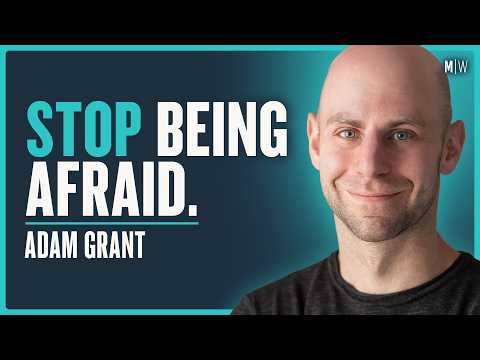
Destroy Your Mental Limits & Unlock Your Best Self - Adam Grant
Chris Williamson (host), Adam Grant (guest)
In this episode of Modern Wisdom, featuring Chris Williamson and Adam Grant, Destroy Your Mental Limits & Unlock Your Best Self - Adam Grant explores adam Grant Explains How To Unlock Hidden Potential And Resilience Adam Grant and Chris Williamson explore what really drives high performance, arguing that opportunity, motivation, and environment outweigh innate talent. Grant emphasizes the role of ‘hidden potential’—capacity for growth that even we and those around us often can’t see—and how great coaches, mentors, and feedback cultures help surface it.
Adam Grant Explains How To Unlock Hidden Potential And Resilience
Adam Grant and Chris Williamson explore what really drives high performance, arguing that opportunity, motivation, and environment outweigh innate talent. Grant emphasizes the role of ‘hidden potential’—capacity for growth that even we and those around us often can’t see—and how great coaches, mentors, and feedback cultures help surface it.
They dissect how meaning, motivation, and emotional regulation influence persistence, explaining why criticism must be filtered, why failure is a better teacher than success, and how to turn worry from rumination into problem-solving. The conversation also covers dealing with uncertainty, setting healthier expectations for success, and resisting the trap of cynicism in an information-overloaded world.
Throughout, Grant offers practical tactics: designing environments that spark motivation, using premortems and psychological distance to handle fear, creating worry time windows, inviting brutally honest feedback, and balancing lofty aspirations with “minimum acceptable” outcomes.
Key Takeaways
Natural talent is overrated; early passion, practice, and opportunity are underrated.
Grant cites Benjamin Bloom’s work showing that world-class performers rarely looked like prodigies early on; what distinguished them was a love of learning, lots of practice, and someone who made the early, boring work feel fun.
Get the full analysis with uListen AI
Great coaches and mentors see and amplify your hidden potential.
His diving story illustrates that someone who believes in your future capacity more than you do can ignite motivation; the key is people who neither just cheerlead nor criticize, but coach toward the better version of you.
Get the full analysis with uListen AI
Meaning comes from mattering—knowing who is better off because you exist.
Grant’s fundraising experiment showed that a five-minute interaction with a scholarship student dramatically boosted callers’ effort and revenue because it reconnected them to the human impact of their work, not just metrics.
Get the full analysis with uListen AI
Failure is both inevitable and essential if you’re aiming high enough.
He suggests setting a goal of a few meaningful failures per year to ensure you’re stretching; research on tenure decisions and rocket launches shows we overestimate how long failure hurts and underestimate how much it improves future performance.
Get the full analysis with uListen AI
Worry can be useful reflection—or useless rumination—depending on how you manage it.
Grant distinguishes reflection (generating new ideas) from rumination (recycling old fears), recommending tools like premortems, time-limited “worry windows,” and a rule of moving on if you’ve had no new ideas in 5–10 minutes.
Get the full analysis with uListen AI
Ask for more, and better, feedback—then normalize hearing it often.
People sugarcoat feedback unless you show vulnerability first; self-criticizing out loud and asking for specific input (e. ...
Get the full analysis with uListen AI
In an age of infinite information, filtering and synthesis beat raw knowledge.
Grant argues that being “less dumb” now means practicing critical ignoring and symphony—deciding quickly what not to consume, and then connecting the right dots into coherent patterns, rather than hoarding more facts.
Get the full analysis with uListen AI
Notable Quotes
“What look like differences in natural ability are often differences in opportunity and motivation.”
— Adam Grant
“We all have hidden potential, which is a capacity for growth that might be invisible to you and to some of the people around you.”
— Adam Grant
“Meaning is ultimately about mattering. It’s about knowing that you’re valued by others and you have value to add to others.”
— Adam Grant
“If at first you don’t succeed, it’s a sign that you’re actually aiming high enough.”
— Adam Grant
“Happiness is reality minus expectations.”
— Adam Grant (quoting Tim Urban)
Questions Answered in This Episode
How can I better identify my own hidden potential and create environments that bring it out?
Adam Grant and Chris Williamson explore what really drives high performance, arguing that opportunity, motivation, and environment outweigh innate talent. ...
Get the full analysis with uListen AI
Who in my life actually functions as a coach—seeing a better future version of me—rather than just a critic or cheerleader?
They dissect how meaning, motivation, and emotional regulation influence persistence, explaining why criticism must be filtered, why failure is a better teacher than success, and how to turn worry from rumination into problem-solving. ...
Get the full analysis with uListen AI
If my work disappeared tomorrow, who would be worse off, and how could I reconnect with those people to increase my sense of meaning?
Throughout, Grant offers practical tactics: designing environments that spark motivation, using premortems and psychological distance to handle fear, creating worry time windows, inviting brutally honest feedback, and balancing lofty aspirations with “minimum acceptable” outcomes.
Get the full analysis with uListen AI
Where am I currently avoiding failure so much that I’m probably not stretching myself enough—and what would a ‘three-failures-per-year’ target look like for me?
Get the full analysis with uListen AI
What practical filters or “critical ignoring” rules could I adopt to reduce information overload and focus more on synthesizing what really matters?
Get the full analysis with uListen AI
Transcript Preview
"What look like differences in natural ability are often differences in opportunity and motivation." What does that mean?
Well, I, I did write that, and I think I believe it. (laughs) So if you look at, if you look at the, the history of, you know, of great talent, we tend to see people at their peak, and we assume that they were just naturals, right? Steph Curry could always drain three-pointers. Um, Mozart was, you know, a natural musician. And in some cases, w- if you trace back, these people were pr- child prodigies. Um, and Mozart, I think, was a great example, but for every Mozart, it turns out that there are multiple Bachs and Beethovens, um, who actually bloomed late and took a long time to improve. And I guess the, the study that really open- opened my eyes to this was, Benjamin Bloom looked at world-class athletes, musicians, scientists, artists, and he went back to their, their childhoods and wanted to know, were they, were they innately just brilliant a- at these skills from day one? Um, and the consistent answer was no. That (laughs) very often, their early teachers and coaches, even their own parents, had no idea how great they were gonna become. And when they did stand out, it wasn't for natural ability. It was because they were unusually passionate, they loved to learn, um, and they had early opportunities to get lots of practice in. And I think what that suggests to me is that sometimes we overestimate the importance of raw talent, and we underestimate the, the importance of, uh, of creating opportunities that open doors for people and then giving them a chance to, to actually showcase their enthusiasm.
What about motivation? Where does that, where does that come from in, in this context?
I think in a lot of the cases, if you look at the Bloom study, at least, um, the, the world-class performers tended to have an early teacher or coach who made learning fun. And I think that's, that's not common for a lot of us (laughs) , right? Like, learning to do scales if you're a musician, doing drills if you're an athlete. It can be a slog. And the idea that this, this boring task they, that might just lose your interest or might exhaust you, um, could actually be exciting, um, it draws you in and it makes you wanna keep learning. And, and over time, that becomes self-reinforcing, because after all, it's hard to like something that you, that you just suck at, right? (laughs)
Mm-hmm.
As you, as you gain skill and build up mastery, that's when your motivation begins to really soar.
Yeah, when you turn, uh, any task into... Or any, I guess, activity into a task that needs to be ticked off, it sort of s- takes one step toward drudgery, uh, which just doesn't sound fun.
Well put.
Uh, I think, I wonder whether people will be uncomfortable to think about motivation as something that's almost bestowed on them by the environment, because, you know, highly agentic, meritocratic world, I can make my own way, I can... Eh, yes? But as the other part of it, differences in opportunity and motivation, and it seems like motivation can quite often be brought about by the right opportunity, too. Uh, it's very much out of our hands also.
Install uListen to search the full transcript and get AI-powered insights
Get Full TranscriptGet more from every podcast
AI summaries, searchable transcripts, and fact-checking. Free forever.
Add to Chrome