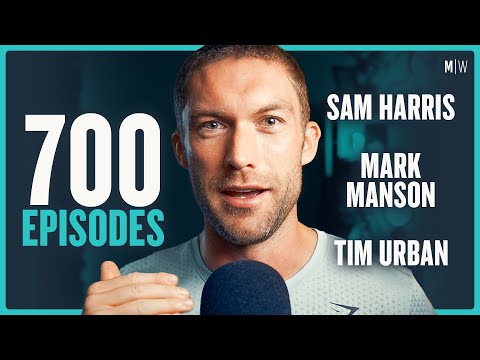
16 Lessons From 700 Episodes - Sam Harris, Mark Manson & Tim Urban
Chris Williamson (host)
In this episode of Modern Wisdom, featuring Chris Williamson, 16 Lessons From 700 Episodes - Sam Harris, Mark Manson & Tim Urban explores chris Williamson distills 700 episodes into hard-won life lessons Chris Williamson shares a rapid-fire collection of insights drawn from recent podcast guests and his own life, touching on happiness, ideology, masculinity, productivity, and self-development. He explores how expectations shape happiness more than circumstances, why ideological mono-thinking and group dynamics make individuals dumber, and how to pursue a realistic form of mindfulness in everyday life. He critiques bad success advice from gurus, warns about the dark side of monk mode, and introduces practical decision-making tools like the “24-hour you.” Throughout, he returns to themes of male mental health, cultural narratives about masculinity, and the importance of curating both your information diet and your chosen life “struggles.”
Chris Williamson distills 700 episodes into hard-won life lessons
Chris Williamson shares a rapid-fire collection of insights drawn from recent podcast guests and his own life, touching on happiness, ideology, masculinity, productivity, and self-development. He explores how expectations shape happiness more than circumstances, why ideological mono-thinking and group dynamics make individuals dumber, and how to pursue a realistic form of mindfulness in everyday life. He critiques bad success advice from gurus, warns about the dark side of monk mode, and introduces practical decision-making tools like the “24-hour you.” Throughout, he returns to themes of male mental health, cultural narratives about masculinity, and the importance of curating both your information diet and your chosen life “struggles.”
Key Takeaways
Your expectations determine your happiness more than your circumstances.
Because humans compare themselves to others and to their past/future selves, satisfaction comes from narrowing the gap between expectations and reality—either by improving circumstances or moderating expectations—rather than from objective achievement alone.
Get the full analysis with uListen AI
Beware mono-thinking and outsourcing your worldview to a tribe.
If one belief predicts all your other opinions, you’re likely recycling group dogma instead of thinking independently; this makes you a predictable ally in tribal politics, but a poor, shallow thinker.
Get the full analysis with uListen AI
Groups can make rational individuals act irrationally (Abilene paradox).
People often go along with decisions they privately dislike because they assume others support them, leading to collective choices nobody truly wants; recognizing this helps you speak up earlier and test real consensus.
Get the full analysis with uListen AI
Stop modeling early-stage behavior on late-stage guru advice.
Many successful people downplay the resentment, obsession, and sacrifice that actually fueled their rise and instead preach balanced, holistic strategies that only became viable after they’d already “made it”; you should study what they did at your stage, not what they say now.
Get the full analysis with uListen AI
Aim for frequent moments of presence, not permanent enlightenment.
Williamson reframes mindfulness as deliberately punctuating your day with short, fully present moments—like feeling the steering wheel or pausing to connect with a partner—rather than chasing an unrealistic, constant non-dual state.
Get the full analysis with uListen AI
Make decisions for your future self, not your current impulses.
Using the “24-hour you” question—what would tomorrow-me want today-me to do? ...
Get the full analysis with uListen AI
Monk mode is powerful but can become an addictive escape.
Extended periods of hyper-disciplined isolation drive huge gains, but they can also justify retreat from life and relationships; periodizing monk mode with clear end dates prevents it from becoming a permanent hiding place.
Get the full analysis with uListen AI
Narratives about masculinity directly affect men’s mental health.
Research Williamson cites shows that seeing masculinity as inherently toxic correlates with worse mental health in men, while viewing it as protective and prosocial correlates with better outcomes—suggesting culture-wide messaging has real psychological costs.
Get the full analysis with uListen AI
Curate content based on how you feel after consuming it.
Because content is engineered to be compelling in the moment, the only reliable test is “post-content clarity”: notice whether you feel hopeful, connected and energized, or cynical, tense and resentful, then prune your feeds accordingly.
Get the full analysis with uListen AI
Choose your ‘shit sandwich’—success is about tolerating the pain, not just loving the dream.
Borrowing Mark Manson’s framing, Williamson argues that any path has its own brand of ongoing discomfort, and people who persist are those who can live with the specific, unglamorous difficulties their chosen pursuit requires.
Get the full analysis with uListen AI
Notable Quotes
“If I know one of your views and from it I can accurately predict everything else that you believe, then you're not a serious thinker.”
— Chris Williamson
“The world isn't driven by greed, it's driven by envy.”
— Charlie Munger (quoted by Chris Williamson)
“You observe events and you allow the flow of things to do the steering, and you go where you go.”
— Jed McKenna (quoted by Chris Williamson)
“Having a negative view of masculinity damages boys’ and men’s mental health.”
— Dr. John Barry (paraphrased/quoted by Chris Williamson
“You just have to decide what sort of suckage you're willing to deal with.”
— Mark Manson (quoted by Chris Williamson)
Questions Answered in This Episode
How can individuals practically lower or recalibrate their expectations without losing ambition or drive?
Chris Williamson shares a rapid-fire collection of insights drawn from recent podcast guests and his own life, touching on happiness, ideology, masculinity, productivity, and self-development. ...
Get the full analysis with uListen AI
What concrete steps can someone take to avoid ideological mono-thinking while still belonging to communities they care about?
Get the full analysis with uListen AI
How should early-stage creators or entrepreneurs distinguish between useful guru advice and luxury beliefs that only apply once you’re already successful?
Get the full analysis with uListen AI
In a culture saturated with ‘toxic masculinity’ narratives, what would a positive, pro-social vision of masculinity look like in practice for boys and men?
Get the full analysis with uListen AI
Where is the healthy line between disciplined monk-mode self-improvement and socially isolating escapism, and how can you tell when you’ve crossed it?
Get the full analysis with uListen AI
Transcript Preview
What's happening, people? Welcome back to the show. It is a 702nd episode. It would have been 700, but Huberman took that spot, so I guess can't really kick him off to do this arbitrary run through of lessons. If you are relatively new here, over the last 100 episodes, you might not know that around about every 100, I recap a bunch of lessons that I've got from the show or from life or from writing my newsletter, and I get to run through them. So today you're gonna get to go through as many as I've got time for from the last nine months or so, and there are some absolute bangers in there. Before I get started, if you haven't already, Nootonic is live now. My first ever product. It is the only thing that you need to drink to get absolutely dialed in, no matter what you need to do to be more focused, attentive, to improve your memory. This thing is phenomenal, so... Without further ado, by the way, nootonic.com if you need that. Without further ado, "Your expectations define your happiness more than your circumstances." And this is something that I knew intuitively, but needed a couple of quotes to kind of really synthesize it. So Tim Urban says, "If you only wished to be happy, this could be easily accomplished, but we wish to be happier than other people, and this is always difficult, for we believe others are happier than they are." Montesquieu said this 300 years ago, and we're still working on this one. So Tim Urban resurfacing that famous quote really highlights the asymmetry between what we see of ourselves and what we see of everyone else, right? Because humans are comparative, relative beings. We don't just judge what we are in isolation, we judge it as a part of the entire hierarchy of society. It's not just about being in a situation and it being good, it's about being in a better situation than we were before, and also a better one than the people that were around, and also a better one than our parents were in when they were our age. This is, uh, intergenerational competition theory, it's referred to as. Charlie Munger had a really great insight where he said, um, "The world isn't driven by greed, it's driven by envy." Our lives are objectively the best humanity has ever had, yet complaining and detas- dissatisfaction is as high as ever. And also because everyone usually only shows the world the best of themselves, this means that we see our own misery and our failings and foibles and vacillation from a front row seat while we watch the highlight reel of everyone else. And this makes us think that other people are doing better than they really are, and when we feel the delta between where we are and where we imagine they are, it hurts, right? There is no such thing as objective wealth. Everything is relative, and most relative to those around you. That's from Morgan Housel. And there's kind of a way to look at this that your circumstances are one, uh, indication of your happiness, but your expectations are one too, and you can either bring your circumstances up to meet your expectations or try as best you can to bring your expectations down. But the problem is no one is going to feel fired up or romantic about the opportunity of leaving lots on the table, right? This isn't very Hormozy-pilled to say, "Oh, yeah, I'm just gonna expect less of myself. I'm gonna leave as much as I can on the table, because I understand that the gap between my circumstances and my expectations are where happiness sits, so by having lower expectations, I can increase my happiness." That doesn't... Uh, it kind of feels like, like folding, uh, almost to this, uh, ineffable force that's out there trying to crush us. But, and you know, I think, I think there's something to it inasmuch as you can take satisfaction in the things that you have done. Uh, I was talking to, uh, Dan Bilzerian, someone that you might not think of as a fount of, like, life bro wisdom, but he's a s- really smart guy, and we were talking about how, um, each time that you achieve a new level of success, uh, it essentially just creates a new bar for you to meet again in the future. And that sounds, and I know it might sound kind of trite, but the problem with a rapid increase in status or wealth or- or accolade or whatever is that all that you're thinking about is, "Oh, God. That's now the new bar that I need to get to." So for instance, let's say that we release a- a YouTube video and it breaks some record for a 24-hour plays. Let's say it does a million plays in an hour, which I think in, uh, a day, which is around about our current record, there is elation at the fact that we've done it, but then there's, uh, also this despondency in the back of your mind where you think, "Oh my God, that's the new bar. In order for us to get another best record, we have to do a million... 1.1 million plays in a day," and that's terrifying. It's also a reason, I think, why I'm not so bought in on universal basic income being a solution if AI automates all of our jobs and starts producing better podcasts than me, because as soon as humans reach an acceptable level of existence, they start wanting to push for more in order to stand out from the crowd, and a- a- a flat hierarchy doesn't stick about for long. So even if every single person earns the same amount of money, people will just find something else to compete on, right? So in 2100 when everyone's needs are met and nobody needs to go to work or something, we're all going to be, uh, collecting leaves or wives or social credit score system points or something. Like, it... You are naturally going to stratify out into a hierarchy because it is not about your absolute happiness, it is all about your relative happiness, your relative attractiveness, your relative wealth. Uh, Gad Saad said this on the episode a couple of weeks ago, right? He said, um, "If you want to be happy and satisfied with your sex life, you not only need to have the amount of sex that you want, but you want to be having a little bit more sex than all of your friends around you." So yeah, uh, happiness and, uh, satisfaction in life does not exist in a vacuum. As much as you and me may think, "Oh yeah, fantastic, I can do this from first principles."That's not the way that it works. So, yeah, uh, be careful about your expectations. Another one about mono thinking, which got some, uh, backs up on the internet a couple of weeks ago, which was great, uh, was by Gwenda Bogle. He says, "You can gauge someone's ignorance by the number of phenomena they explain with the same answer. Those who blame many different issues like war, poverty and pollution on just one cause, like capitalism, are recycling explanations because the demand for answers outstrips their supply." So good, man. The demand for answers outstrips their supply, so they keep on repurposing the only answer that they do know. Everything is because of toxic masculinity, or everything is because of climate change, or everything is because of progressive ideology, or whatever it is, right? And it got me onto another idea which might explain why you get ostracized sometimes for not being a card-carrying extremist or a cookie-cutter ideologue. So, if I know one of your views, and from it I can accurately predict everything else that you believe, then you're not a serious thinker, right? So, if you tell me your view on abortion, and from it I know your stance on immigration and healthcare and gun control and vaccines and taxation, it seems likely that you haven't arrived at all of those beliefs on your own. Rather, you've just unquestioningly adopted an entire suite of beliefs from some group, right? You've outsourced your worldview to the crowd. And these people are very predictable, right? I can be very confident about what they'll say if a new social campaign movement comes along, because it's exactly the same as what everybody else in that group will say. And this is why anyone who thinks for themselves and doesn't adhere to a cookie-cutter ideology wholesale is so unpopular, right? You are an unreliable ally. Surely, you- you might agree with me on abortion, but I know that you disagreed with me on your opinion of Donald Trump, so I'm, uh, very skeptical of you in the future, right? These unreliable allies need to be treated with much more skepticism and distance, and in a tribal warfare game, the most reliable members are the most popular. And I think that this is something reassuring to remember if you ever feel like you don't fit in, or like people sometimes don't treat you with the same degree of, uh, like tribal acceptance that you notice other people do. Even people who are perhaps compromising what they believe, uh, compromising their, um... You're aware that they don't actually believe the things that they're saying, yet they say them, and somehow members of the group would rather have a lying compatriot than an honest adversary, or even just, like, an honest associate, right? And, um, yeah, I think I felt that a good bit myself. I felt that, um, whether it's being accused of, on the same video, being a blue-pilled cuck and a, uh, uh, right-wing bigot, right? By (laughs) by opposite people pointing in the same di- in this opposite direction. It's just, um, it's an interesting one, and it's reassuring, uh, in some ways. And this leads into probably my favorite new idea that I'm kind of obsessed by at the moment, which is the Abilene paradox. The Abilene paradox is, "A situation in which a group makes a decision that is contrary to the desires of that group's members because each member assumes the others approve of it. It explains how a number of accurate individuals can become idiots when they get together." So think Emperor's New Clothes, right? An acquaintance invites you to his wedding despite not wanting you there because he thinks you want to attend. You attend despite not wanting to because you think he wants you there. Or at a- a business meeting, someone suggests an idea that he thinks the others will like, uh, for instance, recruiting a trans influencer as the face of a brand. Each member has misgivings about what it is, but assumes that the others will consider them transphobic if they speak out. So everyone approves the idea despite no one actually liking it. Or, uh, every member of a family in North Korea hates communism, but they never mention this to each other because each assumes that the others approve of it. And I think I wondered for a good while about how rational people that I knew in private held, uh, quite balanced beliefs or quite normal beliefs, or just a, uh, a relatively normal worldview seemed to change an awful lot when they got into a group. And not just in a- a performative way, but that their actual, you know, like ground ethics seemed to adjust. Like they were a different person not only in presentation, but in content too, in substance as well. So it's just, again, it's reassuring, I think. If you're somebody that sits anywhere outside of the absolute cookie-cutter extremist on both sides ideology, you are going to be observed as an unreliable ally by the people that are further out to the right or the left than you, because they are, by definition, more predictable. The s- the s- further toward the middle that you get, the less predictable you are. And this, whether it's to do with sports, right? If you're the sort of person that will both praise and criticize your sports team, right? Or- or- or praise and criticize your child's sports team, all of these things, the lack of predictability, the lack of a cookie-cutter ideology about anything means that people will treat you with more skepticism because in the future they can't accurately project whether or not you're going to be on their side or on the side of someone else that they absolutely hate, or somewhere else that they haven't even thought of.... much, much easier. We just go, "Ah, yeah, we don't need to worry about John. John's, John's always... John's sweet, John's sweet. John's, John's always on our side." So yeah, I think useful lesson to know. Uh, another one that I actually had illustrated recently, which was pretty cool, by, um, uh, Vizzy Andre, was about the reason that you should stop taking advice from super successful people. And I'd noticed that there's a trend of people who've made it, explaining how work/life balance is actually what's most important and how you can't be powered by resentment, or a sense of insufficiency, or a chip on your shoulder, or whatever. And it's a failure, I think, on the part of the guru to understand that the tools you need to get from naught to 50 are not the same that you need to get from 90 to 95. And it's also a basic failure of memory, right? When you look at what got that person to where they are, it's precisely the traits that they're now castigating. Almost, almost everybody has more pain, and resentment, and fear in the beginning, which is why they all use it. And once you've achieved enough success and validation from the world to not be fueled by that anymore, that's great. But that doesn't mean that people who are just starting out can achieve the success that you now have by using strategies which you only accessed after becoming, uh, successful, right? Like, it's almost like, uh, the luxury belief of success, kind of like Rob Henderson's luxury beliefs idea. Um, defund the police, for instance, was pushed heavily by people that live in communities that didn't need a massive police presence, and you need holistic balanced drive is pushed by people who already benefited from their resentment-fueled obsession for a decade, right? Like, we have to be very careful modeling off what successful, statusful, famous people say that you should do in the beginning, especially if it diverges heavily from what they did do. Uh, the best question to ask is not, "How does my favorite guru say people should behave to achieve success?" Instead it would be, "What did my favorite guru actually do when they were at my stage?" Because that is a much more realistic idea of how you can emulate what they're doing. Ali Abdaal has this great idea where he says about how, um, you want to be teaching people that are three steps behind you, because when you're ten steps ahead you can't remember the problems that you were having ten steps ago. And everybody falls into this trap, right? You... The theory of mind, again, Steven Pinker's idea about, uh, the curse of knowledge. Like, once you know a thing, you can't imagine what it's not like to not know that thing. And, uh, the f-... The ability for people to jump back by, you know, three years, five years, a decade, 20 years is basically impossible. They can't remember where they were at. And we don't have some, you know, uh, photographic memory of the texture of our mind and of the way that we spent our time. So yeah, a much better way to do it if you're looking at someone is not to listen to what they're saying but to look at what they did when they were at the same stage as you. Um, talking about realistic paths to difficult things, I came up with this idea about a realistic path to enlightenment. So, as much as moving to a cave, right, in the woods and spending a decade in silent retreat might be great for your spirit, it's not going to be doable by pretty much anyone. And if you've meditated enough, you know that you accumulate momentum in mindfulness kind of like a swell moving underwater. And after enough time, there's kind of a force and a power to your ability to drop into the present moment. And sometimes even little waves of genuine calm insight break above the surface, and it's lovely. But if you're anything like me, it doesn't result in an extended, self-perpetuating enlightenment. It doesn't even really work on its own where your mindfulness sneaks up on you and you're in the present moment without realizing. And I've done, you know, 1,500 sessions of meditation over the last five years. More so, consistent meditation and a focus on mindfulness strengthens the thinking muscle that you use to wrangle your mind to actually exist right now. You, you learn to punctuate your day with instances where your mind finally settles into the moment, and then it's gone. But then you can get back later in the day. And as far as I can tell, this is the realistic path to enlightenment. You're never going to become fully blissed out in perpetual non-dual astral realm synchronicity, right? But you can string together a few moments of peace so that at least for a few times each day your mind rests where your feet are. And I always used to think that this was a failure. Uh, i- if I can achieve mindfulness but then I lose it, that's still not persistent enlightenment, so I failed. And instead, I think it's smart to reframe the goal. If you can just have your mind and your feet in the same location five or 10 times a day, then that's a good start. And then maybe you can do 15, or 20, or 100. And that seems importantly both attainable and really useful. And, um, just finding these moments where you can catch yourself. This... You know, Sam Harris said it on the episode that I did with him. This is who inspired this. And he said... He was late coming to the podcast, and he was rushing around in the house, rushing, rushing, rushing, and him and... His wife was leaving at the same time, and they were passing each other as he was sorting his shoes or whatever. And then he just caught himself, stopped.... picked her up, gave her a kiss, put her down, and left. And you know, that's a ten-second punctuation of whatever obsessive machinations you've got going on in your mind that you're currently captured by until you stop, and you look, and you realize where you are, and your mind and your feet are in the same location, and you do something with so much more intentionality and presence, and then you move on with your day. And stringing together sequences of those kinds of moments, to me, seems like it's so much more attainable, it's so much more realistic, uh, that that's kind of what I'm aiming for at the moment. And maybe, you know, the Jed McKenna out there, my fledgling Jed McKenna who's like this super enlightened spiritual teacher, uh, would... Eh, maybe that's me being cucked and leaving it on the table, but again, you know, that expectations and happiness thing, if your expectation is the only time that I can be satisfied or feel, um, grateful for the work that I've put in on a mindfulness, uh, level is when I finally reach complete non-dual fucking enlightenment, it's not gonna happen (laughs) uh, for pretty much anybody, so you're perpetually going to be dissatisfied with your own mindfulness practice. Whereas I think this, this seems to work, and I know that I can do it. I've done it. Every single person listening to this that's ever tried mindfulness, which is almost all of you, knows that you can do it. You're washing the dishes and you just catch yourself and you f- actually feel the water hitting your hands, right? Or I love to do this when I'm driving, which is one of the saddest things about not driving out here in Austin yet, because it takes forever to get a driver's license in America. The leather on the steering wheel of my car had little perforations in it, and I remember if I was sat at traffic lights, like, really trying to feel every single perforation on the steering wheel, and it just puts you into the- genuinely puts you into the present moment and you know that you can do it, and you know that if you strung 50 of those together every single day, that's pretty fucking enlightened to me. So anyway, that's my realistic path to enlightenment. Uh, you might have seen that I was hanging about with Jimmy Carr. Uh, obviously he came on the show, but we've been talking for quite a while. Turns out that he's a, uh, a big fan of Modern Wisdom and we'd been chatting a lot on WhatsApp and exchanging ideas, and then he did my show... My show in R- Our episode in Rogan's dropped I think within two days of each other, even though mine had been recorded, like, three or four weeks before, and, uh, he brought up to Joe this idea that me and him had both been working on for a little while, which is the 24-hour you, and this is one of the best questions, I think, to ask yourself when faced with a decision, which is, "What would you tomorrow want you today to do?" And it's something that I've relied on for a long time to help me get perspective and make better choices. The reason that it's so effective, I think, is it rips you out of the moment and it stops you from relying so heavily on the confused chemical signals coming from your body, and instead it gives you a bit more distance. Uh, it depersonalizes the decision and helps you treat yourself like a friend that you're responsible for helping, in Peterson language. Uh, it forces you to optimize for long-term thinking rather than immediate gratification. Uh, it reminds you that ultimately decisions aren't being made for you now, they're being made for you in 24 hours, in 24 days, in 24 months. You could see our decisions as investments that we make into our future, and the more ruminative and deep of a thinker that you are, the more you need to make decisions for your future self and not yourself now. Does that make sense? So optimizing to gratify your desires in the moment at the expense of the way that you will feel and the story that you will tell yourself about yourself in the future is rarely a good deal, because you live with the story of your decisions for far longer than the impact of them, so you have to choose wisely. And we don't have crystal balls, right, to see the future, but this is about as close to clairvoyance as I can think. Like, in fact, I can't think of a single decision which would be worse if I actually did what I wished that I'd done 24 hours later, and I can't... (laughs) Imagine if all you did was things that you wanted to do now but you in the future would regret, like, that's a just direct path toward misery, right? Like I- I- I... It's a guaranteed way to make decisions which you're going to have to not only live with the consequences of but for even longer than that, you're gonna have to live with the story that you tell yourself about being the kind of person who made that sort of decision. And again, especially if you're, you know, an introspective, reflective, ruminative sort of person who's gonna think about the things that you do and tell yourself a story about what that means about you, you need to be very, very careful about what you invest into that future story of you, uh, because, you know, the negativity bias is a hell of a drug, and if it once... I- if you have a predisposition to think of yourself as a bit of a piece of shit, you will permanently be scouting for (laughs) any excuse to fit your priors, "Oh, yeah, I knew, I- I- I knew that I was always gonna do that thing. I- I- I- I've not changed at all. This proves to me that I'm not the person that I thought I was." So yeah, decisions are as much about the sort of person that you will tell yourself that you are for having made the decision as the actual impact of the decision itself, and, uh, "What would you tomorrow want you today to do?"... pretty bulletproof, but difficult, right? Very difficult to do because it gives you pretty much nowhere to hide. There's essentially nowhere to hide at all. And, uh, when you do make bad decisions, it's on you. Anyway, there was another one from Jed McKenna who, again, Spiritual Enlightenment Now, uh, it just- This guy's writing is so interesting. He writes with this degree of clarity. He's either an unbelievable writer and charlatan or definitely completely enlightened and- and- and crazy dude. Um, I love his books. Anyway, Jim O'Shaughnessy got me onto them, and he's got this quote that I've been thinking about for a while, which is- it relates to how hard we try to control our lives. He says, "Fear and ego are keeping your hand on the tiller. Release the tiller for whatever reason, and the steering takes care of itself." So, if you think about what life would be like if you didn't grip the tiller so hard, the tiller is the handle attached to the rudder on a boat. It's the thing that steers it. And just thinking about, you know, you- life is chaotic and there is a swell or a storm coming and you- you grip on harder, you try to wrangle control of your life more by applying more effort and pressure and cognitive horsepower. And it relates to something, probably my favorite ever video from Aubrey Marcus. So he stood on stage at the announcement of his New York Times best-selling book party and he says, "I spent so much of my life terrified of what I was going to become and whether I was going to be right here, right now. God, how much time did I waste afraid I wasn't going to be right here, right now? If I could change, the only thing I'd change about my whole life would be fearing less that I wouldn't get right here, the place I was going anyway. I wouldn't change all the mistakes and mishaps. I needed those, but all the constant worry that I wasn't going to make it, that took me out of the moment, it took me out of enjoying these experiences or smiling or eating my lunch or whatever I was doing. Know your mission. Have faith you're going to get there. Wherever you go, it's going to be all right. Just find ways to get out of your head." Pretty good. So, if you imagine that the outcomes in your life are predetermined, right? Imagine that where you're going to end up, the achievement of your goals, the attainment of your pursuits are predestined, and you're going there no matter how much you fear or worry. Now, you still need to do the work, you still need to do the things, but you don't need to fear about completing the work or worry about whether you'll do the things. The things you need to do will get done, and the ones that you don't, won't. How differently would you experience life? You'd be able to just be, right? In the world, but not of the world. Doing the things, but not afraid of the things. According to Jed, he says, "You observe events and you allow the flow of things to do the steering, and you go where you go." And I really think that there is something to this. Release the tiller is a mantra that I should tattoo on the inside of my eyelids, and it's good to be reminded of when we find ourselves gripping too hard to fears or expectations. Because why fear about whether you're going to go to the place that you were going all along? And it's a delicate balance between agency, you know, which is one of the words that I use the most on this podcast, trying to internalize that locus of control, you are able to make changes to your life, you are able to lean in, et cetera, et cetera. But there is also a degree of anxiety and- and concern and rumination and obsession and neuroticism which is no longer helpful. It- it's- it's not a part of you taking control. It's outside of you taking control, and you faking or you confusing what you think for how you impact the world. That, to me, is a- a really nice reframe. Release the tiller. So, another one of the topics that we've spoken about a lot over the last couple of months has been masculinity. And, you know, a lot of guests, a lot of female guests as well, which I do appreciate. I wish- I wish that... By the way, how beautiful is this can? Look at that. Get in there. Look at that puppy. Um, I wish, in some regards, that it was more accepted for men to be talking about masculinity. Again, not to say that it's not, but, you know, Politico did a seven-part series on men and there were zero male writers for it. Uh, probably the most famous masculinity-focused article over the last six months was Christine Emba, female. Uh, you know, so many of the people that I've been speaking to about this are women, and I get the impression at the moment that guys would happily take anyone speaking about their problems, so, you know, like a beggar on the street, you know, like, "Give me the end of your sausage roll or give me two pence or give me whatever, like, I'll take what you get." But, um, I do wish that it was easier for men to have this conversation without having to prostrate themselves, right, on the, "Well, I- I- I must, before we get started, I must say that by focusing on the problems of men, we're not ignoring the problems of women. And I'm aware that for a long time, you know, men did have some privileges apart from the war and the disease and the only 40% of us reproducing." All of that, like these unnecessary caveats and the-... hurdles that guys need to jump over, especially in some regards, if you're a young dude that goes to the gym, right? You're just branded as some right-wing firebrand Andrew Tate, like, fucking from Wish. Because (laughs) that is how the mainstream media has captured all of the conversations around men. And it's just, it- it- that bit, that bit sucks. But anyway, I was trying, after the conversations that I'd had, to work out why men struggling and- and is largely a thankless task. Like, why is it that it's so hard to give men any attention or to give them much attention in the mainstream media? And I think it's because of a zero-sum view of empathy. So there's an assumption that any attention paid toward men takes it away from women or some other minority group who is more deserving. Like, after all, haven't men had it good for long enough? Maybe they should just suck it up for a while. But empathy doesn't work in this way, right? Like, it's not a limited resource. And recognizing the plights of men does not ignore the plights of women. And ultimately, women end up suffering in any case because it's this increasing cohort of apathetic, checked-out, resentful men who contribute to the exact lack of eligible partners that women say that they're struggling with. So the women who post, like, mocking tweets saying, "Boo-hoo, poor patriarchy, sad," whilst also complaining, "Where are all of the good men at?" Uh, it's just mating logic seppuku, right? Like they're just... It- it- if one sex loses, both sexes lose. And I think the difference is... The main difference is that, at least when it comes to women's problems, and they have many of them, I think that, you know, five or 10 years' time, the actual big story is going to be, uh, male body image and female crisis of femininity. Uh, I think that it's going to pivot. Whereas at the moment, it's mostly, uh, in terms of the way that people appear, w- w- women's body s- standards and body types, uh, and men's mental health. I think that's going to flip based on the trends. Ma- male, uh, body dysmorphia is- is set to overtake women's within the space of the next two decades. So everything's gonna go upside down. But anyway, male blame, right? I- i- a common question, I think, is, why don't men just do better, right? Surely, they can just try harder in school, and employment, and in health. It's like, "Chop chop, men. Hurry up and stop being so useless." But no other group is told that when they suffer with poor performance or accolades in the real world, that they should just pull themselves up by their bootstraps. Like, we don't tell any other group that they should just talk about their problems. Instead, we spend billions in taxpayer-funded money and private charity to set up committees and departments and campaigns and funds to solve the problem. So if a woman has a problem, we ask, "What can we do to fix society?" And if a man has a problem, we ask, "What can men do to fix themselves?" And it's a blatant double standard. And anyone who is unwilling to admit the structural disadvantages faced by men are standing in the way of us solving the problems that are hurting men and the potential wives that they should be viable for, right? The problems are not in men's heads, but they're out there in society. And we shouldn't gaslight men into thinking that they can solve these problems by just being less toxically masculine. Like, if the patriarchy is so powerful, why aren't men flourishing more? Right? The- the single biggest risk to a man under the age of 40 is his own hands. Christine Ember had this really lovely quote where she said, um, "Many men feel that their difficulties are often dismissed out of hand as whining from a patriarchy that they don't feel a part of. Just because you're in the majority doesn't mean you don't need support." So in this regard, modern men are being made to pay for the sins and the advantages that perhaps their fathers and their grandfathers enjoyed. And, you know, it's just... (sighs) It's such a shame that men are, men are kind of told, "If only you were less masculine. If only you were more like a woman." Like most of the, uh, or the only, in fact, mainstream publicly acceptable versions of masculinity look an awful lot like traditional femininity. Men need to open up more about their emotions. They need to not be so focused on status and prestige and mastery and conquering. Uh, their aggression needs to be tuned down. All... You know, well, okay, like (sighs) I- I get that, but that's not fixing masculinity. That's neutering masculinity, right? It's- it's not, uh, sanitizing the bad elements that men are struggling from. It's sterilizing them altogether. And, uh, yeah, it's just, it's not gonna work. It's ultimately not gonna work because you're fighting against biology. (swallows) And then there was a study, I wish I'd read it earlier on, but Dr. John Barry, he was on the show maybe six months ago, uh, Center for Male Psychology, the lead for the Center of Male Psychology, and he said, um, "Having a negative view of masculinity damages boys' and men's mental health. Brand new research assessing the views of over 4,000 men found that thinking masculinity is bad for your behavior is linked to having worse mental wellbeing. Around 85% of respondents thought that the term toxic masculinity is insulting and probably harmful to boys, although..."... the direction of causation isn't definite, right? Do negative views about masculinity damage mental health or does low mental health cause men to view masculinity negatively? It's clear that negative views of masculinity are linked to well-being to a significant degree. And on the other hand, having a positive view of masculinity is linked to better mental well-being. And it fits with other evidence that's overlooked in the media and everywhere, uh, that masculinity can be beneficial to mental health. The news shouldn't really be any surprise to any average person on the street who actually recognize the value of masculinity, but much more people who are in academia and the media and the government probably don't. There's rare ex- like, exceptions, but the majority of information about masculinity that we all get exposed to is unreasonably negative. So, you can be forgiven for thinking that men are the oppressors of women rather than the protectors of women. And interestingly, the study found that better mental well-being was associated with believing masculinity makes men protective of women, and worse mental well-being was associated with believing masculinity makes men feel violent toward women. So, one of the implications of the study is that if we want men to have good mental health, a useful strategy might be to help them appreciate the ways in which their masculinity can have a positive impact on their behavior and the people around them. Uh, so the message to schools, uh, and the media and the government from Dr. John Barry is, there is more to be gained by being positive, so it's time to stop being so negative about men and masculinity. And if you were to think that it's kind of, it's almost like an information hazard that the self-fulfilling prophecy of what you tell men, or what you tell people about what they are and what that means actually ends up changing the outcomes of their mental health. If you allow the media and academia to perpetuate a negative narrative about masculinity, that is directly linked to worse mental health outcomes for men. That's almost like, I don't know, like a- a custom pa- uh, pathogen or something that only impacts half of the population and only impacts their mental health, but just allowing that to be perpetuated, and the presumption is, "Oh, you know, like, men are just whining, they need to get over it." It's like, hang on a second. I thought that the whole point of this was that we were trying to bring men along for the ride and that we were supposed to care about their mental health. So yeah, (sighs) that's, uh, like that whole masculinity conversation, I'm really glad that I had so many great guests on. You know, George from The Tin Man, just phenomenal, super, super interesting dude talking about it from a leftist perspective. Uh, Christine Emba talking about it from a feminist perspective. Really great. And I think Richard Reeves has got something new coming out next year too, so he'll be back on. I think he might... No, it is gonna be next year. Uh, anyway, uh, something else that I realized. (laughs) I came up, I came up with this rule called the parental clout gauge, which is how I work out whether a news story has reached mainstream significance or not. And it's not when it trends on Twitter or hits daytime news or lands on the front page of a newspaper. It's when my dad messages me about it on Facebook. Like, that is holy shit, like, this is a big story. (laughs) Uh, he messaged me, um, maybe two year- uh, 18 months ago saying, uh, "I see your friend, Mr. Rogan is in the news again." And, um, he messaged something about Andrew Tate as well. It's like, it can be all well and good, you know, there can be like millions, billions of tweets trending on Twitter, and that's, that's fine, but when your mum or your dad messages you about something from your world, that's when you go, "Oh my God, like what (laughs) , what's ha- this has got way out of hand and way too big." So, um, the rule stands pretty well too, that it's only the biggest stories that actually cross the threshold from, from millennial to- the millennial boomer, uh, wall that's being built. Um, yeah, it's funny. I put out last week on my newsletter, I put, (laughs) I put out a new theory about why women support body positivity so much, or at least a- a contributing element to it. Uh, so I'm gonna try and dance through this minefield here. I do think that there's some there, there, but upfront it's only a potential theory, so just hear me out. It's also not a comment on anyone as a person. So this is the rivalry theory of body positivity. Female support for body positivity is at least in part fueled deep down by female intrasexual competition, which pushes women out of the dating pool by discouraging them from losing weight. So Bill Burr, on one of his Netflix specials where he did it, uh, outdoors at Red Rocks, I think, said, uh, quote, "You guys are so into destroying each other. I see all that sneaky shit you do. Ladies, if you could just support the WNBA the way you support a fat chick who's proud of her body and no longer a threat to you, that league would be doing better numbers than the NBA. Oh my God, you're a goddess. You're gorgeous. You look great in that bikini. I'd kill myself if I looked like that. Keep eating, keep eating. Lose a toe, you fat bitch. It's like if you saw an alcoholic. Oh my God, you're face down passed out. Your kids are crying. You're a hero. You're a god. Keep doing what you're doing." (laughs) So, that really got me thinking. I was like, that's ruthless, but really, really smart. And then there was this new study that just came out couple of weeks ago in the Journal of Personality and Individual Differences that kind of...... put a little bit more legitimacy to this idea than just, like, some comedian's two-minute segment. So, they found that women who are high in intrasexual competitiveness are more likely to advise women who they perceive as potential mating threats to cut off more hair, potentially in an attempt to sabotage their attractiveness. The researchers studied 450 women who were presented with hypothetical salon clients. Participants were asked to cut off the amount of hair, uh, to recommend the amount of hair to be cut off for each client. Women who reported high levels of intrasexual competitiveness were more likely to recommend that clients have more hair cut off when the hair was in good condition, and clients expressed a preference for minimal cutting. And the reason behind this recommendation might be to subtly manipulate the appearance of their rivals, right? Because longer hair is a cue to youth and health. By advising more extensive haircuts, these women could potentially diminish the physical attractiveness of other women. And another finding is that women advise clients of similar attractiveness as themselves to cut off the most hair. So in this scenario, participants effectively targeted women they perceived as being on the same attractiveness level as them, which suggests a form of competitive behavior called horizontal competition, when, uh, individuals compete with others of, uh, similar attributes or qualities. So, the choice to focus on women of similar attractiveness may be strategic. High attractive individuals may not pose a significant mating threat to others because they likely already have access to high-quality mates. On the other hand, targeting less attractive individuals might not yield the desired results as their physical appearance might not be easily harmed through hairstyle changes, right? Okay, so, why do I think that this relates to the body positivity movement? Because as far as I can tell, the parallels seem pretty obvious. Plus, you get social renown for standing up for a mistreated group. And importantly, there's no body positivity movement for men, right? If a guy is unhappy with his body, either publicly or privately, most guys won't say something along the lines of, you know, "You're absolutely gorgeous as you are. You shouldn't feel any discomfort between where you are and where you want to get to." Uh, and women... The justification for this from an Eve Psych perspective is that women use indirect aggression way more than men do. So, men's intrasexual competition is more like a large sledgehammer, whereas women's is like a poisoned arrow that you never see coming. And I'm not saying that this is the entirety of the justification for female support for body positivity, but I think it would be naive to say that it doesn't contribute at all, right? Now, I imagine that this is going to be an unpopular idea because it's uncomfortable to realize that what we thought were altruistic compulsions might have a selfish undercurrent, but intrasexual competition is a hell of a motivator. And it's just an idea, but I do think that there is something here to do with this, and, uh, if I make it through the next couple of weeks, then I'll be fine. Uh, another thing that I've been thinking about a good bit, I've started, I guess, pivoting back into, um, a little bit of productivity stuff because the show has been, uh, quite aggressive. Plus, obviously, Newtonic launch, which has been, like, just so much work behind the scenes and then live tour, which is Ireland and UK and Dubai and Canada and America supporting James Smith later this year. And then just a ton of all of the cinema episodes, everything. There's been lots and lots of kind of pressure behind the scenes for me. Uh, so I got back into thinking about, uh, productivity, and there was this idea from, uh, Ana Codrea-Rado that I totally forgot about, and then I was reminded of it and it's just... I- I've fallen in love with it. So, this is productivity dysmorphia. "Productivity dysmorphia is the inability to see one's own success, to acknowledge the volume of your own output. It sits at the intersection of burnout, imposter syndrome, and anxiety. It is ambition's alter ego. The pursuit of productivity spurs us to do more while robbing us of the ability to savor any success that we might encounter along the way.' 'I've started thinking of this unhealthy relationship I have with my professional achievements as productivity dysmorphia,' Ana said. 'I have realized that it is an inability to see my own success. It's like I'm looking in the mirror of my professional life, and I don't see the published author staring back at me. All I see is a failure.' So good, dude. Productivity dysmorphia is just this total jaded opinion of what we do, of the achievements that we have made, of the outcomes that we are getting on a, you know, minutely or daily basis. Especially, especially if you are a little bit more isolated when it comes to the work that you do, you know, if you're a work-from-home kind of person or work for yourself or, you know, nomad entrepreneur type thing, or b- you know, anybody that just isn't part of a- a team that has very objective metrics of success because who are you comparing yourself to, right? How are you comparing your PT sessions that you do for your clients with someone else's? Well, you can come in and do more PT sessions during earlier or later than everyone else so you fit more in at the same time and your clients get better outcomes. But it's all kind of, like...... fluffy stuff. It's real hard to work out, okay then how much, how much of that is really, how much of that has got there there, and how much of the rest of it is just me sort of BSing myself? And then, you know, for the people that work at home, dude, I went to, I went to an office for the first time in probably two years, the backend of 2021. (laughs) I went to go and see Mike Winnet, uh, from the Contrapreneur Series at his office in Warrington, which is like not even Manchester (laughs) , in the northwest of the UK. Uh, and I went to go and see him, and I'd, you know, just been locked in the house for quite a while, (laughs) , uh, working for the best part of two years, and then snapped Achilles and all the rest of it. So I was quite insulated and forgotten what normal office like was, life was like. And you know, Mike's team, are hardworking and they do their stuff and all the rest of it. But I went in and just observed people, you know, the, all of the fucking distractions that you have of an open plan office. Like, oh, someone's gonna get up and, "Does anybody want a coffee?" And then, you know, for 90 seconds or two minutes, everyone talks about the different co- "I, I, I once had a really great coffee from this place. And are there any of those biscuits left with th- the ones that have got the, the raisins in it? What, what about the, oh, we're gonna have to go to the, we need to get more coffee for the whatever." And I realized that my perception of my own work rate was measured against some totally arbitrary view of perfection that was unrealistic anywhere else, and it's only when you get around other people and you realize, especially in somewhere like an office, just how much slippage there is. So much just, just things occurring that just chip away here and there. And this isn't to say that it doesn't happen at home. In fact, you know, for some people, maybe even for most, it also does happen even more so at home because there's no one looking over your shoulder to make sure that you don't scroll Instagram or, or check YouTube or, or reply to emails when you're supposed to be deep working or, or do something else when you're supposed to be replying to emails. Like, I don't think that any one situation is necessarily better than the other, but although there are definitely personalities that lend themselves to one or the other being better, but there is definitely a case to be made that you should see your level of productivity with a lot more equanimity than you, than you do. And this kinda leads into an idea I had about monk mode. So I'd, I first learned about monk mode, fuck, like 2018 probably, probably 2018. And one of my friends, Jordan, sent me this awesome article from Illimitable Man, who was kind of red pill before there was red pill, but it was much more, uh, to do with productivity and personal men's advice than exclusively about dating and doing things for dating. Um, but you know, the last few years we've seen monk mode really accelerate. Uh, Iman Gadzhi is a big proponent of it, I think he's got an app or something that tracks your monk mode. Uh, so yeah, it's grown hugely in popularity over the last few years, and it's especially amongst men, you know, a popular self-improvement strategy. So for the people that don't know, monk mode is at least, uh, originally a productivity strategy where you retreat from the world to focus on three Is. There's introspection, isolation, and improvement. And despite the recent ascendance, it's nothing new. Like I say, um, that 2014 blog post that I read from Illimitable Man, uh, described it as, uh, "Monk mode is a temporary form of men going their own way. By cutting yourself off from the rest of the world for a while, you can fine-tune your focus, calibrate your direction, and confront yourself. You'll be acknowledging your weaknesses and then formulating a plan of action to deal with them." So the focus is on minimizing your time contributed to social obligations and junk activities, because these consume much of your time whilst yielding little to negligible increases toward your social market value. So monk mode is a serious commitment not to be half-assed. You're either doing it or you're not. It'll be a struggle in the beginning, but once you've fully engaged, it becomes beneficial and productive, and dare I say it, even an addictive lifestyle. And that's the words of Illimitable Man. So it's that last bit, "Even an addictive," dare I say, "Even an addictive lifestyle." So for me, right, the reason that I can comment on this is I've gone full monk mode a number of times in my life with really, really great success. I did 2017, did 2018, then I did mid-2019, basically straight through COVID until 2021 when I moved out here. I cut out alcohol for over 2,000 days in the last eight years. I did 500 days without caffeine, 1,500 sessions of meditation, over five years of daily journals filled, like over 300 sessions of yin yoga, 500 sessions of Stuart McGill's Big Three, pretty much all of that done in a bedroom in Newcastle, sat on my own, usually first thing in the morning. And almost all of the most important progress that I've ever made was facilitated by a concentrated period like this. So you might think, "Why have you got a problem with monk mode if you have benefited from it so much and it was such a powerful productivity tool for you?" But it's precisely monk mode's reliable effectiveness creates a problem because the dark side is that addictive lifestyle thing. The issue is monk mode justifies a retreat from life and risk and self adventure, uh, as a, it justifies it as self-development, and it makes you feel noble in isolation, so much so that it can become hard to bring yourself back out. And this means that if you already have a tendency to live a sheltered-... slightly unsocial life, you're encouraging yourself to further abscond away from ever building a real-life support network, which is ultimately the thing you need the most in the long run. And I saw this in a friend probably a decade ago. So he went on a, a fitness journey. He was already pretty introverted and, and shy, and then he had a- an upcoming fitness competition which justified 8:00 PM bedtimes and militant routines and the rejection of all social invites. The competition came and went, but the routine didn't change, and it took years for him to re-venture out into some sense of normality. And this is largely a personal reflection for me as well, right? The allure of perpetually working on yourself is very, very high because improvement is rewarding. But if you're not careful, you can spend the rest of your life focused on those three Is at the expense of the actual reason that you did monk mode in the first place, to be able to show up in the world in a better way. Bill Perkins, the dude that wrote Die With Zero, who's now become a really good friend, says, "Delayed gratification in the extreme results in no gratification." And with monk mode, you practice in private so that you can perform in public. Private practice in the extreme results in no public performance. So the fear is... (sighs) I guess the summary is don't obsess for too long in solitude for personal growth, or you will struggle to reintegrate, and the best solution that I've found and kind of my strategic tactical takeaway is to periodize, right? So you set a deadline for your monk mode to end, three to six months, I think, is a sweet spot in my experience. You can do longer if you've not done it before and shorter if you've been doing it a good bit. But if you do not set some sort of end goal, you're just going to continue to blast through whatever time... W- what's the reason for you to ever reintegrate? And you hear this in YouTube comments, and I get it. Like I... Dude, I've been there. I've been the person who has found the, the comfort of not having to rely on other people, uh, of, of always saying no to social invites to the point where you no longer need to say no, especially if you're a bit of a people pleaser like I am. Saying no to things is tough, so creating a routine of people not inviting you because they know that you're going to say no also alleviates the nos that you have to say in future. Uh, it, it is so seductive and enjoyable to go and do this thing, but the reason that you want to go and do this isolation, personal development thing in the first place was to then reintegrate into the world as a leveled-up, higher social market value, more equanimous, more calm, more peaceful, more competent person with this whole new skill set and this degree of self-love and, and, and self-awareness. And if... (laughs) If you never actually bother to reintegrate, or if you even make it so difficult to reintegrate because you can't remember what it's like to not do that, it's dangerous. Like, it's... It- it... There are... Here there be demons, or whatever it is. (laughs) Here there, here there be monsters. Um, something that can be really, really good in the first place can end up being toxic at high doses, and I think monk mode is one of those, and I would have made life a little bit easier if I'd just taken small breaks every six months, uh, or so, as opposed to doing these much bigger, longer stretches where breaking the habit becomes super rough. So post-content clarity is another idea that I fell in love with, and I was... You know, largely a lot of what I'm doing is trying to aggregate interesting shit from the internet and books and, and other podcasts and, and news and stuff and then use them to instigate new ideas on my own or, or on the show or in my writing, and, um, I was finding myself feeling... I don't know, just unsettled sometimes after I would consume certain bits of content, so I wanted to create a rule for myself that would help me work out whether the content that I was consuming was making my life better or worse. Uh, because the problem is, while you wi- watch anything, you're distracted by the content itself, uh, which means that you can't judge how the content impacts you during the consumption of it. The creator of whatever you're consuming has designed the content to be compelling and to keep you hooked, because if they didn't, they'd be beaten by another creator who just did that better. But just because something is compelling doesn't mean that it's good for you. You will happily hate-watch adversarial, argumentative videos not because there's a fascinating question being answered, but because you want to make your team... You want to see your team make the other team look silly, and you pity-follow accounts to check in on the slow-motion car crash of whatever catastrophe is happening in some person's existence, or you descend into scroll holes and browse Twitter arguments as your heart rate gets jacked up through the roof in some silent apoplectic rage. But when you finish consuming it, you forget that you consumed it, and you move on with your life, and you don't assess whether or not that was actually good for you. So in this way, you're kind of like a shop owner in a shop with no walls. You're allowing your most valuable resource, which is your attention, to be stolen by whichever individuals are the most bold and aggressive, and then tomorrow you forget that they didn't pay you.... and you allow them to do it all over again. So the solution, I think, is to ask yourself, how does watching different creators make me feel? Right? Some YouTube channels are compelling and limbically hijacking and they keep me watching, but I feel uptight and- and tense and negative and cynical and zero sum after watching them. Like, I don't want to message my friends and tell them that I miss them, or pay people compliments or ring my mum or go outside and see nature. And I feel like the world is against me. And that's not the sort of content that I want to consume any of, no matter how much it makes my dopamine fire, right? On the other hand, you can watch content or read or whatever, listen to stuff that makes you feel the most connected to the world, that makes you feel hopeful and open and prepared and informed and- and light and aligned. If you think that your body is made up of what you put into your mouth, your mind is made up of things that you put into your eyes and ears, and your content diet should be spirulina for the soul, not fast food for your amygdala. So, thinking very carefully about how you feel after you consume some content is the only fix for this, because during the consumption of it, it is so compelling and it's been designed to be that compelling, and if it wasn't sufficiently compelling, you wouldn't be watching it, you'd be watching something which is more compelling. You can't really defeat the consumption of the content while you're consuming it. What you can do is assess how you feel afterward. You know, if you go back through your YouTube history, which is something that you can do, and think, "Okay, how did I feel after I watched that?" It's best to do it probably, you know, five or 10 minutes after you finish up. Hmm. I'll check that as well. Sexy little Newtonic cooler. Um... Think about how you feel after you've finished watching something or- or- or reading something, spending time on any social media, and just reflect, "Okay, would I want to do that again tomorrow?" And if not, start to tune down your use of that. You know, there's a "Not Interested" or "Don't Show This Channel" or "Not Interested," I think, uh, two, um, options that you can click when you see videos on your, uh, home feed. So let's say that you watch some video and you don't like it, uh, "Don't Show This Channel," you will never see that channel again on your suggested feed, right? Or in Up Next. There you go. There's, that- that's fixed. Uh, if it's more platform wide, you know, you can delete the app, uh, if you can (laughs) manage to stick to it. Uh, George Mack has this solution of his two phones where he's got a cocaine phone and he's got a kale phone. Uh, the cocaine phone is only on Wi-Fi and the kale phone is the one that goes around with him all the time. And the cocaine phone's got all of the bullshit on it, and the kale phone has just got like Uber and- and Audible and- and Kindle and stuff like that. Uh, George actually has an awesome rule, uh, he calls Mack's Content Razor. "Would you consume your own content? If not, don't post it." Awesome, right? You know, I asked a bunch of different guys over the last year whether or not they would consume the stuff that they make, and there's definitely (laughs) a trend amongst the guys who... Amongst the guys who seem more dissatisfied with their content creation life that when I ask them that question, there's like a (inhales sharply) "Mm..." Like, dude, if it takes you more than five seconds to say yes, that's a fucking no, right? Um, that's one of the advantages, I think... Uh, f- like, let's break the fourth wall about some content creation stuff, right? Like when you... Newtonic bottle. When you start doing any content, the accepted wisdom is you should niche down super, super hard, capture an audience, get the thousand true fans, and then you can broaden out from there, because it's way easier to penetrate into a very small cohort or a narrow cohort than it is to penetrate across multiple cohorts all at once. The problem is, as far as I can see, very few people are just interested in one thing. Like, there's some obsessive CrossFit people out there, but even the most obsessive CrossFit person is also into '70s jazz, you know, uh, and- and, uh, rom-coms and, uh, loves to play pickleball or, you know, there's, the, uh, cooking, bakery, whatever. Everyone is this Frankenstein's monster of idiosyncratic limbs that's kind of been attached to a torso, and by niching down super, super hard, what it does is get you known very, very well for one thing, but in future, that can often become your, uh, kind of like an Achilles heel, but it- it's almost a restrictive label. You know, Zach, my housemate, started off in fitness for a long time and crushed. He's got some of the best fitness videos. If you're talking Olympic weightlifting, I think he's the best on all of YouTube. And Olympic weightlifting is a super popular sport, but he's now at a stage of his life where he may never go back and compete in Olympic weightlifting again. And he does much... He's got way more varied interests. He's interested in philosophy and psychology and human nature and culture. Okay, so he now has to pivot from that super, like, tight, defined, uh, niche to try and broaden out. And as he does that, the people who came for one thing are going to leave. So, look, it's not impossible to do, and I think that Zach will do a good job of it. So if you wanna watch (laughs) , if you wanna watch how someone does it, I guess just watch his channel over the next couple of years. But-... certainly from my side (sniffs) , the, um, "Would you consume your own content? If not, don't post it," if you are not engaged with the stuff that you are producing online, the sort of things that you're talking about, the kind of stories that you're sharing on your Instagram, et cetera, uh, just stop. Like, don't do it. Just make stuff and share stuff that you like, not that you think people will like. Because ultimately, if you're only doing what people, what you think people will like, you become a puppet, and you outsource your sense of self-worth and all of the content creation to the crowd. You know, these episodes, I don't know, it's, what, an hour and 10 minutes or something? Me waffling on about bro philosophy horse shit that I've, like, pulled out of my, pulled out of the last nine months of life in the hopes that something's interesting. But it's what I would've wanted 10 years ago. Like, this entire show is what I wished that I had when I was 25 and starting to realize, "There's probably more to the world than just getting drunk and partying. All right. Where do I start?" So... And it still largely is. All of the lessons still largely are. So, yeah, all right. Let's do, let's do two more. I've got this, this, like, double up from Mark Manson, which is great. So this is, um, about resilience. "The willingness to be disliked is a superpower. If you develop the willingness to be disliked, you will inevitably have the courage to do the hard things that most people are not willing to do. (sniffs) This will then imbue your life with a sense of meaning and importance. It will also lead to success that others will be too intimidated to go after. But I would go even further than this. I would argue that until you're comfortable with the disapproval of others, you are not truly a free individual yourself. You must develop the ability to be disliked in order to free yourself from the prison of other people's opinions. Learn to do what's right, even if others think it might be wrong. Learn to tolerate criticism and negative feedback, because that's what will make you better. Learn to be laughed at, hated on, and trolled, because if you can become comfortable with the hate, you'll be fucking unstoppable." And he's got this (clears throat) other, uh... What's that book? "The Courage to be Disliked" by some Japanese author whose name I'm going to absolutely butcher and I haven't read, but I've heard is really great. Um, he also, uh, taught me about "Choose your suck. Every single pursuit, no matter how wonderful and exciting and glamorous it may initially seem, comes with its own brand of shit sandwich, its own lousy side effects. Everything sucks some of the time. You just have to decide what sort of suckage you're willing to deal with. So the question is not so much, 'What are you passionate about?' The question is, 'What are you passionate enough about that you can endure the most disagreeable aspects of the work?'" "Because if you love something and want something enough, whatever it is, then you don't really mind eating the shit sandwich that comes with it." And Mark said this on the episode that we did a couple of months ago where he mentioned that when the blogosphere started kicking off a few years ago, maybe a decade ago or so, uh, he would go to these conventions, and I think his blog post, he would maybe do multiple 1,000, 2,000, 3,000-word essays per week. And he would be asked, I think by other people, w- how he was able to put out such a high volume of content. And he said something along the lines of, like, "It- it- it just comes, it comes a combination of easily to me, and the difficulty comes easily to me too." I was like, "Ah, that's interesting. 'The difficulty comes easily to me too.'" Like, that's the shit sandwich that he's prepared to eat. And I think it helps to make you much more aligned with what you want. Anything that you want to pursue is going to be, uh, it's gonna have an amount of associated pain. And the best predictor is not who loves the thing the most. The best predictor is who else can deal with the suck that comes along with whatever you want to do the best. So yeah, orienting yourself toward the difficulties as opposed to toward the pleasures will... Uh, uh, no one, or very few people stop doing a thing or don't achieve success because of a lack of pleasure. It's more an increase of pain, I think. Yeah, sure, you need positive reinforcement, but you get that from the dopamine of just making progress in any case. The pains that you come up against, the burnout, the self-doubt, the, "Oh God, I've got to do that thing. I've got to get the paintbrush out and get the easel out," or whatever, uh, that's really what's going to cause you to stop, as far as I can see. So yeah, orient yourself toward the pains, uh, and that would be the best way to do this. Uh, anyway, neutonic.com. Go and try this. Get yourself a case right now. It's available on Amazon Prime next day delivery UK and US. You can get that right now at neutonic.com, or search on Amazon for N-E-U-T-O-N-I-C. And that's pretty much it. I will see you in 98 more episodes.
Install uListen to search the full transcript and get AI-powered insights
Get Full TranscriptGet more from every podcast
AI summaries, searchable transcripts, and fact-checking. Free forever.
Add to Chrome