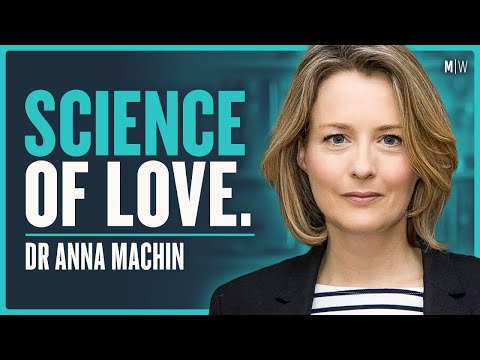
How Love Actually Works - Dr Anna Machin
Chris Williamson (host), Dr Anna Machin (guest)
In this episode of Modern Wisdom, featuring Chris Williamson and Dr Anna Machin, How Love Actually Works - Dr Anna Machin explores love as Survival Tech: Biology, Culture, Cheating, and Control Explained Dr. Anna Machin explores love as an evolved survival mechanism, driven by complex neurochemistry that bonds humans into long-term, cooperative relationships. She distinguishes between lust, attraction, and enduring love, highlighting roles for dopamine, oxytocin, and especially beta-endorphin in maintaining deep social bonds. The conversation covers genetics, attachment, culture’s distortion of love (from gender roles to dating apps), and how both monogamy and non‑monogamy reflect underlying evolutionary pressures. Machin also examines the darker side of love—manipulation, abuse, and intergenerational trauma—alongside emerging forms of love such as aromanticism, polyamory, and religious and parasocial attachment.
Love as Survival Tech: Biology, Culture, Cheating, and Control Explained
Dr. Anna Machin explores love as an evolved survival mechanism, driven by complex neurochemistry that bonds humans into long-term, cooperative relationships. She distinguishes between lust, attraction, and enduring love, highlighting roles for dopamine, oxytocin, and especially beta-endorphin in maintaining deep social bonds. The conversation covers genetics, attachment, culture’s distortion of love (from gender roles to dating apps), and how both monogamy and non‑monogamy reflect underlying evolutionary pressures. Machin also examines the darker side of love—manipulation, abuse, and intergenerational trauma—alongside emerging forms of love such as aromanticism, polyamory, and religious and parasocial attachment.
Key Takeaways
Love evolved as ‘biological bribery’ to make costly cooperation worthwhile.
Human group living is stressful and risky, but essential for childrearing and social learning; love’s neurochemical rewards (dopamine, oxytocin, beta-endorphin) motivate us to form and maintain relationships that are critical to our survival and reproduction.
Get the full analysis with uListen AI
Lust, attraction, and long-term love are distinct but interacting systems.
Lust is hormonally driven by the hypothalamus and sex hormones; attraction is an oxytocin–dopamine process that underpins all types of relationships; long-term romantic and social bonds rely heavily on beta-endorphin, the body’s endogenous opiate that supports decades-long attachment.
Get the full analysis with uListen AI
Genetics and early environment jointly sculpt how you love, but nothing is fixed.
Variants on genes like the oxytocin receptor influence empathy, social motivation, and even resilience to bad upbringings, while nurturing or neglectful early care literally rewires the social brain architecture—yet adult brains remain plastic enough for change through self‑work.
Get the full analysis with uListen AI
Men and women experience love similarly; differences are mostly cultural, not biological.
Brain scans show no sex-based differences in love-related neural activation; instead, gendered socialization teaches men to be stoic protectors and women to be emotionally expressive, shaping how each thinks they ‘should’ behave in love more than how they actually feel.
Get the full analysis with uListen AI
Cheating is evolutionarily intelligible for both sexes, but not purely hormonal.
Men may gain additional reproductive success by spreading genes beyond a monogamous partnership, while women may seek affairs with genetically ‘better’ partners while keeping an investing mate; however, culture, upbringing, and personal values powerfully modulate who actually cheats.
Get the full analysis with uListen AI
Romantic love is not inherently superior to other forms of love.
Friendships, familial bonds, spiritual and even parasocial attachments can yield similar neurochemical rewards and health benefits; aromantic people often have rich, non-romantic love lives, revealing that the cultural hierarchy placing romantic love at the top is largely a Western construct.
Get the full analysis with uListen AI
Love’s power makes it a potent tool for manipulation and abuse.
Because humans desperately need love and find beta-endorphin–based bonds addictive, some individuals—from everyday partners to dark-triad personalities—exploit this by using love to control, coerce, or trap others; victims often stay out of love, hope of change, or fear for children.
Get the full analysis with uListen AI
Modern tools like dating apps and reality shows reshape how we meet, not what love is.
Apps function best as ‘introduction tools’ but starve our evolved sensory assessment systems and incentivize extreme mate-choice behavior, while dating shows dramatize transactional, appearance-based pairing; the underlying biology of attraction and bonding remains unchanged.
Get the full analysis with uListen AI
Notable Quotes
“Love is basically a form of biological bribery.”
— Dr. Anna Machin
“We don’t grow tolerant to beta-endorphin, so it’s the neurochemical of long-term love.”
— Dr. Anna Machin
“There are more differences within the sexes in how people experience love than there are between the sexes.”
— Dr. Anna Machin
“Monogamy is, to a large part, a societal construct that’s been placed upon our biological behavior.”
— Dr. Anna Machin
“If you don’t have love, you live very much half a life.”
— Dr. Anna Machin
Questions Answered in This Episode
How can individuals with difficult childhoods practically leverage brain plasticity to change their attachment patterns in adulthood?
Dr. ...
Get the full analysis with uListen AI
Given that men and women’s love circuitry is the same, what specific cultural practices could help men feel safer expressing emotional vulnerability?
Get the full analysis with uListen AI
What ethical framework should guide people who recognize their non‑monogamous inclinations but also value commitment and minimizing harm?
Get the full analysis with uListen AI
How might dating apps be redesigned to better align with our evolved need for rich, in‑person sensory information when choosing partners?
Get the full analysis with uListen AI
In what ways can societies better recognize and support non‑romantic primary bonds—like deep friendships or platonic life partnerships—on par with romantic relationships?
Get the full analysis with uListen AI
Transcript Preview
Nice to see you again. I really enjoyed our first conversation. We talked about dads, the importance of fatherhood. Today, your most recent book, Why We Love, I wanna talk about that.
Mm-hmm.
Very universal. Perhaps one of the most universal things that humans have got.
Yep.
W- why did love evolve at all?
Okay. So, love evolved basically in the same way that most things evolved, is because it aids our survival. So, humans are arguably the most cooperative species on the planet, both in terms of the number of relationships we can keep going at once, which is about 150, uh, in terms of the duration of those relationships that can last decades, and in terms of the very many different categories of relationships that we have. So, we're very cooperative. But cooperation is really hard as un-... We, we all know, we all know getting along with our friends, with our family, with our coworkers can be a little bit stressful sometimes, and it would actually be much, much easier to be solitary. But we have to live in a group and we have to get along with, with each other to just survive. And so, evolution came up with love basically. It's, it's kind of like a form of biological bribery at the most basic level. So it's, it's a set of neurochemicals which motivate and reward you for starting and then maintaining what we call your survival critical relationships. So those relationships that are critical to you both surviving on a day-to-day basis, but also passing your genes down to the next generation. So at the most basic level, that is all love is. It's just this biological bribery to make us feel good about doing this really quite difficult thing.
Are there any animals that don't have love? Are there any animals that haven't evolved that?
It's hard to say because love is a really nebulous concept, and it depends w- how you define it. I think we all have our own definition of love, and it depends at what stage you, you define it. I think a lot of animals feel what we would call basic love. So, all the mammals, for example, experience attachment. All the mammals are underpinned by things like oxytocin and dopamine. Um, you know, all mammals have those sort of caring, nurturing relationships, particularly be- between mothers and offspring. So we would say all mammals experience love. What we get a little bit hot in the head about is whether any animals experience human-type love, which is a little bit more complicated. And what I find (laughs) a little bit sad really is, you know, when... We just assume all humans feel love. So if I said to you, "Do you know what love is? Have you experienced love?" You'd go, "Yeah." And I'd go, "Okay." Um, but with animals, we hold them to a very high level of evidence. And so, to actually tell whether an animal experiences human-like love, you kind of have sort of a ch- a checkbox of five different things. So do they experience attachment? Is there, um, neurochemistry, does their neurochemistry involve beta-endorphin as well? Beta-endorphin is a more complex neurochemical that's involved in human love, which we don't see in the lesser mammals. Do they grieve, which is the loss of love? Uh, do they have friendships? So do they have relationships which have nothing really directly to do with reproduction or passing genes down, just for the hell of it essentially? And do they experience cognitive empathy? So there are different types of empathy. Um, there's emotional contagion, which is just, "Oh my God, you scream, I scream. I have no idea why I'm screaming, but something's scary." That's... A lot of animals have that. There's emotional empathy, which is, "I can see you're really upset, but I don't know what to do about it." And then there's cognitive empathy, which is, "I can see you're really upset, and I'm gonna help you in the appropriate way," which is what humans have. So I think if we use those five things, um, then we can say yeah, some high- higher mammals definitely do. So for example, cetaceans, the dolphins, the whales do. Um, gorillas, chimps do. Um, beyond that, it's a little bit tricky to say. Dogs might. Um, we're still not sure on the cognitive empathy with dogs, but dogs certainly may experience human levels of love. Um, there's a wonderful effective neuroscientist, unfortunately he's no longer w- with us now, called Jaak Panksepp, and he spent his whole life researching love. And what he said about human love is he said, you know, "Love is like the cupcake, and loads of animals have the cupcake, but what humans have done is they've over-decorated the cupcake. They put lots of rubbish on top, which is mostly the cultural stuff we associate with love. But all that lovely decoration on top isn't actually necessary to experience love. We've just kind of overly complicated it." So, I would say yes, a lot of animals experience love. I, I think keeping it exclusively for humans and setting this very high bar is, is maybe not fair, I think.
Install uListen to search the full transcript and get AI-powered insights
Get Full TranscriptGet more from every podcast
AI summaries, searchable transcripts, and fact-checking. Free forever.
Add to Chrome