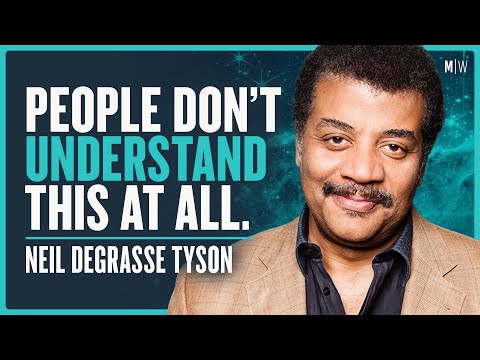
Discovering The Wonders Of Science - Neil deGrasse Tyson
Neil deGrasse Tyson (guest), Chris Williamson (host)
In this episode of Modern Wisdom, featuring Neil deGrasse Tyson and Chris Williamson, Discovering The Wonders Of Science - Neil deGrasse Tyson explores neil deGrasse Tyson Explores Science, Risk, Aliens, and Human Delusion Neil deGrasse Tyson joins Chris Williamson to discuss scientific literacy, effective communication, and why being right is useless if you’re not persuasive. They unpack public confusion about vaccines, probability, and risk, highlighting our tendency to trust stories over statistics. The conversation widens to extraterrestrial life, the Fermi paradox, consciousness, and how the Moon, exoplanets, and future telescopes shape our cosmic perspective. Tyson also reflects on astro‑politics, asteroid mining, and why recognizing the universe’s indifference can actually be empowering for humanity.
Neil deGrasse Tyson Explores Science, Risk, Aliens, and Human Delusion
Neil deGrasse Tyson joins Chris Williamson to discuss scientific literacy, effective communication, and why being right is useless if you’re not persuasive. They unpack public confusion about vaccines, probability, and risk, highlighting our tendency to trust stories over statistics. The conversation widens to extraterrestrial life, the Fermi paradox, consciousness, and how the Moon, exoplanets, and future telescopes shape our cosmic perspective. Tyson also reflects on astro‑politics, asteroid mining, and why recognizing the universe’s indifference can actually be empowering for humanity.
Key Takeaways
Being correct is meaningless without effective communication.
Tyson argues that if you want to change minds, you must adapt your message to how people think, rather than just asserting facts and blaming the audience for not understanding.
Get the full analysis with uListen AI
Statistical illiteracy drives bad risk judgments and susceptibility to anecdotes.
Humans poorly grasp probability, so vivid stories (e. ...
Get the full analysis with uListen AI
Trust in mainstream expert institutions is critical for public health.
He distinguishes between legitimate political debate and rejecting the consensus of thousands of health professionals, emphasizing that he merely relays their findings rather than acting as a lone authority.
Get the full analysis with uListen AI
Consciousness is poorly understood, so we shouldn’t assume humans are unique.
Tyson points out that many animals clearly show consciousness‑like traits and that life’s common building blocks suggest conscious beings elsewhere in the galaxy are plausible.
Get the full analysis with uListen AI
The Fermi paradox highlights a mismatch between cosmic timescales and our solitude.
Given how quickly a civilization traveling at a fraction of light speed could colonize a galaxy, our lack of evidence for such civilizations demands explanations like self‑destruction or limiting “great filters.”
Get the full analysis with uListen AI
Removing or altering celestial bodies would deeply reshape—but not necessarily doom—civilization.
Without the Moon, we’d have weaker tides, different seasons, less romantic nights, altered calendars, and perhaps no early, achievable target for space exploration—yet life could still function.
Get the full analysis with uListen AI
Cheap access to off‑world resources could radically rewire Earth’s economies.
Asteroid mining could flood markets with metals like gold, collapsing current price structures but unleashing entirely new technological uses and industries in response to lower costs.
Get the full analysis with uListen AI
Notable Quotes
“It’s not good enough to be right. You have to be effective.”
— Neil deGrasse Tyson
“We embrace passionate testimony above data in almost everything.”
— Neil deGrasse Tyson
“Maybe just science needs better PR, that’s all.”
— Neil deGrasse Tyson
“The universe could care less what’s happening to you.”
— Neil deGrasse Tyson
“In the court of science, the last thing anyone will say is, ‘I need a witness.’”
— Neil deGrasse Tyson
Questions Answered in This Episode
How can educators and communicators systematically design messages that are both scientifically accurate and emotionally compelling enough to overcome anecdote-driven thinking?
Neil deGrasse Tyson joins Chris Williamson to discuss scientific literacy, effective communication, and why being right is useless if you’re not persuasive. ...
Get the full analysis with uListen AI
What practical steps could school systems take to make probability and statistics as foundational as algebra or calculus for everyday decision-making?
Get the full analysis with uListen AI
Where should we draw the line between healthy skepticism of institutions and counterproductive contrarianism that endangers public health or climate policy?
Get the full analysis with uListen AI
If a nearby discovery of microbial life or an Earth‑like exoplanet is likely, how should governments and societies prepare for the psychological and political impact of such a finding?
Get the full analysis with uListen AI
In a future of asteroid mining and space colonization, what new forms of inequality or conflict might emerge, and how could international treaties realistically evolve to manage ‘astro‑politics’?
Get the full analysis with uListen AI
Transcript Preview
Are bacteria conscious? Well, they're really in control of your body and your digestive tract. There are more bacteria that live and work within one centimeter of your lower colon than the total number of humans who have ever been born. So, however high up you want to think of yourself, to the bacteria, you are a darkened vessel of anaerobic fecal matter. (air whooshing)
Neil deGrasse Tyson, welcome to the show.
Yeah, thanks. Thanks for having me. Thank you.
We were discussing your overly baroque column background behind you before we got started. I've got a story about Sir Christopher Wren, famous English architect. During his extremely long career as England's most celebrated architect, Sir Christopher Wren was often told by his patrons to make impractical changes in his designs. Never once did he argue or offend. He had other ways of proving his point. In 1688, Wren designed a magnificent town hall for the city of Westminster. The mayor, however, was not satisfied. In fact, he was nervous. He told Wren that he was afraid the second floor was not secure and it could all come crashing down on his office on the first floor. He demanded that Wren add two stone columns for extra support. Wren, the consummate engineer, knew that these columns would s- d- s- serve no purpose and that the mayor's fears were baseless. But build them he did. The mayor was grateful. It was only years later that workmen on a scaffold saw that the columns stopped just short of the ceiling. They were dummies.
(laughs)
Both, (laughs) both of them got what they wanted. The mayor got his columns and Wren actually didn't have to molest his, uh, original design.
Well, I think, uh, wasn't one of the big reasons he was catapulted to significance was that he was, um, an active and celebrated architect at the time of the London Fire?
I don't know.
Is that-
But that would have been-
Correct?
... around about the right time, 1680s, yeah.
Yeah, and I think s- And, and you gotta rebuild stuff, right, afterwards, and I, I... So I, I had some memory that he, he was around when, when people needed architects (laughs) , so...
I asked a good friend, a historian, about which British person from history did he wish had more exposure in the modern world, and he said Dick Whittington.
(clicks tongue) Why do I know that name?
So Dick Whittington, the real character that was Dick Whittington, ended up being this rich guy. It was cats, Dick Whittington and his cat was the story that you might have heard. Um, but he ended up g- giving away almost all of his money. There's still buildings that are alive today and educational grants and all sorts of stuff that are downstream from this one guy and his cats.
Oh, okay. Cool.
Install uListen to search the full transcript and get AI-powered insights
Get Full TranscriptGet more from every podcast
AI summaries, searchable transcripts, and fact-checking. Free forever.
Add to Chrome