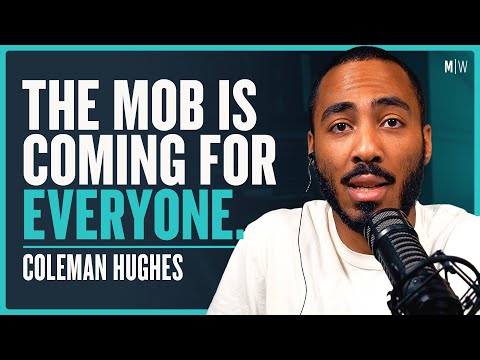
Joe Rogan's Censorship Battle - Coleman Hughes
Coleman Hughes (guest), Chris Williamson (host), Chris Williamson (host)
In this episode of Modern Wisdom, featuring Coleman Hughes and Chris Williamson, Joe Rogan's Censorship Battle - Coleman Hughes explores joe Rogan, Free Speech, and the Mainstream Media’s Credibility Crisis Chris Williamson and Coleman Hughes unpack the backlash against Joe Rogan over COVID "misinformation" and a resurfaced N‑word supercut, arguing that much of it is driven by envy, hypocrisy, and hostility to open discourse. They emphasize Rogan’s unusually honest relationship with his audience, his willingness to apologize, and the double standards compared with legacy media. The conversation broadens into a defense of free speech, the role and fragility of stand‑up comedy, and why censorship is a tempting but dangerous societal instinct. They also discuss the trajectory of “wokeness,” the internal contradictions of intersectionality, and how ridicule and cultural pushback may be shifting the landscape.
Joe Rogan, Free Speech, and the Mainstream Media’s Credibility Crisis
Chris Williamson and Coleman Hughes unpack the backlash against Joe Rogan over COVID "misinformation" and a resurfaced N‑word supercut, arguing that much of it is driven by envy, hypocrisy, and hostility to open discourse. They emphasize Rogan’s unusually honest relationship with his audience, his willingness to apologize, and the double standards compared with legacy media. The conversation broadens into a defense of free speech, the role and fragility of stand‑up comedy, and why censorship is a tempting but dangerous societal instinct. They also discuss the trajectory of “wokeness,” the internal contradictions of intersectionality, and how ridicule and cultural pushback may be shifting the landscape.
Key Takeaways
Rogan’s success exposes mainstream media’s trust gap.
Hughes argues Rogan thrives because he hosts open, taboo conversations that cable news avoided or prematurely labeled as ‘misinformation,’ making his popularity a standing indictment of mainstream media performance rather than proof that his audience is bigoted.
Get the full analysis with uListen AI
Context and intent matter when judging offensive speech.
The N‑word compilation is framed as propaganda that strips context (quoting, discussing, joking) to imply obsessive racism; Hughes insists there is a crucial moral difference between mentioning a slur and using it as a weapon, which many critics are now pretending not to see.
Get the full analysis with uListen AI
Long-form creators will inevitably say regrettable things at scale.
With thousands of hours of unscripted conversations, mistakes and clumsy jokes are statistically guaranteed; Hughes and Williamson stress that this should be expected and evaluated against the full “iceberg” of someone’s public record, not a curated supercut.
Get the full analysis with uListen AI
Sincere apologies can strengthen trust when they’re perceived as real.
Unlike most politicians or TV anchors, Rogan’s apologies are seen as unscripted and heartfelt, which Hughes views as a human virtue and an important part of maintaining an honest bond with an audience, even if some right‑wing allies see any apology as ‘playing the game wrong.’
Get the full analysis with uListen AI
Corporate platforms must decide whether they defend or outsource free speech norms.
Spotify’s partial defense of Rogan and its $100M pledge to marginalized creators illustrate the tension between supporting broad expression, appeasing internal and external critics, and quietly removing controversial episodes—setting a precedent other companies will study.
Get the full analysis with uListen AI
Comedy depends on freedom to test taboos and ‘find the line by crossing it.’
Hughes warns that surveillance, phone bans at clubs, and social-media pile‑ons make it harder for comedians to experiment; because taboo itself is a core ingredient of humor, overzealous policing risks hollowing out stand‑up as an art form altogether.
Get the full analysis with uListen AI
Woke ideology is powerful but internally unstable and culturally uncool over time.
They suggest we’ve passed “peak woke” (circa 2020), noting that intersectionality spawns purity spirals and in‑group cannibalization (e. ...
Get the full analysis with uListen AI
Notable Quotes
“His success is a finger pointed at mainstream media saying, “You guys are fucking up.””
— Coleman Hughes
“All the evidence of him being a bad person, if such evidence exists, it’s already in the open. There’s nothing to discover.”
— Coleman Hughes (on Joe Rogan)
“Comedy does not work under surveillance.”
— Coleman Hughes
“The point of free speech isn’t free speech for things you like; it’s free speech precisely for things you don’t like and think are dangerous.”
— Coleman Hughes
“Joe is a guy who is leading the pack in forging an entire new world. He is failing in public and learning out loud.”
— Chris Williamson
Questions Answered in This Episode
Where should platforms like Spotify realistically draw the line between acceptable controversial content and bannable offense, and who should decide?
Chris Williamson and Coleman Hughes unpack the backlash against Joe Rogan over COVID "misinformation" and a resurfaced N‑word supercut, arguing that much of it is driven by envy, hypocrisy, and hostility to open discourse. ...
Get the full analysis with uListen AI
How can audiences distinguish between genuine misinformation and ideas that are merely unpopular or prematurely labeled as dangerous?
Get the full analysis with uListen AI
Is there a principled way to handle old, offensive material from creators that respects both cultural evolution and individual growth?
Get the full analysis with uListen AI
What practical norms would best protect stand-up comedy’s ability to explore taboo topics without enabling genuinely harmful speech?
Get the full analysis with uListen AI
Has the cultural backlash to wokeness improved public discourse, or has it simply produced a new set of polarized, identity-driven camps?
Get the full analysis with uListen AI
Transcript Preview
His success is a finger pointed at mainstream media saying, "You guys are ******* up." Mainstream media doesn't want to admit that. They would much rather believe his success is an element of him being able to weaponize racism, misogyny, and homophobia, and feed red meat to a bigoted audience. That's the way that they can preserve their image of saying, "No, there's nothing wrong with us. We're doing an amazing job."
(wind blowing) Coleman Hughes, welcome to the show.
Thanks so much for having me.
What has the response been like since you released your rap track? Because I know that you've been rapping for far longer than you've been writing.
Mm-hmm.
But to a lot of people, this probably sounds like finding out that Sam Harris has released a diss track on someone-
(laughs)
... that it runs quite, quite counter to their perception of what you are and who you are.
Right. Yeah, the reception has been awesome. I mean, I've gotten so much good feedback. I think people are receiving it the way that I meant for it to be received. And, um, it's, it's, it feels great to finally be able to converge my music identity and my public intellectual identity, because, you know, like you said, I've been doing both for a long time, uh, in my private life, but in my public life, I've, I've been doing the writing and podcasting way more than I've been doing music. So it's good to finally show people both of these sides of myself.
The track bangs as well. It slaps man. It's really good.
Thank you.
Really, really good. And you went to Ukraine to shoot some music video in the freezing cold?
Yeah, that, that's where it was shot. It was, um, in like a s- what would normally have been a kind of circus, as in for animals, uh, in Ukraine, and it was not at all heated. It was in the dead of the Ukrainian winter, so it was basically like being outside in the middle of a Ukrainian winter for like 12 hours, two days in a row. It was brutal. But the result-
That's the sacrifices you gotta make, man. The sacrifices you gotta make.
Yeah, I mean, I ended up having a lot more respect for actors. I had no idea the actual toll it takes to act several days in a row in conditions that are tiring and exhausting. Like these people, like I have no idea what they went through to, to, to shoot that movie, The Revenant, with Leonardo DiCaprio and Tom Hardy, but my God, the stamina it takes is far greater than you would assume from the outside.
I saw a behind the scenes of Game of Thrones' final season. Now, say what you want about narratively, the way that that show finished, but looking at the cast, sat down on seats, just waiting for their turn to go as the film crew finally get the lighting right, they finally get the camera angles right, and they've run through it and run through it and run through it. It's the patience game. I imagine that a lot of actors develop a, a serious amount of patience while they're doing that.
Install uListen to search the full transcript and get AI-powered insights
Get Full TranscriptGet more from every podcast
AI summaries, searchable transcripts, and fact-checking. Free forever.
Add to Chrome