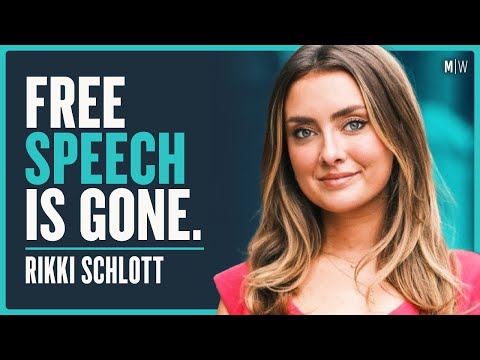
What They Don't Want You To Know About Cancel Culture - Rikki Schlott
Chris Williamson (host), Rikki Schlott (guest)
In this episode of Modern Wisdom, featuring Chris Williamson and Rikki Schlott, What They Don't Want You To Know About Cancel Culture - Rikki Schlott explores inside Cancel Culture’s Rise: Free Speech, Fragility, And Silent Majorities Rikki Schlott discusses the explosion of cancel culture since 2014, arguing it’s driven by social media, institutional abandonment of free speech values, and a generational shift toward fragility and protectionism. She and Chris Williamson trace its roots from early campus political correctness to today’s pervasive self-censorship among students, professors, and professionals. They contend that cancellations fail to eliminate bad ideas, instead driving them into more radical echo chambers while training everyone else to walk on eggshells. The conversation closes with potential solutions, emphasizing parenting, institutional neutrality, corporate backbone, and a renewed, lived culture of free speech rather than reliance on laws alone.
Inside Cancel Culture’s Rise: Free Speech, Fragility, And Silent Majorities
Rikki Schlott discusses the explosion of cancel culture since 2014, arguing it’s driven by social media, institutional abandonment of free speech values, and a generational shift toward fragility and protectionism. She and Chris Williamson trace its roots from early campus political correctness to today’s pervasive self-censorship among students, professors, and professionals. They contend that cancellations fail to eliminate bad ideas, instead driving them into more radical echo chambers while training everyone else to walk on eggshells. The conversation closes with potential solutions, emphasizing parenting, institutional neutrality, corporate backbone, and a renewed, lived culture of free speech rather than reliance on laws alone.
Key Takeaways
Cancel culture now rivals and exceeds McCarthy-era repression in scale.
FIRE has documented over 1,000 attempts to get professors fired since 2014, with 200 sanctions—twice the rate of ideological firings during McCarthyism—suggesting historians may view this period as a major free speech backslide.
Get the full analysis with uListen AI
Social media turns ad hominem attacks into a viral, low-cost enforcement tool.
Platforms allow anyone to pile on without engaging arguments, making individuals into public examples and incentivizing others to replicate shaming rather than debate, like a highly transmissible “meme virus.”
Get the full analysis with uListen AI
A small, highly motivated minority is driving widespread self-censorship.
Surveys show roughly two-thirds of students and about 90% of professors self-censor, while about four in five Americans say political correctness has gone too far; yet an aggressive minority wields disproportionate power, creating a “tyranny of the squeaky wheel.”
Get the full analysis with uListen AI
Deplatforming extremists doesn’t erase their ideas; it radicalizes them in echo chambers.
Data tracking mass Twitter bans and the growth of Gab show purges drive banned users to more isolated platforms where their views circulate with less criticism and stronger reinforcement.
Get the full analysis with uListen AI
Youth raised on smartphones are hyper-vulnerable to permanent digital mistakes.
Schlott notes middle-schoolers are already being “canceled” over saved snaps and posts, arriving at college conditioned to self-censor and terrified that any adolescent misstep can define them forever.
Get the full analysis with uListen AI
Free speech laws are hollow without a broad free speech culture.
Countries like Russia and North Korea have robust-sounding speech protections on paper, while vibrant periods like the French Enlightenment flourished with no such laws—showing that norms and practice matter more than formal statutes.
Get the full analysis with uListen AI
Fixing cancel culture requires both personal courage and institutional backbone.
Schlott urges individuals to precommit to defending friends under attack, and recommends that universities, employers, and platforms emulate examples like Netflix and Coinbase by clearly privileging expression over ideological purity tests.
Get the full analysis with uListen AI
Notable Quotes
“We are now outstripping McCarthyism at roughly twice the pace.”
— Rikki Schlott
“Cancel culture and illiberalism thrive by making everyone feel alone.”
— Rikki Schlott
“Censorship does not make these ideas go away. It just puts them into more obscure crevices of the internet, where people are more likely to agree and have a positive feedback loop.”
— Rikki Schlott
“Liberty lives in the hearts and minds of every man and woman, and if it dies there, no court or law can save it.”
— Rikki Schlott, paraphrasing Judge Learned Hand
“Cancel culture is a cheap tactic to win arguments without winning arguments.”
— Rikki Schlott
Questions Answered in This Episode
How can parents practically raise children to be both empathetic and anti-fragile in a digital environment where every mistake is permanent?
Rikki Schlott discusses the explosion of cancel culture since 2014, arguing it’s driven by social media, institutional abandonment of free speech values, and a generational shift toward fragility and protectionism. ...
Get the full analysis with uListen AI
What concrete policies should universities adopt if they genuinely want to reverse self-censorship and restore intellectual diversity on campus?
Get the full analysis with uListen AI
Where is the line between responsible moderation of genuinely dangerous content and counterproductive deplatforming that fuels extremism?
Get the full analysis with uListen AI
How can ordinary employees or students safely resist a cancellation attempt against a peer without destroying their own careers or social standing?
Get the full analysis with uListen AI
If most of Gen Z dislikes cancel culture but lacks an alternative framework, what educational or cultural interventions would most effectively rebuild a robust free speech ethos?
Get the full analysis with uListen AI
Transcript Preview
I feel like if there was ever a conspiracy to try and launch a book, a ton of free speech furors at some of America's highest education institutions might very well be it. So I'm not saying that you and Greg started all of this stuff off.
(laughs)
But I am saying that it seems to be conveniently timed.
Yeah. Um, I, we convinced all of the Ivy League and elite institutions to just self-detonate exactly as we were dropping this book about how terrible and dire the state of free speech is on their campus and the state of discourse. So-
I knew it.
... it's been an interesting time for sure. Also, uh, often an unideal time to be a vocal free speech absolutist, um, because it requires that you defend speech that is often very heinous even in the depths of an unfolding crisis. Um, but certainly, I think we're seeing the, the consequences of decades of just the, these major elite institutions in America just abdicating the value of free speech, completely throwing it to the wayside, and then allowing radicalism and, and some really frightening illiberal tendencies to fester in its place.
What has happened to the rates of calls for cancellation over the last few years?
It's been absolutely staggering. And since 2014, um, fire, which is my, my co-author, Greg Lukianoff, is the, the president of the Foundation for Individual Rights and Expression, and they've tallied more than 1,000 attempts to get professors fired, 200 of which have been successful in getting them sanctioned. Um, and that actually is twice the rate of the, uh, 10 years that roughly constitute what McCarthyism was. And so if we're looking back in historical context, we look at that as a horrendous blight on our record as a country in terms of, you know, firing people for ideological reasons. And we are now outstripping that at roughly twice the pace. So I think, in the future, historians will be looking back at this moment in time and studying it much as we did, um, and rightfully so, the 1950s.
What is driving this increase? Why is it ramping up so much? What are the, the undercurrents that are causing this thing to happen?
Yeah. So I think the, the major catalyst here and why we define cancel culture as starting in 2014 in its modern iteration is because social media allows it to just take off like wildfire. And we, um, we kind of refer to Richard Dawkins' idea of a meme because cancel culture is very, uh, it's very effective. You know, you don't have to actually engage with somebody's argument. You just attack them ad hominem. You make an example of them. You make sure that no one else wants to tread the same ideological path as them. And in the end, people see that and watch that and replicate that. And I think that social media has allowed for an unprecedented amount of scrutiny on institutions, ideas, and people, which, of course, is a good thing. However, we're in one of those, like, post-printing press moments of social unrest where we haven't yet figured out how to navigate this world in which now billions of people are in the cultural conversation. And, um, and anyone could be te- torn down at any moment unceremoniously, fairly, unfairly. And so I think, you know, this is, our book is a, an attempt to call attention to the issue and also, um, hopefully get more people on board to figuring out how we get out of this mess because I think that there actually is a lot of, um, just general desire and, and a general understanding that, that things have gone too far, that people are walking on eggshells, and that that's not a healthy way to live.
Install uListen to search the full transcript and get AI-powered insights
Get Full TranscriptGet more from every podcast
AI summaries, searchable transcripts, and fact-checking. Free forever.
Add to Chrome