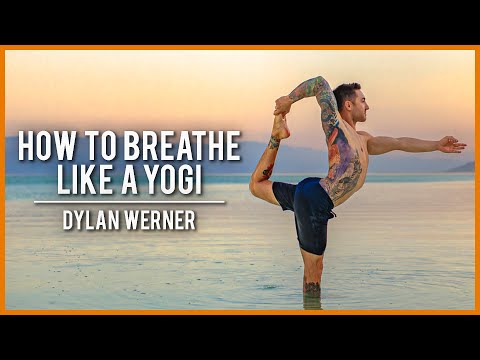
How To Breathe Like A Yogi - Dylan Werner | Modern Wisdom Podcast 282
Dylan Werner (guest), Chris Williamson (host), Narrator, Narrator
In this episode of Modern Wisdom, featuring Dylan Werner and Chris Williamson, How To Breathe Like A Yogi - Dylan Werner | Modern Wisdom Podcast 282 explores yogi Breathing Mastery: Using Breath To Transform Body, Mind, Performance Dylan Werner and Chris Williamson explore yoga as a complete life philosophy rather than just physical postures, emphasizing its role in discovering personal truth and presence. Dylan explains how breath (pranayama) links physiology, emotion, and energy, arguing that conscious breathing can influence performance, mood, and nervous-system balance. They dive into the science of CO₂, oxygen, and the Bohr effect, showing why most people over-breathe and how nasal, slower, and less frequent breathing improves health and athletic capacity. The conversation concludes with practical breath drills, a reframing of stress and the sympathetic nervous system as useful tools, and Dylan’s aim in his book “The Illuminated Breath” to demystify ancient yogic ideas with modern science.
Yogi Breathing Mastery: Using Breath To Transform Body, Mind, Performance
Dylan Werner and Chris Williamson explore yoga as a complete life philosophy rather than just physical postures, emphasizing its role in discovering personal truth and presence. Dylan explains how breath (pranayama) links physiology, emotion, and energy, arguing that conscious breathing can influence performance, mood, and nervous-system balance. They dive into the science of CO₂, oxygen, and the Bohr effect, showing why most people over-breathe and how nasal, slower, and less frequent breathing improves health and athletic capacity. The conversation concludes with practical breath drills, a reframing of stress and the sympathetic nervous system as useful tools, and Dylan’s aim in his book “The Illuminated Breath” to demystify ancient yogic ideas with modern science.
Key Takeaways
Treat yoga as a way of living, not just stretching.
Werner frames yoga as a comprehensive philosophy—how you think, relate, and breathe—aimed at returning to the truth that you are already whole, rather than just a fitness class of poses.
Get the full analysis with uListen AI
Breathe less and through your nose to improve health and performance.
Nasal breathing filters, humidifies, and naturally restricts airflow, raising CO₂ tolerance, improving oxygen offloading to tissues, and reducing chronic sympathetic overactivation compared to mouth-breathing.
Get the full analysis with uListen AI
Understand CO₂ as your ally, not just a waste gas.
Most people assume breathing more equals more oxygen; Dylan explains that hyperventilation mostly blows off CO₂, alters blood pH, tightens the oxygen–hemoglobin bond, and can actually reduce oxygen delivery to muscles and brain.
Get the full analysis with uListen AI
Use breath intentionally to steer your nervous system for the task at hand.
Fast, forceful breathing (e. ...
Get the full analysis with uListen AI
Train respiratory strength and CO₂ tolerance like any other fitness quality.
Targeted practices—breath holds, nasal-only training, and drills like Kapalabhati, Bhastrika, and Agni Sara—build diaphragm strength, lung capacity, red-blood-cell production, and the ability to stay composed under “air hunger,” boosting athletic output.
Get the full analysis with uListen AI
Reframe stress and sympathetic arousal as functional, not inherently bad.
They argue the sympathetic nervous system has been unfairly demonized; when experienced as meaningful challenge, the same sensations can fuel growth and performance rather than pathology.
Get the full analysis with uListen AI
Precision of intention gives breathwork power and prevents empty ritual.
Dylan stresses that many yogis and breathwork practitioners don’t know why they use certain techniques; choosing the right pattern for a clear goal (sleep, focus, performance, emotional balance) turns breathing from vague spirituality into a practical lever.
Get the full analysis with uListen AI
Notable Quotes
“How you do one thing is how you do everything. Well, how do you breathe?”
— Dylan Werner
“Yoga’s not about trying to be happy or be fit... it’s returning back to the truth. And the truth is that we are whole.”
— Dylan Werner
“Essentially, you can control almost every aspect of your life by learning how to control the breath.”
— Dylan Werner
“The breath is a tool. It’s not a cure-all.”
— Dylan Werner
“We’re guaranteed only two breaths in this life, our first and our last. We can waste every breath merely existing, or we can use every breath to create meaning.”
— Dylan Werner (reading from his book "The Illuminated Breath")
Questions Answered in This Episode
How might integrating the philosophical side of yoga change the experience of someone who currently only practices physical postures?
Dylan Werner and Chris Williamson explore yoga as a complete life philosophy rather than just physical postures, emphasizing its role in discovering personal truth and presence. ...
Get the full analysis with uListen AI
If most of us chronically over-breathe, what simple daily experiments could show us the benefits of breathing less and through the nose?
Get the full analysis with uListen AI
In what ways can we safely push our CO₂ tolerance without tipping into anxiety or panic, especially for people prone to breath-related discomfort?
Get the full analysis with uListen AI
How can understanding yogic energy models (gunas, nadis, vayus) alongside modern neuroscience change how we approach mental health and emotional regulation?
Get the full analysis with uListen AI
What criteria should someone use to choose between energizing breathwork and calming breathwork on a given day, rather than just following a fixed routine?
Get the full analysis with uListen AI
Transcript Preview
Breathing is one of those things, we're always doing it. How you do it matters. All right. What's the famous saying? "How you do one thing is how you do everything." Well, how do you breathe? 'Cause that's what you're doing the most of. You're not doing any one activity more than that. (wind blows)
Where are you practicing your yoga in Canggu?
Where am I?
Where are you practicing it in Canggu? Are you going to a studio?
Oh, look right behind me, like right there, that, that little space behind me on that floor. That's, uh, that's where I practice yoga. (laughs)
So you're not going to... Obviously there's a lot of different yoga studios out there, nice places with bamboo leaves and everyone in Lululemon, and you're not bothering to venture?
There's, there are some beautiful studios here. On Saturdays I go to Kirtan, which is like, um, yoga music. So basically people get together and someone plays harmonium and someone plays, uh, a, a drum or something and you sing mantras and kirtans. Yeah. It's, uh, I don't know, it's, it's kind of a, uh, it's called Bhakti yoga. Bhakti means the yoga of devotion. And so it's a, it's a different, different sector, different aspect. It's, uh, it's good though. Yeah. So that's, that's...
I, I didn't... I didn't realize until reading your book that there was a philosophy behind yoga. I knew that it was to do with embodied practice and different levels of awakening and stuff like that. But I didn't realize that there was a full philosophy behind it. Can you tell us a bit about that?
(laughs) The full philosophy about, of yoga? There's, there's a lot of philosophy in yoga, and it, it really depends on what, what you're talking about. I think, uh, I think what most people are familiar with as far as, like, the fundamental philosophy of yoga would be padat- um, the Yoga Sutras and Patanjali's Eight Limbs, which is essentially like the path of yoga towards enlightenment. Uh, yeah. There, there's, there's a lot of different ways you could look at it or in- interpret it. And I think, just like religion, people take the text and they kind of interpret it to make sense of their lives. And, and yoga philosophy is really, really kind of the same way. But it's, it's a guide just basically to understand your life and how to live a more harmonious life, like any philosophy is. And I think that's really one of the big differences with, with yoga compared to other kinds of fitness. I mean, yoga's, yoga's an interesting word in and of itself, because like all words, we give words meaning and we define them to be what it is. And so, uh, like, I know when I came into yoga, my definition for the word yoga was very different than what it is now. It, it was, it was like what I think the, the vast majority of people think of yoga. It's stretching and sun salutations or maybe Ashtanga, or some sort of like physical calisthenics-type movement. And, and that is, that is definitely what yoga is, but it's, it's also, it's also like the way that you interact, the way that you think, the way that you breathe. And there's... The, the way that you conduct yourself. Um, I don't know. For, for me, like, it's this, it's the word that encompasses understanding your fundamental truth, which I'm, I'm not gonna tell you what your fundamental truth is. Everyone's is, is like... That's, that's the journey. It's like understanding that in and of itself. You know, we're all living a subjective experience. We all see the world through our eyes. And I know for a long time I thought, I thought the world like kind of, uh, revolved around me, right? It's like you, you become self-centered. And, and not even in a negative way. It's just, you are the center of yourself, and, and, and that's how you see things. Uh, uh, and I think as you become more mindful and more aware of, of reality or the truth of reality, you see that your perspective is, is simply that it's your perspective and no one else shares your perspective. And therefore you can't understand anyone else's perspective because you can only understand their perspective from your space. Yeah. A- and, and yoga shows you kind of where you fit into that whole, not being separate, but more of being a part of it. Right? And I, I think, uh, I have a, one of my, my favorite teachers, his name is Shiva Das. He talks about what, what the true meaning of yoga is, and it's, um, you know, it's not about trying to be happy or be fit or anything or, or even like, uh, the, or freedom from suffering, but it's returning back to the truth. And the truth is that we are whole. And so, uh, that, that's kind of like, when I think of yoga, that's, that's what I think of. And when I practice yoga, like I, I, I use the common vernacular that everyone uses. Like, yeah, "Are you gonna go do yoga?" And I know what they mean is, "Are you gonna go do asana?" And which is fine, right? Yeah. 'Cause yes, I'm, that is a part of it. That is definitely a part of it. So I'm gonna go practice asana. But, uh, yeah. It's definitely the definition for it has changed, and, and that's kind of just like the start of the philosophy. I mean, we could spend the whole time talking about different aspects of philosophy of yoga. We could talk about maya, how we see everything as illusion. We could talk about the yamas and the niyamas and, and conducts with yourself, and we could talk about what enlightenment is and spirituality and all that. But I think, uh, I think at the end of the day, everybody is going to find what those words mean to them and define those words and give those, those things significance. And, and essentially that's what all philosophy is. It's finding the significance.
Install uListen to search the full transcript and get AI-powered insights
Get Full TranscriptGet more from every podcast
AI summaries, searchable transcripts, and fact-checking. Free forever.
Add to Chrome