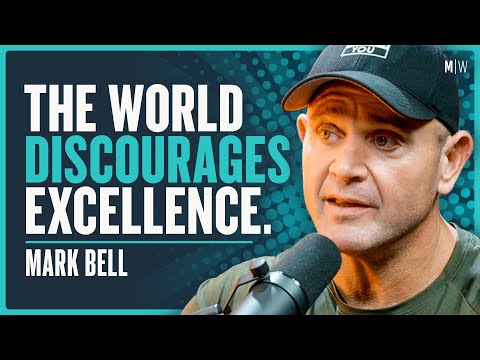
Stop Being Shamed Out Of Your Competitive Edge - Mark Bell
Mark Bell (guest), Chris Williamson (host)
In this episode of Modern Wisdom, featuring Mark Bell and Chris Williamson, Stop Being Shamed Out Of Your Competitive Edge - Mark Bell explores stop Hiding Your Ambition: Reclaiming Excellence, Competitiveness, And Growth Chris Williamson and Mark Bell explore how culture often shames ambition and competitive drive, discouraging people from pursuing excellence or openly celebrating wins. Using stories from powerlifting, business, and personal relationships, they dissect tall‑poppy syndrome, envy, and why many people feel threatened by others’ success. They discuss surrounding yourself with like‑minded, growth‑oriented peers, learning to both give and receive compliments properly, and reframing negative emotions through stoicism and deliberate interpretation. The conversation expands into routines, choice overload, exercise as therapy, and whether people can truly change, concluding that service to others and constant movement are powerful antidotes to resentment, stagnation, and self‑doubt.
Stop Hiding Your Ambition: Reclaiming Excellence, Competitiveness, And Growth
Chris Williamson and Mark Bell explore how culture often shames ambition and competitive drive, discouraging people from pursuing excellence or openly celebrating wins. Using stories from powerlifting, business, and personal relationships, they dissect tall‑poppy syndrome, envy, and why many people feel threatened by others’ success. They discuss surrounding yourself with like‑minded, growth‑oriented peers, learning to both give and receive compliments properly, and reframing negative emotions through stoicism and deliberate interpretation. The conversation expands into routines, choice overload, exercise as therapy, and whether people can truly change, concluding that service to others and constant movement are powerful antidotes to resentment, stagnation, and self‑doubt.
Key Takeaways
Protect and express your competitive edge instead of hiding it.
Social circles that mock trying hard can condition you to downplay ambition and regress to the mean; deliberately choose environments where striving, caring, and wanting to win are normal and respected.
Get the full analysis with uListen AI
Curate your circle to include people who celebrate your wins.
If sharing success triggers defensiveness, one‑upmanship, or subtle sabotage, that’s a signal to limit those influences and seek peers whose default response is genuine support and constructive challenge, not envy.
Get the full analysis with uListen AI
Learn to give and receive compliments without deflection.
Deflecting praise (“it was nothing,” making excuses) makes others feel foolish for complimenting you and robs both of you of a positive moment; practice simply accepting with “thank you” and, when you compliment others, follow up with questions, not self‑referencing stories.
Get the full analysis with uListen AI
End more statements with question marks to deepen relationships.
Bell suggests shifting from statements to questions—asking how someone achieved something or what their ‘dark times’ were—because curiosity turns interactions from covert competition into mutual learning and connection.
Get the full analysis with uListen AI
Reframe negative events by questioning your interpretation, not the event.
Bell argues most negative emotions stem from our interpretations; pausing, creating time buffers, moving your body (lifting, running), and deliberately re‑labeling events can turn ‘bad days’ into raw material for growth.
Get the full analysis with uListen AI
Use movement and “do more, be more” to manage stress and inertia.
Regular physical activity acts like a broad‑spectrum ‘medicine’ for mood, resilience, and decision‑making; treating movement as a non‑negotiable default response to stress helps prevent rumination and emotional overreaction.
Get the full analysis with uListen AI
Fight scarcity mindset by actively helping and connecting others.
Instead of resenting others’ success, Bell intentionally connects people, shares opportunities, and leverages his network; this builds goodwill, reduces envy, and creates positive‑sum dynamics where everyone can rise together.
Get the full analysis with uListen AI
Notable Quotes
“If you walk with the lame, you’ll develop a limp.”
— Louie Simmons (quoted by Mark Bell)
“If you’re getting more out of life than I am, I’m gonna sabotage you.”
— Mark Bell
“Sometimes it’s hard to celebrate victories around certain people.”
— Mark Bell
“If you want to punish somebody, tell them they’re wrong when they do something right.”
— Jordan Peterson (paraphrased by Chris Williamson)
“Negative emotions come from negative interpretations.”
— Mark Bell
Questions Answered in This Episode
In what ways have I been shamed out of showing my competitiveness or ambition, and how has that shaped my behavior?
Chris Williamson and Mark Bell explore how culture often shames ambition and competitive drive, discouraging people from pursuing excellence or openly celebrating wins. ...
Get the full analysis with uListen AI
Who in my life truly celebrates my successes without defensiveness, and how can I spend more time with those people?
Get the full analysis with uListen AI
When someone shares a win with me, do I instinctively one‑up, downplay, or critique them instead of asking curious questions?
Get the full analysis with uListen AI
What recurring ‘negative’ events in my life might change if I deliberately reframed my interpretation of them?
Get the full analysis with uListen AI
How could I use movement (lifting, running, walking) and small acts of service or connection to break cycles of envy, stagnation, or self‑doubt?
Get the full analysis with uListen AI
Transcript Preview
I think it’s really important to be around like-minded people. A quote from Louie Simmons is, "If you walk with the lame, you’ll develop a limp." When you share a success, they immediately want to bring up their own successes to try to measure up. And if that doesn’t work, they will immediately go to some negative context around how you did it. If you’re getting more out of life than I am, I’m gonna sabotage you. (wind blowing)
Mark Bell, welcome to the show.
Thank you so much. I appreciate it.
For the people that aren’t familiar with you and your background, what is it?
Uh, l- uh, many, many years of powerlifting, lifting some heavy-ass weight, and powerlifting consists of a squat, a bench press, and a deadlift. And so most of my time was spent trying to build strength in those exercises, and then, in the gym, when you work on a, a squat bench and a deadlift, all the workouts that I did for about 30 years were all ... Everything was focused and honed in on how to make those lifts stronger.
And you trained under some of the, uh, savants-
(laughs) .
... in terms of coaches of our era?
Yeah, I got to rub elbows with Louie Simmons, Charles Poliquin, uh, Dave Tate, a bunch of different, uh, kind of giants in fitness, giants in strength. And, uh, Louie Simmons, I actually went and trained at his gym, Westside Barbell, and he was a mentor of mine, and, uh, that gym was very, very intense. S- uh, Westside Barbell had probably about 50 or 60 lifters in there. Uh, each guy probably ... Uh, most of the guys were big. Most of the guys were really big, like 275 and up. And, uh, it was intimidating. There, there was a ... The squat rack was all the way in the, well, not all the way, but it was in the back of the gym. And, uh, first couple times that people went into the gym, they would kind of go by the dumbbell area. They might make their way to the bench press. But most of the time, people didn't make it to the back of the gym until they felt, uh, a little more comfortable, which was pretty much never, because it was, uh, high-intensity, just everyone in there, their goal was to get as strong as possible, and not even just that. Some of the guys were in there trying to be the strongest in the world.
Dude, I mean, the legends of those stories, the videos that people have seen of Westside, of Louie training. "Up, up, up, up, up."
Yeah. "Back, back, back, back, back."
(laughs) So what do you think, um, what do you think's been lost with Louie, or has, 'cause he's now passed-
Yeah.
Has his legacy managed to live on, do you think? Has he made a sufficient impact that people are now taking the good stuff that he brought in and continuing that?
Install uListen to search the full transcript and get AI-powered insights
Get Full TranscriptGet more from every podcast
AI summaries, searchable transcripts, and fact-checking. Free forever.
Add to Chrome