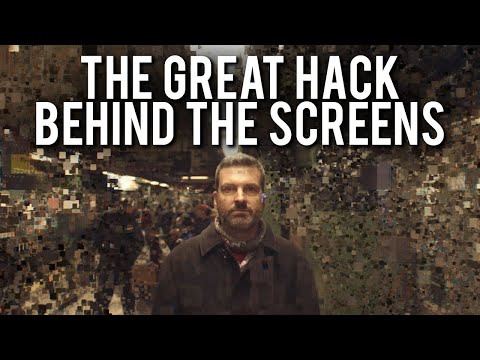
Behind The Scenes Of Netflix's The Great Hack - David Carroll
David Carroll (guest), Chris Williamson (host)
In this episode of Modern Wisdom, featuring David Carroll and Chris Williamson, Behind The Scenes Of Netflix's The Great Hack - David Carroll explores inside The Great Hack: Data, Democracy, And Weaponised Persuasion Exposed Chris Williamson interviews Professor David Carroll about Netflix’s documentary *The Great Hack* and the real-world scandal of Cambridge Analytica and its parent company SCL. They explore how military-grade psychological operations and big data were repurposed to influence elections, including Brexit and the 2016 Trump campaign. Carroll explains his legal fight in the UK to obtain his voter data, revealing how European-style data rights enabled action that wasn’t possible in the US. The conversation broadens into Facebook’s responsibility, surveillance capitalism, regulatory failures, and what citizens and lawmakers must do before upcoming elections.
Inside The Great Hack: Data, Democracy, And Weaponised Persuasion Exposed
Chris Williamson interviews Professor David Carroll about Netflix’s documentary *The Great Hack* and the real-world scandal of Cambridge Analytica and its parent company SCL. They explore how military-grade psychological operations and big data were repurposed to influence elections, including Brexit and the 2016 Trump campaign. Carroll explains his legal fight in the UK to obtain his voter data, revealing how European-style data rights enabled action that wasn’t possible in the US. The conversation broadens into Facebook’s responsibility, surveillance capitalism, regulatory failures, and what citizens and lawmakers must do before upcoming elections.
Key Takeaways
You can rarely prove if data tactics ‘decided’ an election.
Elections have no control groups and are shaped by a perfect storm of factors, so the real issue is not whether Cambridge Analytica was decisive, but whether democracy can function when such opaque manipulation is possible.
Get the full analysis with uListen AI
Legal rights to your data depend on where it’s processed.
Carroll could only challenge Cambridge Analytica because his US voter data was processed in the UK under the 1998 Data Protection Act; without that cross-border processing, he’d have had virtually no recourse under US law.
Get the full analysis with uListen AI
Military-grade influence tactics were repurposed for civilian elections.
SCL’s experience in defense and psychological operations—mapping social fractures and exploiting them—was commercialized through Cambridge Analytica to target voters, turning tools built for counter‑extremism into instruments of domestic political warfare.
Get the full analysis with uListen AI
Facebook was the enabling platform, not a neutral bystander.
The platform’s design to maximize data collection and microtargeting—originally to sell products—was also sold to campaigns; evidence suggests Facebook knew Cambridge Analytica was a rogue actor yet continued to work alongside it in the Trump campaign.
Get the full analysis with uListen AI
Surveillance capitalism creates structural incentives to polarize societies.
Business models that monetize attention and data reward fear, outrage, and filter bubbles; this asymmetry dispossesses users of agency and degrades collective decision-making, even if individual users feel “too savvy” to be manipulated.
Get the full analysis with uListen AI
International cooperation is essential to regulate tech ‘super states.’
Platforms like Facebook operate above any single jurisdiction, so parliaments in the UK, Canada, and others had to coordinate aggressive hearings and investigations, highlighting that a patchwork of weak national laws is inadequate.
Get the full analysis with uListen AI
Citizens must press for fundamental data rights, not just better settings.
Carroll argues that rights to one’s own data should be as basic as free speech or bearing arms; in practice, that means lobbying especially at state and national levels for GDPR‑style laws and resisting attempts to water them down.
Get the full analysis with uListen AI
Notable Quotes
“This is not a movie about whether it worked. This is a movie about whether we can live in a democracy where this stuff is going on.”
— David Carroll
“Legal truth is now the only pure truth, because the media machine is a truth distortion device, and then social media is a truth distortion device.”
— David Carroll
“Facebook was the host and Cambridge Analytica was the parasite.”
— David Carroll (quoting Shoshana Zuboff’s framing)
“We built the machine that tore us apart because it made the charts go up and that’s all people were looking at.”
— David Carroll
“The right to your data is so fundamental in the 21st century it maybe has to be in the Constitution, like the right to bear arms or freedom of speech.”
— David Carroll
Questions Answered in This Episode
If we can’t empirically prove electoral outcomes were changed, what threshold of risk or potential harm should trigger regulation of political data operations?
Chris Williamson interviews Professor David Carroll about Netflix’s documentary *The Great Hack* and the real-world scandal of Cambridge Analytica and its parent company SCL. ...
Get the full analysis with uListen AI
How should societies balance the legitimate ‘good uses’ of behavior-change technology (e.g., countering extremism) against its potential for democratic subversion?
Get the full analysis with uListen AI
What specific constitutional or legislative language would meaningfully enshrine a ‘right to your data’ without stifling useful innovation?
Get the full analysis with uListen AI
Given lawmakers’ dependence on platforms like Facebook to win elections, what mechanisms could insulate tech regulation from conflicts of interest?
Get the full analysis with uListen AI
As different regions adopt different data regimes (GDPR vs. US vs. others), how will the emerging ‘splinternet’ change who has power over citizens’ information and political influence?
Get the full analysis with uListen AI
Transcript Preview
A weird company has been working in elections around the world for a long time and allegedly worked on the Brexit campaign and the Trump presidential campaigns, as well as others. For people who are hoping for a movie that gives you the proof of whether or not this stuff worked, those people will be disappointed. This is not a movie about whether it worked. This is a movie about whether we can live in a democracy where this stuff is going on. We really can't know whether any of this was the defining factor in any of these elections. There's no control group in elections. You cannot determine whether or not this affected that. It's all of the above. When people think about, "Why did people vote for Brexit?" and "Why did people vote for Trump?" there's no single reason. There is a perfect storm of reasons. I think one of the most alarming things about this company and this movie is that fundamental idea that Americans are working on British politics and Brits are working on American politics. We should just be working on our own politics, and that's it. To be honest, the, the popularity of this movie will inspire more bad guys to do more bad things. So it shows us that we need to inoculate ourselves against this, and we need to make sure that our governments are ready to try and withstand these kinds of attempts to subvert and industrialize democracy itself.
I'm joined by Professor David Carroll. Professor, welcome to the show.
Uh, it's great to be on here. Thanks for having me.
What is your life like at the moment? (laughs)
(laughs) It's pretty overwhelming. Um, the response to the film, uh, i- is mind-blowing. Mostly because I get so many messages per minute, uh, from people around the world saying that their mind is blown. Um, so this sort of mutual mind-blowing is happening right now. And, uh, it's overwhelming. I, I, I, I n- I never expected it to go this big.
So, I mean, you were in the press the f- during the first iteration, like the, the real time, uh, unveiling of this particular storyline. And now there's this sort of recap of all of that that's got Netflix's power behind it. So yeah, it's, uh, it doesn't surprise me that you're feeling a little bit overwhelmed by that. The last couple of days ... It's only been out for, upon when we're recording now, like two days. I think 24th it came out on Netflix?
Yeah.
And usually when people suggest something to me and different spheres of awareness say the same thing, I'm like, "Right, I need to, I need to take notice of this." And in the space of two days, I had like five people like, "Man, man, have you watched that, The Great Hack on Netflix? It's sick. You gotta go watch it."
(laughs)
Install uListen to search the full transcript and get AI-powered insights
Get Full TranscriptGet more from every podcast
AI summaries, searchable transcripts, and fact-checking. Free forever.
Add to Chrome