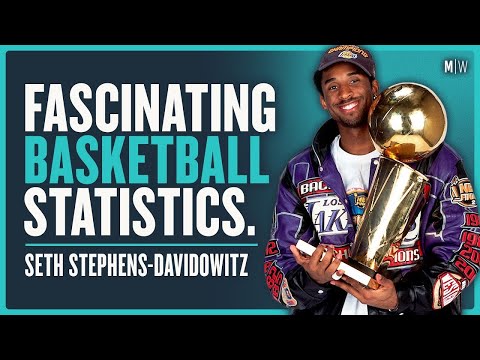
The Hidden Statistics That Control The NBA - Seth Stephens-Davidowitz
Chris Williamson (host), Seth Stephens-Davidowitz (guest)
In this episode of Modern Wisdom, featuring Chris Williamson and Seth Stephens-Davidowitz, The Hidden Statistics That Control The NBA - Seth Stephens-Davidowitz explores how Hidden Genetics and Data Shape Who Actually Makes the NBA Seth Stephens‑Davidowitz explains how height, genetics, and overlooked statistics determine who reaches and succeeds in the NBA, arguing that basketball is unusually governed by biological luck. He details how traits like extreme height, hand size, and vertical leap are vastly more predictive than effort alone, and shows how popular narratives about players’ backgrounds often get the data wrong. Using large datasets and AI tools, he uncovers inefficiencies in NBA scouting, from undervalued standing jumps and hand size to the outsized impact of being an ex‑player’s son. The conversation also explores how AI supercharged his research process, what this means for talent, and how much hard work can or cannot overcome genetic limits.
How Hidden Genetics and Data Shape Who Actually Makes the NBA
Seth Stephens‑Davidowitz explains how height, genetics, and overlooked statistics determine who reaches and succeeds in the NBA, arguing that basketball is unusually governed by biological luck. He details how traits like extreme height, hand size, and vertical leap are vastly more predictive than effort alone, and shows how popular narratives about players’ backgrounds often get the data wrong. Using large datasets and AI tools, he uncovers inefficiencies in NBA scouting, from undervalued standing jumps and hand size to the outsized impact of being an ex‑player’s son. The conversation also explores how AI supercharged his research process, what this means for talent, and how much hard work can or cannot overcome genetic limits.
Key Takeaways
Extreme height is both incredibly rare and absurdly rewarded in basketball.
Being seven feet tall is a one‑in‑650,000 trait, yet roughly one in seven seven‑foot men play in the NBA. ...
Get the full analysis with uListen AI
Each extra inch of height massively boosts NBA odds across the spectrum.
Stephens‑Davidowitz finds that roughly every additional inch of height doubles the probability of making the NBA, from sub‑six‑foot guards up through 7‑footers, highlighting how relentlessly the sport rewards being taller.
Get the full analysis with uListen AI
Tall NBA players are often worse pure athletes but still win because of structural advantages.
Data shows taller players jump lower, run slower, shoot worse, and choke more under pressure than shorter NBA players. ...
Get the full analysis with uListen AI
Basketball success is unusually genetic, especially compared with many other sports.
The NBA has an outsized number of identical twin pairs and sons of ex‑players, indicating strong genetic influence on height, wingspan, leaping ability, and speed. ...
Get the full analysis with uListen AI
Scouting commonly misses key traits like standing leap and hand size while overvaluing flashier metrics.
Standing vertical (from no run‑up) predicts rebounds and blocks better than running vertical, yet players with big running jumps but mediocre standing jumps are over‑drafted. ...
Get the full analysis with uListen AI
Contrary to myth, NBA players skew toward more stable, middle‑class, two‑parent backgrounds.
Name data and demographic studies reveal Black NBA players are less likely than the broader Black population to come from single‑parent or impoverished homes and are more likely to have common, mainstream names like Chris or Michael. ...
Get the full analysis with uListen AI
AI tools can compress years of quantitative research into weeks, changing how books get written.
Using ChatGPT’s Data Analysis (formerly Code Interpreter), Stephens‑Davidowitz automated scraping, cleaning, and analyzing NBA datasets, turning a project that once would have taken years into about 30 days—illustrating how AI can remove drudgery and let researchers focus on questions and interpretation.
Get the full analysis with uListen AI
Notable Quotes
“Being seven foot or above is one in 650,000, and about one in seven seven‑footers make the NBA.”
— Seth Stephens‑Davidowitz
“Basketball seems like the sport designed in a lab to rely on genetics.”
— Seth Stephens‑Davidowitz
“If you’re under 5'10", you have about a one in 3.8 million chance of reaching the NBA.”
— Seth Stephens‑Davidowitz
“You shouldn’t be able to reach the top of a sport the way George Muresan did, through a growth hormone disorder.”
— Seth Stephens‑Davidowitz
“Things that used to take me four months now literally take me four hours.”
— Seth Stephens‑Davidowitz, on using ChatGPT’s Data Analysis
Questions Answered in This Episode
If the NBA truly wanted to reduce the role of genetic luck, what rule or structural changes (e.g., rim height, court size) might meaningfully rebalance the game?
Seth Stephens‑Davidowitz explains how height, genetics, and overlooked statistics determine who reaches and succeeds in the NBA, arguing that basketball is unusually governed by biological luck. ...
Get the full analysis with uListen AI
Given the evidence on hand size and standing leap, how should NBA front offices change their scouting and draft evaluation processes?
Get the full analysis with uListen AI
What ethical or practical implications arise when we recognize that some careers are largely gated by genetics rather than effort?
Get the full analysis with uListen AI
How might AI‑driven analysis change how teams identify undervalued players or design player development programs over the next decade?
Get the full analysis with uListen AI
Does knowing that most NBA players come from more stable, middle‑class backgrounds change how we should talk about “basketball as a ticket out” in disadvantaged communities?
Get the full analysis with uListen AI
Transcript Preview
What percentage of seven-footers are in the NBA?
Uh, to the best of our knowledge, it's about one in seven, which is enormous. Uh, Pablo Torres, the first guy who calculated this. I've done a similar calculation. And everyone seems to, uh, unite around this number, around one in seven, which just insane. Is there any other pursuit, glamorous pursuit, where one trait gives you a one in seven chance of reaching the absolute pinnacle of that, uh, field? I don't think so.
Think about all of the- the six and seven people that could have been on an NBA player's wage.
Yeah, they must feel terrible. (laughs)
Dude, you blew it.
I mean, I guess they can... A lot of them are probably playing abroad. Uh, you know, they're- they're probably our basketball players regardless, and make... And having fun, and, you know, make a living playing a game, but they're not getting the NBA wage for sure.
How rare is seven-foot height?
Being seven foot or above is one in 650,000 height.
(laughs) Wow, that is such a genetic lottery.
Yeah, I mean, it's... Yeah, you're basically... I, yeah, I don't think there's any other gene that gives you such a chance of being a famous multimillionaire. (laughs) Uh-
Yeah, that's a good point. What else do you learn about height?
Uh, so one of the things interesting about height is, uh... A- and basketball, is each inch roughly doubles your chances of making the NBA, like throughout the height distribution. So, if you're six foot tall, you have basically twice the chances of becoming an NBA player than if you're 5'11". If you're 6'1", twice the chances than if you're six feet, all the way out to if you're 7'2", you have twice the chance than you're 7'1", like throughout the height distribution. What that means is just there's this enormous difference in probability of reaching the NBA. We said one in seven chance if you're a seven-footer. If you're under 5'10", which is the average height of an American male, you have a one in 3.8 million chance of reaching the NBA.
(laughs)
Like, it's basically impossible. I mean, there are exceptions. Uh, you know, I talk a lot in the book about, uh, one of my favorite players, Muggsy Bogues, 5'3" and played 14 seasons in the NBA. Uh, so it's not impossible, but it's pretty close to impossible and probably not worth putting much energy even trying.
What are the disadvantages of being tall from a player perspective?
There is a... If you look at the tallest humans in history, uh, many of them are over eight feet tall, and just about all of them, it's due to a thyroid disease. Uh, you literally, there's a growth hormone that just overproduces... Uh, the growth ho- hormone is overproduced. There have been, there has been at least one NBA player who got to his height through a thyroid disease. That's George Muresan. Some people might remember him. He was- he also was an actor for a little bit. Uh, and he was... Literally, it was a disease that gave him that height. His parents were average height. And if you're, uh, that, uh, tall just from a disease, you're gonna have all kinds of problems. A lot of the tallest people in history, very few of the tallest people in history even make it past the age of 40. Uh, but I think one of the other things that's interesting is that se- uh, seven-footers or just taller NBA players, in general, are just way worse athletes any way we can measure it. They jump much less high. They're much slower. They're worse shooters. They are... Th- this kind of surprised me. I don't think anybody's shown this before. They're worse in the clutch. They can't handle pressure to the same degree shorter NBA players can. And I think the reason for this is just because the select- the advantage of being tall is so enormous-
Install uListen to search the full transcript and get AI-powered insights
Get Full TranscriptGet more from every podcast
AI summaries, searchable transcripts, and fact-checking. Free forever.
Add to Chrome