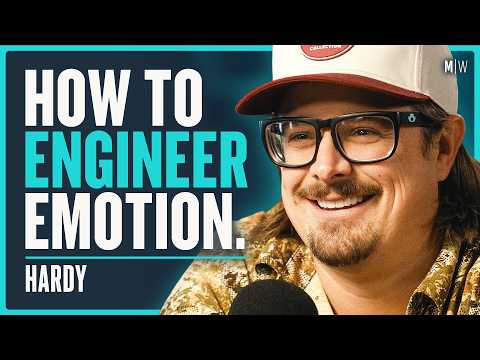
The Personal Pain of Country Music - HARDY (4K)
Chris Williamson (host), HARDY (guest)
In this episode of Modern Wisdom, featuring Chris Williamson and HARDY, The Personal Pain of Country Music - HARDY (4K) explores hARDY on songwriting, dark truth, trauma, and Nashville’s engine-driven creativity HARDY frames his career philosophy as “be nice first, work hard second,” arguing likability and professionalism often outlast pure talent in the music business. He breaks down Nashville’s high-output co-writing culture—hundreds of rooms writing daily—and explains how country’s lyric-first tradition makes it uniquely suited for narrative storytelling and emotional impact.
HARDY on songwriting, dark truth, trauma, and Nashville’s engine-driven creativity
HARDY frames his career philosophy as “be nice first, work hard second,” arguing likability and professionalism often outlast pure talent in the music business. He breaks down Nashville’s high-output co-writing culture—hundreds of rooms writing daily—and explains how country’s lyric-first tradition makes it uniquely suited for narrative storytelling and emotional impact.
He shares a pragmatic view of creativity: ideas live in a long-running notes list, sessions start like normal workdays, and collaboration reduces pressure and unlocks momentum. A major turn in the episode is HARDY’s detailed recounting of a violent tour-bus crash caused by the driver’s undiagnosed brain tumor, followed by delayed trauma processing that surfaced as panic attacks a year later.
The conversation ends on vulnerability and mental health in male artists, the paradox of “flow” (best performances becoming least remembered), and what’s next—touring and the HARDY Fund charity initiative.
Key Takeaways
Being “a good hang” can outpace raw virtuosity.
HARDY prioritizes kindness and room-energy because people avoid talented “assholes” over long timelines; reputation travels faster than credits, and success can falsely appear to be caused by ego rather than merely excusing it.
Get the full analysis with uListen AI
Nashville’s advantage is structured collaboration at massive scale.
He describes a city where hundreds of rooms write simultaneously, with strong work ethic and world-class topliners/storytellers—an ecosystem built around songs first, then records and careers.
Get the full analysis with uListen AI
High-emotion songs can be written in un-romantic, workmanlike settings.
Sessions often begin with small talk and coffee, then idea “pitching” until something sticks; the room may feel ordinary, yet writers knowingly craft lines that will “hammer” listeners emotionally.
Get the full analysis with uListen AI
Country’s storytelling power comes from lyric and vocal dominance.
HARDY agrees the genre is less riff/arrangement-led and more voice/lyric-front, which creates space for plot, character, and “twist” reveals—akin to an M. ...
Get the full analysis with uListen AI
Dark songs often connect faster—and can be easier to write.
He observes that heartbreak, death, and mortality themes attract stronger listener attachment, possibly because people feel less alone in sadness; he also admits upbeat concepts feel harder for him to execute authentically.
Get the full analysis with uListen AI
Trauma may not “arrive” until life slows down or seasons cue it.
After the crash, wedding/CMA week/honeymoon kept him moving, delaying processing; panic attacks emerged roughly a year later, triggered by time-of-year associations and unresolved fear.
Get the full analysis with uListen AI
Targeted therapy can meaningfully “rewire” fear responses.
HARDY credits EMDR and a brain-stimulation-style treatment with reducing the crash from a present threat to a distant memory, enabling him to return to overnight bus touring and regain quality of life.
Get the full analysis with uListen AI
Notable Quotes
“If I put them in order, it would be be nice first and work hard second.”
— HARDY
“Famous jerks are not role models… Being talented is merely how they get away with being a jerk.”
— Chris Williamson (quoting Paul Graham)
“There are probably 300 rooms of people writing songs right now in Nashville, trying to get the next hit.”
— HARDY
“Dark songs tell the truth in a way happy songs can’t.”
— HARDY
“We wrecked because he had a brain tumor he didn’t know about… It ended up killing him about a year later.”
— HARDY
Questions Answered in This Episode
When HARDY says “be nice first,” what specific behaviors does he think separate a “good hang” from someone merely being polite on the surface?
HARDY frames his career philosophy as “be nice first, work hard second,” arguing likability and professionalism often outlast pure talent in the music business. ...
Get the full analysis with uListen AI
In Nashville’s co-writing machine, how are credits and splits typically negotiated, and what does HARDY think outsiders misunderstand about “everyone in the room” getting credit?
He shares a pragmatic view of creativity: ideas live in a long-running notes list, sessions start like normal workdays, and collaboration reduces pressure and unlocks momentum. ...
Get the full analysis with uListen AI
HARDY mentions he can tell by verse/chorus if a song is “for me” or for another artist—what are his decision rules (voice, persona, audience, production lane)?
The conversation ends on vulnerability and mental health in male artists, the paradox of “flow” (best performances becoming least remembered), and what’s next—touring and the HARDY Fund charity initiative.
Get the full analysis with uListen AI
He says he never plays anyone his best stuff until release—how does he balance secrecy with the practical need for feedback and label/team alignment?
Get the full analysis with uListen AI
What makes a “dark” song easier for him to write: clearer stakes, stronger imagery, personal catharsis, or market feedback that rewards intensity?
Get the full analysis with uListen AI
Transcript Preview
Work hard and be nice. Is that basically your career philosophy?
Yeah. Have I said that exact, exactly before? I feel like I have. I, I feel like that's, like, the number one, um... [inhales] You know, honestly, if I put them in order, it would be n- be, be nice first and work hard, uh, second. Not, not, not like, you know, um, don't dismiss working hard, but man, being, being a good hanger, just being somebody that somebody wants in the room will take you so far, I feel like, in, in any, any sort of, any job atmosphere at all.
Why? I, I would've assumed, especially in music, if you're some virtuoso guitarist-
Nobody likes an asshole, dude. It doesn't matter how good you are at something. I, I just... Nobody wants that person in the room, I feel like, and, and, uh, I just... How many times-- I, I cannot tell you how many times I've done podcasts, or we've gotten a VIP tour of something, or we had a driver, you know, in LA or in New York, and then we've been like: "You ever had anybody that was just terrible to work with?" And people just remember that, man, and it's, a lot of times it's people that are, like, really famous and really successful and very talented. And, and there's just-- I know that people like drivers and, you know, people that give Disney World tours and stuff like that are not people that are gonna, uh, you know, help advance your career. But, but I think that transcends stuff like that, and, um, just being nice to people and making, making sure everybody is appreciated and feels comfortable around you, and I just think it's important.
There's a guy called Paul Graham, who's an investor and a writer from the UK, or he lives in the UK now. He's got this great idea: "Famous jerks are not role models. Some talented people are jerks, and this sometimes makes it seem to the inexperienced that being a jerk is part of being talented. It isn't. Being talented is merely how they get away with being a jerk."
Oh, wow, that's really good.
I think it's true.
Yeah, totally, 100%.
The, the success is not because of them being an asshole. The fact that they are successful is how they get away with being an asshole.
Yeah. 100%.
[laughing]
Yeah. It's a para- Would you call it a paradox?
A little bit.
Yeah, yeah, yeah.
Uh, well, it's certainly, uh, it's certainly surprising because it gives people this idea that, oh, ego is where the success has been, like, uh, cultivated from-
Right
... as opposed to the fact that, like, the success gave them this buffer zone where people are, "Oh, I can't be too mean to HARDY 'cause, like, you know, like, look at all the songs he does and stuff. He's a bit of a dick," you know, whatever.
Yeah. Right.
Install uListen to search the full transcript and get AI-powered insights
Get Full TranscriptGet more from every podcast
AI summaries, searchable transcripts, and fact-checking. Free forever.
Add to Chrome