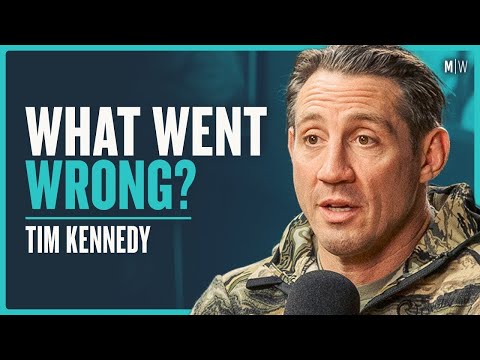
The Dark Truth About The Trump Assassination Attempt - Tim Kennedy
Chris Williamson (host), Tim Kennedy (guest)
In this episode of Modern Wisdom, featuring Chris Williamson and Tim Kennedy, The Dark Truth About The Trump Assassination Attempt - Tim Kennedy explores tim Kennedy Exposes Systemic Security Failures Behind Trump Assassination Attempt Tim Kennedy, a former Green Beret and presidential security professional, dissects the attempted assassination of Donald Trump, arguing it stems from years of organizational decay rather than a one‑day failure.
Tim Kennedy Exposes Systemic Security Failures Behind Trump Assassination Attempt
Tim Kennedy, a former Green Beret and presidential security professional, dissects the attempted assassination of Donald Trump, arguing it stems from years of organizational decay rather than a one‑day failure.
He frames the incident through Occam’s and Hanlon’s razors, suggesting a mix of incompetence and potential malice if leadership knowingly fielded dangerously underqualified teams.
Kennedy details multiple breakdowns: inadequate site surveys, misused or hesitant counter‑snipers, chaotic close‑protection response, and politicized leadership and DEI‑driven hiring that, in his view, prioritized identity over capability.
He concludes that Trump survived largely by luck, warns that nothing meaningful will change before the election, and urges Trump to bring in elite private security while voters reassess how they view both Trump and U.S. security institutions.
Key Takeaways
The failure was systemic, not just a bad day on the ground.
Kennedy insists you must look back several years at leadership appointments, hiring pipelines, training standards, and policy changes across DHS and Secret Service to understand how such an obvious threat position was left exploitable.
Get the full analysis with uListen AI
An obvious, low‑difficulty threat position was known and not neutralized.
The shooter used a fixed ladder to access a roof 150–151 yards from the podium—well within standard small‑arms range and clearly visible—yet crowd warnings went unacted upon for minutes and no preemptive control of that position occurred.
Get the full analysis with uListen AI
Counter‑sniper teams appeared hesitant, under‑experienced, and poorly conditioned for real gunfire.
Kennedy describes their body language—coming off glass, flinching at shots, delayed engagement—as indicative of shooters who likely lacked combat experience and confidence in using their delegated authority to engage a suspected threat early.
Get the full analysis with uListen AI
Close protection around Trump failed core fundamentals of their job.
He argues that once a round struck Trump, the detail had already failed, and then compounded it with chaotic exfiltration, agents unable to move a very large principal efficiently, poor firearm handling, and some agents visibly using Trump as cover rather than shielding him.
Get the full analysis with uListen AI
Kennedy blames DEI‑driven and lowered standards hiring for degraded capability.
He differentiates between competent women he’s worked with and what he calls a policy problem: selection standards (fitness, speed, load‑bearing) scaled down by gender and diversity targets prioritized over raw competence, which he sees as lethal in high‑risk roles.
Get the full analysis with uListen AI
Leadership and investigative bodies are conflicted and unlikely to self‑correct.
With the same DHS and Secret Service heads in place, and the FBI (which recently raided Trump’s home) leading the investigation into an attempt on Biden’s electoral opponent, Kennedy expects no serious institutional reform before the election.
Get the full analysis with uListen AI
Trump’s personal reaction may shift public perceptions of his character.
Both Kennedy and Williamson emphasize that Trump’s response—standing up, fist raised with blood on his face, continuing his schedule—signals unusual resilience and courage, potentially altering how even skeptics view him as a leader under fire.
Get the full analysis with uListen AI
Notable Quotes
“The only reason that that man is not dead is because his head, at the very last second, changed a few degrees and a bullet went past his ear instead of hitting his temple.”
— Tim Kennedy
“If they are knowingly aware about how dangerously inept they are, we then move into the malice category. Then we move into the complicit category.”
— Tim Kennedy
“A nine‑year‑old can make that shot. Every single Texas kid that’s hunted out of a blind can make that 150‑yard shot.”
— Tim Kennedy
“Their job is to be bullet magnets. Their job is to absorb any threat… literally becoming a human shield around the principal. They failed.”
— Tim Kennedy
“There is no more costly signal than after you’ve just been shot, how you respond after that… it’s very difficult to deny that that guy is built different.”
— Chris Williamson
Questions Answered in This Episode
To what extent is Kennedy’s critique about DEI and standards supported by broader data across law enforcement and protective services, versus being anecdotal or politically colored?
Tim Kennedy, a former Green Beret and presidential security professional, dissects the attempted assassination of Donald Trump, arguing it stems from years of organizational decay rather than a one‑day failure.
Get the full analysis with uListen AI
Could clearer, less ambiguous rules of engagement for counter‑snipers have prevented hesitation and enabled an earlier shot on the assailant, or would that create an unacceptable risk of wrongful killings?
He frames the incident through Occam’s and Hanlon’s razors, suggesting a mix of incompetence and potential malice if leadership knowingly fielded dangerously underqualified teams.
Get the full analysis with uListen AI
How should security details balance civil liberties (e.g., not locking down every rooftop in a town) with the near‑zero‑risk expectations around protecting high‑value political figures?
Kennedy details multiple breakdowns: inadequate site surveys, misused or hesitant counter‑snipers, chaotic close‑protection response, and politicized leadership and DEI‑driven hiring that, in his view, prioritized identity over capability.
Get the full analysis with uListen AI
What governance or oversight mechanisms could realistically depoliticize investigations into attacks on political leaders when agencies like the FBI and DOJ already have partisan baggage?
He concludes that Trump survived largely by luck, warns that nothing meaningful will change before the election, and urges Trump to bring in elite private security while voters reassess how they view both Trump and U. ...
Get the full analysis with uListen AI
If Trump brings in elite private security, how will that integrate—or clash—with existing Secret Service roles, authority, and command structures at future events?
Get the full analysis with uListen AI
Transcript Preview
Busy weekend. (laughs) Busy, busy weekend. Talk to me. How did this happen?
I mean, I think, uh, I think it's the worst and scariest answer possible, which, which is, like, a balance of Occam's razor and Halen's razor. Um, the, the first is so obvious about, you know, basically looking for the most simplest solution and the evidence supporting that, and not looking for anything further than that. Which leads us into Halen's razor, which is, um, never attribute something to malice when it can be explained with stupidity. And, um, if I go back... I, I don't wanna start on Saturday, because I think that grossly misrepresents the problem. We have to go back three years and start looking at what has happened organizationally, what has happened with personnel selection, what has happened with training, what has happened with requirements, um, what's happened with authorities, with authorizations, what's happening with the, the overall labor force within that specific organization, um, the government as a whole, Department of Homeland Security as a whole. Who are the appointees? Who did the appointees then appoint? And then when you take that big, huge picture and you then look at the actions on Saturday, which clearly had inept, negligent, incompetent, stupid people that did a, a abhorrent, dangerous job of doing the one thing, which is keeping their principal alive. They did nothing. There was... The only reason that that man is not dead, that the former President Trump is not dead, is because his head, at the very last second, changed a few degrees and a bullet went past his ear instead of hitting his temple and taking out the back portion of his brain, which is not survivable. That is nothing that anyone else did. That was divine intervention or President Trump's luck.
Jesus Christ. You've worked presidential details before as well, right?
Yeah.
So, you know... They, uh... For the people who don't know, in what you might consider a more golden era, one that was more competent, just how thorough is the process for this stuff?
So, what's supposed to be is that this is the most premier security detail on the planet. This is, this is the standard that everybody looks to. The competence, the selection, the training, the personnel, um, they, they have to be. Because this is the leader of the free world. That is who the American president is. And I'm gonna talk about the position, not about any specific president. 'Cause this is not a partisan issue. You know, if you look, there, there have been, um, a total of 10, uh, sui- uh, assassinations or assassination attempts on former presidents, and 60% of them were Republican, four bu- 40% of them were Democrat. So like, it's not a partisan issue. Uh, like are... I had a whole bunch of friends like, "Yo, why is it always Republicans getting assassinated?" It's like, like, I mean, it's not always. You know, it's, it's, um, it's, it's a dangerous rhetoric, and it's an, a dangerous idea, and it's a social contagion, this thing that is hate, when it moves into discourse that is directed in a very unh- unhealthy way. Um, so if we created this, like, spectrum, this continuum on, this Halen's razor, uh, on one side, we have this complete negligent, stupid, incompetent, inept, uh, ignorant, just unable to do the capa- the, the job, which is being a- c- able to be capable to protect somebody. And then on the opposite end of the spectrum, on the, the, the op- the total other end from just being stupid-
Install uListen to search the full transcript and get AI-powered insights
Get Full TranscriptGet more from every podcast
AI summaries, searchable transcripts, and fact-checking. Free forever.
Add to Chrome