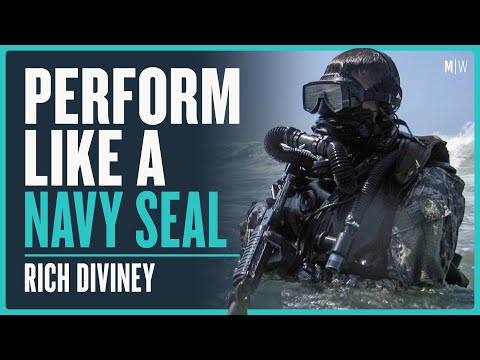
Perform Like A Navy Seal - Rich Diviney | Modern Wisdom Podcast 354
Rich Diviney (guest), Chris Williamson (host), Narrator, Narrator
In this episode of Modern Wisdom, featuring Rich Diviney and Chris Williamson, Perform Like A Navy Seal - Rich Diviney | Modern Wisdom Podcast 354 explores navy SEAL Secrets: Attributes, Stress Mastery, And Truly Optimal Performance Rich Diviney, former Navy SEAL officer and author of *The Attributes*, explains how special operations training reveals the innate qualities that drive human performance under extreme stress and uncertainty. He distinguishes between skills and attributes, and between peak performance (short, planned apexes) and optimal performance (doing the best you can across changing conditions).
Navy SEAL Secrets: Attributes, Stress Mastery, And Truly Optimal Performance
Rich Diviney, former Navy SEAL officer and author of *The Attributes*, explains how special operations training reveals the innate qualities that drive human performance under extreme stress and uncertainty. He distinguishes between skills and attributes, and between peak performance (short, planned apexes) and optimal performance (doing the best you can across changing conditions).
Diviney shares practical methods for regulating the nervous system—shifting between sympathetic and parasympathetic states through breathing, visualization, gaze control, music, and environmental triggers—to recover faster and perform better in everyday life. He also unpacks key attributes such as grit, adaptability, decisiveness, courage, humor, and discipline, emphasizing that they are partly innate but can be deliberately developed through exposure to discomfort and self-awareness.
Throughout, he draws parallels between combat and civilian contexts—presentations, tough workdays, or relationship struggles—showing how the same mental frameworks and micro-strategies used by SEALs can help anyone navigate stress, make better decisions, and sustain high performance without burning out.
Key Takeaways
Focus less on peak performance and more on optimal performance.
Peak performance is a short, planned apex (like game day); optimal performance is doing the best you can in the moment, whether that looks smooth and ‘flowy’ or gritty and ugly. ...
Get the full analysis with uListen AI
Skills get you started; attributes keep you going under pressure.
Skills are teachable, visible, and work well in known conditions, but they often fail when things become volatile and uncertain. ...
Get the full analysis with uListen AI
You can deliberately shift your body from stress to recovery.
Techniques like open-gaze (softening your focus and noticing peripheral vision), CO₂ blowout breathing (e. ...
Get the full analysis with uListen AI
Break fear into anxiety plus uncertainty and tackle each part.
Fear arises from the combination of internal anxiety and external uncertainty; you can lower anxiety with internal tools (breathing, gaze, self-regulation), then reduce uncertainty by asking, “What about this do I understand? ...
Get the full analysis with uListen AI
Attributes can be trained, but only through targeted, uncomfortable exposure.
You can’t learn patience, courage, or adaptability from a book; you have to place yourself in situations that demand them—like starting conversations if you’re socially anxious, tolerating queues if you’re impatient, or traveling with minimal planning if you dislike uncertainty. ...
Get the full analysis with uListen AI
Humor is a serious performance tool, not just a nicety.
Laughter is involuntary and automatically releases dopamine, endorphins, and oxytocin, which reduce pain, increase bonding, and can even act as a shortcut to courage. ...
Get the full analysis with uListen AI
Differentiate between discipline and self-discipline to avoid rigidity.
Self-discipline is sticking to internally controlled goals (diet, workouts) where the world can’t really interfere, whereas discipline applies to longer-term goals where the environment constantly disrupts you. ...
Get the full analysis with uListen AI
Notable Quotes
“It's very difficult, if not impossible, to apply a known skill to an unknown environment.”
— Rich Diviney
“Optimal performance is doing the very best you can in the moment, whatever the best looks like in that moment.”
— Rich Diviney
“We don’t rise to the level of our skills; we fall to the level of our attributes.”
— Chris Williamson, paraphrasing and extending Diviney’s framework
“Whenever you go to achieve a long-term objective that the external world has a say in, throw routine out the window.”
— Rich Diviney
“Humor is a hack into courage.”
— Rich Diviney
Questions Answered in This Episode
If I mapped my own attributes like “dimmer switches,” which ones are clearly low, and what specific situations could I deliberately step into to train them?
Rich Diviney, former Navy SEAL officer and author of *The Attributes*, explains how special operations training reveals the innate qualities that drive human performance under extreme stress and uncertainty. ...
Get the full analysis with uListen AI
How might my obsession with routine or self-discipline actually be limiting my ability to pursue big, unpredictable goals?
Diviney shares practical methods for regulating the nervous system—shifting between sympathetic and parasympathetic states through breathing, visualization, gaze control, music, and environmental triggers—to recover faster and perform better in everyday life. ...
Get the full analysis with uListen AI
In my daily life, what are the predictable stress transitions—like commute home or pre-presentation—and which of Diviney’s tools (breathing, open gaze, visualization, music) could I ritualize there?
Throughout, he draws parallels between combat and civilian contexts—presentations, tough workdays, or relationship struggles—showing how the same mental frameworks and micro-strategies used by SEALs can help anyone navigate stress, make better decisions, and sustain high performance without burning out.
Get the full analysis with uListen AI
Where in my work or relationships do I confuse peak performance with optimal performance, and how could redefining success help me avoid burnout?
Get the full analysis with uListen AI
Do the people I spend the most time with help me be more courageous, adaptable, and humorous under stress—or do they amplify my fear and rigidity?
Get the full analysis with uListen AI
Transcript Preview
Whenever you go to achieve a long-term objective that the external world has a say in, throw routine out the window, 'cause the world is going to hit you with punches all the time. You're going to have to break routine, right? This is why the- some of the highly, highly, highly self-disciplined people sometimes have trouble achieving long-term things, because it's hard for them to break routine, right? (wind blowing) Rich Diviney, welcome to the show. How are you, my friend? It's good to be here. Thanks for having me. You are a fucking badass, man. You did BUD/S at 22 years old, the SEAL team selection. That's right. That's right. Um, but I'm not as badass as some guys. I had an 18-year-old in my class. I mean, you know, so, I mean, I went through as an officer, so I went through four years of college and then, and then went to BUD/S. And so, but we had, we had, uh, we had guys who had just gotten out of high school, they wanted to join the Navy, and, um, and they were 18. I had one 18-year-old dude who was in my class, and this guy was ... He was one of the fastest runners you've ever seen. I mean, he was a freak. And he was a smoker, like an avid smoker. And I remember he'd like be puffing a cigarette and then we would have to go for a run, and he'd beat us all on the run. I mean, but he, uh, he was just that f- at, at one point, and I don't want to get gross right at the beginning of our show here, but, um, we were running on the beach as a class, right? And he had to go to the bathroom really bad. So he figured he'd just sprint ahead as, you know, be- ahead of the class, run into the ocean, 'cause it was on the beach, go to the bathroom, and then, and then as the class passed, he caught, he, he got back with us, right? That's how fast he was. He was just ridiculous. But 18 years old, unbelievable. Is that the youngest that you can do that? Yeah, because, uh, because in the, in the States, you have to be a high- at least a high school graduate or have a high school degree or diploma. And that's usually around 17, 18 years old, and then you can go and ... And, and then, and then if you join the Navy right after high school, say you're 17, you go through your regular Navy boot camp and stuff. So by the time you hit the beaches of SEAL training, you're, you're 18. But that's still, that's just still insane, so ... You can have those kids in America, though, the ones that jump ahead a few years. You've got some child prodigy chess grandmaster that decides he wants to be in the SEALs at age 14 or something like that. That might happen in future. We'll wait- we'll see. It might. I would, I would assume if, if someone's that far ahead academically, the SEAL teams or the military- (laughs) ... is not their first choice. So, uh, I don't know if that's going to happen, but, uh ... So what's it like? You're 22 years old, so you know, you're with someone who's 18. What's that like being, going through something that grown men with hardened military experience for a lot of time, more life experience, more emotional stability, so on and so forth, what's that feel like? Were there any interesting lessons, do you think, from doing it so young? Well, you know, it's interesting. I think, I, and I'm, I don't know the exact... There's an age limit. In other words, you c- you can't be any older than, I think, 29 or 30 if you want to be a SEAL. Now, I think that has to do with some, some of the, just the physical aspects of it. I mean, it literally breaks your body down. You have to be young to do that because you're just bursting with testo- you know. I mean, there's a, in SEAL training, you do obstacle courses, right? And there's an obstacle course there with a bunch of high obstacles, you climb up and do stuff. There's one obstacle called the Slide for Life, and it's about a, it's a four-story tower that you climb up to the top of, and then connecting the, at the top of that tower, there's a rope that goes all the way down, uh, about 100 to 150 yards down to the, to the sand, right? And you're supposed to climb on top of that rope and then slide down that rope to get down off that four-story tower. It's called the Slide for Life. And of course, someone like me who hates heights, it's always, it's, it's tough to do. You just have to focus and do it. Anyway, there was a dude in my class, I remember, who jumped on the rope at the top of the tower, slid down only a co- a couple feet, and then fell off the, fell off the rope and f- fell like almost four stories into the stance, into the sand, right? And this dude's like, he, you, and we're like, "Holy, holy crap, what just happened?" And it's like 10 seconds or so. He gets up and then brushes himself off and then keeps going. You can't do that when you're (laughs) you can, you can, that can, you can only do that when you're young, because your body just is so resilient. And so, so one, so I think one piece is that you have to be young because of just the physicality of it. Um, I think, uh, you know, the SEAL teams and special operations holistically, um, thrive on members who can think through things, can, uh, can, can, um, can, uh, utilize some experience and, and some knowledge and kind of apply that to problem solutions. So, so going through the training young like that is actually, I think, necessary, 'cause you kind of get through that crucible that sees if you have these innate qualities, and then you go to a team, and then you're just a learner. I mean, you're a new guy for a while. And, and so you're surrounded now by experienced dudes who, whereas they may not be as physically, uh, resilient as you are at that age, you're still, they're the guys you're listening to. And so I think, um, I think that was the lesson. You, it was kind of do this upfront. I mean, you certainly get bonded with people. I mean, at 22 and 18, they're not too much different, uh, you know, age-wise, you know. But, um, uh, but you get bonded, you start learning about people. You get, you, you form this bond of people, uh, with people who just go through the shared experience. And of course, that experience, whether it's the people in your SEAL training class specifically or guys who've been through, you know, 20, 30 years ago, right, you all have that commonality. I'll, I'll talk to guys who went through, they were SEALs in the '50s or '60s, you know, and we can talk, and we joke about the same stuff, because we've all been through that. And even now, I'm the old guy, right, 'cause I went through in, in the mid-'90s. Now you got the new guys. I'll talk to SEALs today, you know, currently, and they've just been through training, and we can bond, because we've been through the same... That shared experience is the common denominator, which is really cool. It seems to me, learning a little bit about you, that y- based on what I knew about the SEALs, I knew that the guys were really, really smart, but it seems like you were very well-read as a kid, you were doing visualization and manifestation and stuff. That didn't strike me as the sort of person whose first port of call would be to go into the SEAL team. Is that- Well, yeah. Is that wrong from me? Is that, is it, is it common for someone who's, who's got these sort of academic inclinations to do that?Well, you have a mixture. I mean, again, th- I don't think there are any dumb guys. I mean, we, we would joke. I would, you know, of course, as, as brothers in arms, we would call some of our members dumb, right? But, but you had a, you had the, you had a kind of a, a, a, a spread. I would say, though, that Spec Ops guys tend to trend towards the more intellectual, well-read kind of, uh, guys who just kind of think differently. Because again, the job of Special Operations, I, I always said that, you know, the, the Navy SEALs and that job is not like the movies and the TV shows. It's not like a bunch of door-kicking folks who just run in and shoot guns and all that stuff. They're, uh, they're masters at skydiving. The job is really to be a master of uncertainty. It's to be able to drop into an environment that's deeply uncertain, unknown, volatile. So in the military, you call it VUCA, V-U-C-A, vu- uh, volatile, volatile, uncertain, complex, ambiguous environments. So VUCA environments, right? The job of a SEAL is to drop into those and immediately start performing, right? And so to do that requires a level of A, uh, well, an ability to calm oneself and think through uncertainty, challenge, and stress, but also a level of, um, of knowledge and experience to be able to, uh, or open-mindedness or whatever you call it, to be able to say, okay, what can I apply to this environment? And that takes a lot of learning. I mean, I, there were, th- you know, because it's so hard to get to SEAL training in the first place, um, and the officer path is, is even more competitive than the enlisted path, I had guys in my class... There was one guy in my class, he wa- he had a, a, a college degree in rocket science, um, and he co- he, he enlisted in the Navy to become a SEAL, right? So, um, so yeah, very intelligent guys, mostly. Um, they (laughs) , there are, there are some, some of those just big dumb guys who you, you have carry the big weapons, you know, and we love them too, but, uh, and we, we, we'd tease them all the time. Um, but, uh, but for the most part, yeah, a more, a more intelligent force i- i- you'll find in, in any Spec Op- Special Operations, w- the Navy SEALs, the Army, or even in the, um, in the UK, SBS, SAS tr- uh, I mean, it's amazing. We work with those guys all the time and we're so similar, right? Because it's just, i- it attracts this type of mindset, which is, um, I think a little bit more deep, deep thinking.
Install uListen to search the full transcript and get AI-powered insights
Get Full TranscriptGet more from every podcast
AI summaries, searchable transcripts, and fact-checking. Free forever.
Add to Chrome