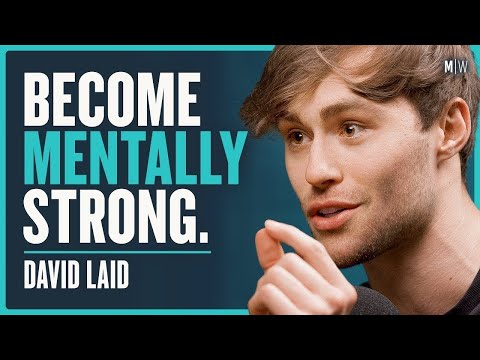
Why Most Jacked Guys Are Still Insecure - David Laid
David Laid (guest), Chris Williamson (host)
In this episode of Modern Wisdom, featuring David Laid and Chris Williamson, Why Most Jacked Guys Are Still Insecure - David Laid explores from Aesthetic Bro To Self-Aware Man: David Laid Evolves Chris Williamson and David Laid explore David’s journey from insecure, hyper-aesthetic teenage bodybuilder to a more introspective, self-aware 25-year-old questioning ego, masculinity, and meaning.
From Aesthetic Bro To Self-Aware Man: David Laid Evolves
Chris Williamson and David Laid explore David’s journey from insecure, hyper-aesthetic teenage bodybuilder to a more introspective, self-aware 25-year-old questioning ego, masculinity, and meaning.
Laid details how early body dysmorphia, social media validation, and extreme training led to spinal injuries and psychological strain, which eventually forced him into deep introspection and value realignment.
They contrast prescriptive self-help and “monk mode” with genuine inner transformation, emphasizing sitting with discomfort, reprogramming desires, and recognizing how even socially rewarded success can still be ego-slavery.
The conversation broadens into male role models, the crisis of modern masculinity, online dating culture, and how to build a firm internal foundation that outlasts looks, status, and material success.
Key Takeaways
Validation built on physique and aesthetics easily mutates into body dysmorphia.
Laid describes how chasing perfect lighting, angles, and leanness for social media amplified his insecurities, making him feel small and inadequate in normal life despite being objectively muscular.
Get the full analysis with uListen AI
Prescriptive self-help routines can become another ego trap instead of true healing.
He found that obsessing over yoga, meditation, and habit checklists gave dopamine hits but didn’t resolve underlying distress; genuine change came from honestly sitting with discomfort without an agenda.
Get the full analysis with uListen AI
You can switch obsessions without actually fixing the underlying ego problem.
They argue that trading materialism for extreme monk mode or spiritual tourism still keeps you a “slave to an egotistical construction” if the real motivation is moral superiority or self-image.
Get the full analysis with uListen AI
Deep transformation often follows rock-bottom experiences that shatter old identities.
Laid’s crippling back injury forced him to abandon reckless, ego-driven training; the pain became so great that changing his mindset was preferable to holding onto his previous ‘hardcore’ identity.
Get the full analysis with uListen AI
Reprogramming your desires—deciding what you want to want—is crucial for autonomy.
Drawing on the idea that unexamined wants make you a ‘rich, successful slave,’ they discuss consciously choosing values (truth, competence, contribution) rather than blindly following status, looks, or money.
Get the full analysis with uListen AI
Modern masculinity is destabilized by weak role models and online extremity.
With fractured families and rapidly changing norms, many young men seek male role models online (from Zyzz to Jordan Peterson), often absorbing polarized or prescriptive ideologies instead of developing grounded self-knowledge.
Get the full analysis with uListen AI
Real-world experience should trump over-optimized ‘prescriptions’—especially in dating.
They criticize heavily scripted pickup and red-pill tactics, arguing that excessive rules suppress natural chemistry; spending time with real people and letting instincts operate leads to healthier interactions.
Get the full analysis with uListen AI
Notable Quotes
“Fundamentally, you're a slave to an egotistical construction with either one. And the goal is to transcend that, even though your egotistical construction that you're feeding is societally rewarded.”
— Chris Williamson (paraphrasing and building on David Laid)
“It hit a point where the back pain was so debilitating that I would rather kill my previous ego and start from scratch than maintain that ego and tolerate the back pain.”
— David Laid
“You can switch one type of obsession for another type of obsession and it does not necessarily mean that that obsession is more holistic.”
— Chris Williamson
“If you don’t go in and program your desires, the best thing that you can hope for is to be a rich, successful or famous slave.”
— Chris Williamson (quoting and summarizing Kai Leshenroeder)
“The person that you are is what subcommunicates at the highest level to people.”
— David Laid
Questions Answered in This Episode
How can someone practically distinguish between healthy self-improvement and ego-driven obsession in their own life?
Chris Williamson and David Laid explore David’s journey from insecure, hyper-aesthetic teenage bodybuilder to a more introspective, self-aware 25-year-old questioning ego, masculinity, and meaning.
Get the full analysis with uListen AI
If prescriptive routines can become ego traps, what does an authentic, non-prescriptive approach to healing and growth actually look like day to day?
Laid details how early body dysmorphia, social media validation, and extreme training led to spinal injuries and psychological strain, which eventually forced him into deep introspection and value realignment.
Get the full analysis with uListen AI
How should young men today balance the drive for status, money, and aesthetics with building a deeper inner foundation that will still matter at 50 or 70?
They contrast prescriptive self-help and “monk mode” with genuine inner transformation, emphasizing sitting with discomfort, reprogramming desires, and recognizing how even socially rewarded success can still be ego-slavery.
Get the full analysis with uListen AI
What concrete steps can someone take to ‘reprogram what they want to want’ instead of being driven by societal conditioning and unresolved trauma?
The conversation broadens into male role models, the crisis of modern masculinity, online dating culture, and how to build a firm internal foundation that outlasts looks, status, and material success.
Get the full analysis with uListen AI
In a world dominated by online dating and red-pill content, how can men rebuild organic social skills and healthier attitudes toward dating and relationships?
Get the full analysis with uListen AI
Transcript Preview
... the most important thing is realizing that fundamentally, you're a slave to an egotistical construction with either one. And the goal is to transcend that, even though your egotistical construction that you're feeding is societally rewarded, right? So, that's a trap that you could really, really fall into. So, the key is, you need to go a little lower than that. (wind blows)
We are both fans of Charlie Houpert, and he says that when somebody asks you, "What do you do?"
Mm-hmm.
You have the opportunity to hook lots of different things in. So, if someone was to ask you, "Why do you do what you do?"
Mm-hmm.
What's the single thread that ties together all of the things that you do? What would you say there?
Hmm. That's interesting. I feel like there's been, like, an evolution, like, throughout that, because ... Just what I do, I guess, it's, like, changed, like, over time, because, like, now, like, broadly speaking, like, on the surface, like, I make, like, YouTube, like, fitness-oriented videos. But I think that started when I was, like, 13 or 14 years old. Like, I got into, like, weightlifting, and then I took a lot of pictures of my progress, made a transformation video that ended up going viral. And then I just, like, started making a YouTube channel just with, like, my friends in the gym, just making random videos of working out. And then, I guess, I started being more interested in making cinematic-ish, like, content, and just making it more, like, I don't know, sophisticated, like, higher quality, like, et cetera, like, more artistic. And, yeah, I guess, I just enjoy making videos that I just, like, enjoy making.
Do you wish, sometimes, that your entrance into the world of virality, social media, YouTube, hadn't been so tightly defined based on the way that you look, the gym? Or, do you, like, integrate that as part of your history perfectly fine?
I'd say so. I mean, I'd say at an earlier point, maybe, like, years and years and years ago, it was to the point where there was like, a, like, I guess, a slight, like, toxicity component to it, because the whole reason that I got into working out was because of, like, very, like, generic stereotypical insecurities, just being, like, extremely skinny, feeling all that. And then, as I started getting more and more progress in the gym, and then that obviously gave me, like, a self-esteem boost. I felt a lot better about myself, and then I would, like, take pictures. And then, obviously, when people take pictures, oftentimes they just want to, like, maximize it to get it, you know, the best lighting angles, et cetera. And then I got to a point where, maybe, like, a few years into working out where I had g- just a decent bit enough of muscle to get pictures that look, like, semi-decent, right? But not in those pictures, like, in real life, like without, like, a pump or whatever. I remember just, like, feeling, like, still, like, very, like, just, like, skinny and insecure. And then it was, like, a problem because even, say, like, my senior year in high school, I remember I would just wear hoodies just all the time, because if you're wearing, like, a big baggy hoodie, you can't, like, exactly tell, like, like, the size of an individual.
Install uListen to search the full transcript and get AI-powered insights
Get Full TranscriptGet more from every podcast
AI summaries, searchable transcripts, and fact-checking. Free forever.
Add to Chrome