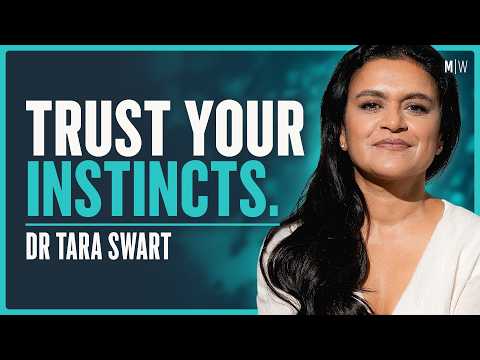
Signs From the Body You Should Never Ignore - Dr Tara Swart
Chris Williamson (host), Dr Tara Swart (guest)
In this episode of Modern Wisdom, featuring Chris Williamson and Dr Tara Swart, Signs From the Body You Should Never Ignore - Dr Tara Swart explores reclaiming Intuition: How Body, Brain, And Gut Guide Decisions Chris Williamson and neuroscientist Dr. Tara Swart explore why modern life overvalues logic while undervaluing intuition, emotion, and bodily signals, and why those "soft" capacities may become superpowers in an AI-driven world.
Reclaiming Intuition: How Body, Brain, And Gut Guide Decisions
Chris Williamson and neuroscientist Dr. Tara Swart explore why modern life overvalues logic while undervaluing intuition, emotion, and bodily signals, and why those "soft" capacities may become superpowers in an AI-driven world.
Swart explains the neuroscience of intuition, distinguishing it from instinct and anxiety, and shows how patterns from lived experience are stored not only in the brain but also in the gut, fascia, and muscles via mechanisms like serotonin and inflammation.
They discuss how stress, loneliness, and poor gut health impair decision-making and intuitive access, and how journaling, embodiment practices, relationships, and diet can strengthen trust in one’s inner signals.
The conversation broadens into near‑spiritual territory—signs, synchronicities, and the limits of scientific rigor—arguing that some subjectively useful phenomena may be worth trusting even before science can fully explain them.
Key Takeaways
Treat intuition as pattern recognition, not magic.
Swart defines intuition as judgment based on deeply stored life patterns—an aggregate of experiences held in the limbic system, gut, and even bodily tissues—so it should be used alongside logic rather than dismissed as irrational.
Get the full analysis with uListen AI
Distinguish intuition from instinct and anxiety.
Instinct and anxiety are often loss-avoidant and change-averse, pushing you to stay safe; intuition tends to point toward growth, and often feels like being both nervous and excited, especially before meaningful opportunities.
Get the full analysis with uListen AI
Support your gut to sharpen your judgment.
Because about 95% of serotonin is produced outside the brain and the gut–microbiome system strongly influences mood and cognition, diverse plant foods, fiber, fermented foods, and possibly targeted probiotics can improve clarity and intuitive access.
Get the full analysis with uListen AI
Reduce chronic stress to avoid ‘low-power mode’ in the brain.
Prolonged cortisol elevation causes inflammation, dehydrates the brain, redirects blood flow away from higher cognitive functions, and erodes immunity—leading to brain fog and poorer decisions; stress management, hydration, magnesium, and sleep are essential.
Get the full analysis with uListen AI
Use journaling to build a data set on your own intuition.
Recording decisions, whether you followed your gut, and how outcomes unfolded—then re-reading entries—reveals repeating patterns, where you ignored red flags, and where intuition served you, gradually building trust in inner signals.
Get the full analysis with uListen AI
Curate relationships that validate (not ridicule) your inner voice.
Psychological safety from friends or partners who respect your gut feelings, challenge you constructively, and avoid “tall poppy” negativity makes it easier to take healthy risks and strengthens confidence in intuitive decisions.
Get the full analysis with uListen AI
Start small: practice intuition on low-stakes choices first.
For highly rational or risk-averse people, beginning with minor decisions where logic and intuition diverge, consciously choosing the intuitive option, and tracking outcomes is a practical way to train this capacity without catastrophic downside.
Get the full analysis with uListen AI
Notable Quotes
“Intuition is wisdom and judgment based on patterns you've picked up through life that are stored deeply in the brain and all the way down to the gut.”
— Dr. Tara Swart
“Your brain will work much harder to stop you losing something than to let you take a healthy risk for a reward.”
— Dr. Tara Swart
“We have this weird sense that we were going to be able to prove the world to us, and now we’re going back to a focus on effectiveness over rigor.”
— Chris Williamson
“When I feel nervous and excited at the same time, that’s been the case just before the biggest successes in my life.”
— Dr. Tara Swart
“Whatever happens, I know that I can roll my sleeves up and deal with it—and I trained myself to be like that.”
— Dr. Tara Swart
Questions Answered in This Episode
How can someone who is highly analytical begin trusting intuition without feeling reckless or unscientific?
Chris Williamson and neuroscientist Dr. ...
Get the full analysis with uListen AI
What practical steps best help differentiate a genuine intuitive nudge from fear, trauma responses, or cognitive bias?
Swart explains the neuroscience of intuition, distinguishing it from instinct and anxiety, and shows how patterns from lived experience are stored not only in the brain but also in the gut, fascia, and muscles via mechanisms like serotonin and inflammation.
Get the full analysis with uListen AI
Given the individuality of the microbiome, how far can we really generalize gut-health advice before it stops being useful?
They discuss how stress, loneliness, and poor gut health impair decision-making and intuitive access, and how journaling, embodiment practices, relationships, and diet can strengthen trust in one’s inner signals.
Get the full analysis with uListen AI
To what extent should we act on ‘signs’ or synchronicities if we know our brain is also wired for pattern-seeking and confirmation bias?
The conversation broadens into near‑spiritual territory—signs, synchronicities, and the limits of scientific rigor—arguing that some subjectively useful phenomena may be worth trusting even before science can fully explain them.
Get the full analysis with uListen AI
How might workplaces and education systems change if intuition, creativity, and emotional literacy were valued as highly as logic and technical skill?
Get the full analysis with uListen AI
Transcript Preview
What do you mean when you talk about trusting our instincts?
I think it's, it's, uh, a return to something quite primal and physical. So I think in, in this modern world, we've, we, we overthink everything, we try to rationalize everything, we prize logic above anything else, and I'm, I'm sort of talking about using intuition as well as logic.
Why do you think it is that we are laying at the feet... Or why, why is it that we're dispensing with sort of the wisdom that comes from instinct? If it's something that is sort of more ingrained, why is that being pushed to a side?
So I think it, it goes back to when the outer cortex of our brain grew from being a sliver around the limbic system, which is the size of, uh, your clenched fist, and that's when we could articulate speech and we could, like, plan better for the future. And so then we sort of prized those things more than the primal instincts that we had relied on before. And then if you fast-forward to much more recently, until about 30 years ago, we didn't have sophisticated scanning technology that could actually show us things like how emotions and intuition work in the brain. So it just, I think, felt safer to rely on something like logic that makes more sense, and then if you also add in the rise of technology, um, it feels like it's counterintuitive but I actually think this is where intuition and emotion and, and creativity and vulnerability are going to become superpowers, whereas, you know, they've sort of been put lower down than logic and rationality.
Why would you say superpowers?
Because I think they're things that technology and AI won't be able to emulate or, you know, actually use in the same way that we can.
Right. Well, I, I always think about this. It's kind of interesting that we had the scientific revolution and, you know, I, I remember when it was early 2000s and I was starting to listen to Christopher Hitchens or Richard Dawkins or d- d- Sam Harris or whatever, and it was very seductive to dispense with wishy-washy mythology and archetype and, uh, you wanted something that felt more rigorous and that you could prove, and, you know, we had this amazing boom in loads of areas of psychology, and, and then 20 years later, the replication crisis has come along and decapitated tons of the studies that we all thought were part of the physics of the human system. And now how many people refer to themselves as an agnostic because they're terrified of calling themselves an atheist? Because it's, it feels sterile. We kind of had this weird sense that we were going to be able to prove the world to us.
Mm-hmm. Mm-hmm.
And, uh, you know, physics has kind of stalled for the last, like, 60 years or so. It hasn't really developed anything that's been that new. And I think people have got this sense that even if stuff can be literally unproven, it can be functionally useful in the same way as, "Ha, well, maybe my gut instinct, I can't give you on a spreadsheet or I, I can't fully dissect why I felt that thing-"
Install uListen to search the full transcript and get AI-powered insights
Get Full TranscriptGet more from every podcast
AI summaries, searchable transcripts, and fact-checking. Free forever.
Add to Chrome