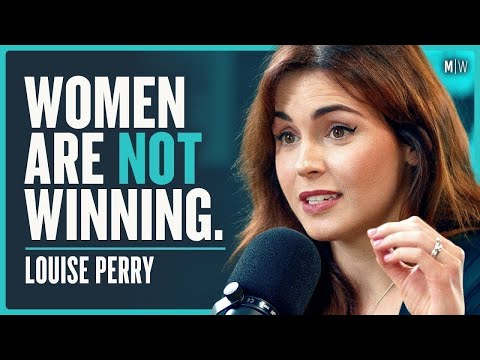
The Absolute State Of Dating Today - Louise Perry (4K)
Chris Williamson (host), Louise Perry (guest)
In this episode of Modern Wisdom, featuring Chris Williamson and Louise Perry, The Absolute State Of Dating Today - Louise Perry (4K) explores louise Perry Dissects Modern Dating, Fertility Collapse, and Sexual Culture Louise Perry and Chris Williamson explore how contraception, changing gender roles, and online culture have radically reshaped sex, dating, and family life in the West.
Louise Perry Dissects Modern Dating, Fertility Collapse, and Sexual Culture
Louise Perry and Chris Williamson explore how contraception, changing gender roles, and online culture have radically reshaped sex, dating, and family life in the West.
Perry argues that the Pill and technological affluence have decoupled sex from reproduction, undermined marriage and fertility, and unintentionally sidelined average men while overburdening women.
They discuss oscillations between sexual permissiveness and prudishness, the psychological and social impact of porn and social media on youth, and the emerging conservative backlash among younger generations.
Throughout, Perry emphasizes trade‑offs: between safety and freedom, equality and complementarity, short‑term pleasure and long‑term flourishing, insisting that human nature and sex differences cannot simply be wished away.
Key Takeaways
Fertility and family norms are heavily mimetic, not fixed by nature.
People copy what they see: when sisters, friends, or peers have children, others are more likely to; when few around you marry or reproduce, lower fertility quickly becomes the ‘normal’ template rather than an aberration.
Get the full analysis with uListen AI
The Pill fundamentally changed sexual incentives and cannot be ‘uninvented.’
By removing pregnancy as the automatic consequence of sex, contraception enabled unprecedented sexual license, weakened marriage’s role as a reproductive institution, and pushed women toward treating sex more like men—at significant physical and psychological cost.
Get the full analysis with uListen AI
Modern sexual culture selects for high-impulse control elites and low-conscientiousness parents.
Those who can resist digital and sexual temptations (high conscientiousness) delay or avoid having children, while more impulsive individuals reproduce more, potentially shifting the population’s psychological traits and political leanings over generations.
Get the full analysis with uListen AI
Women face an inescapable trade‑off between career optimization and higher fertility.
Because pregnancy, birth, breastfeeding, and disproportionate childcare cannot be fully equalized, most women end up either having fewer children than they might prefer or doing a ‘second shift’ at home plus paid work—an arrangement Perry argues is often worse than traditional breadwinner models for the average woman.
Get the full analysis with uListen AI
Consent is too low a bar; we’ve lost language for ‘bad but legal’ sexual behavior.
MeToo focused on consent vs. ...
Get the full analysis with uListen AI
Teen girls’ mental health is uniquely vulnerable to image‑based social media and hormones.
Platforms like Instagram distort girls’ sense of their competition pool by constantly exposing them to curated beauty, while social contagion spreads anorexia, pseudo-Tourette’s, and gender distress; hormonal birth control during adolescence may further elevate anxiety and depression risk.
Get the full analysis with uListen AI
Female rivalry subtly shapes norms around beauty, body positivity, and consumption.
Research Perry and Williamson cite shows women may advise attractive peers to cut their hair shorter and strongly support messages that discourage weight loss in others; expensive beauty, fashion, and cosmetic procedures often function as status and mate‑guarding signals aimed at other women more than men.
Get the full analysis with uListen AI
Notable Quotes
“Traditions are experiments that worked.”
— Louise Perry (quoting an anecdote from a winemaking book)
“There are no solutions, only trade‑offs.”
— Louise Perry (quoting Thomas Sowell)
“It’s a straight line from ‘you should hold the door open for a woman’ to ‘you shouldn’t beat your wife.’”
— Louise Perry
“Any culture that just stops reproducing itself is not gonna last.”
— Louise Perry
“Modern women have been taught that true freedom is having sex like their brother and working like their father.”
— Chris Williamson
Questions Answered in This Episode
If human nature and sex differences are as stubborn as Perry suggests, what realistic policies or cultural norms could increase birth rates without returning to highly coercive patriarchy?
Louise Perry and Chris Williamson explore how contraception, changing gender roles, and online culture have radically reshaped sex, dating, and family life in the West.
Get the full analysis with uListen AI
How should parents balance the clear harms of teen social media use and hormonal birth control against fears of restricting their daughters’ autonomy?
Perry argues that the Pill and technological affluence have decoupled sex from reproduction, undermined marriage and fertility, and unintentionally sidelined average men while overburdening women.
Get the full analysis with uListen AI
Can we revive ideas like chivalry and modesty in a way that protects women without infantilizing them or eroding hard‑won legal equality?
They discuss oscillations between sexual permissiveness and prudishness, the psychological and social impact of porn and social media on youth, and the emerging conservative backlash among younger generations.
Get the full analysis with uListen AI
What would a ‘post–sexual revolution’ dating script look like that’s both honest about risks and still appealing to young men and women?
Throughout, Perry emphasizes trade‑offs: between safety and freedom, equality and complementarity, short‑term pleasure and long‑term flourishing, insisting that human nature and sex differences cannot simply be wished away.
Get the full analysis with uListen AI
How might recognizing female intrasexual competition change the way we think about body positivity, cosmetic surgery, and beauty advertising?
Get the full analysis with uListen AI
Transcript Preview
There's a Wall Street Journal column about marriage as a mirror of human nature that says 40% of young adults say marriage has outlived its usefulness.
Hmm.
What do you think is going on?
I mean, I'm not surprised, 'cause these are young adults who've, like... I think, so I think in London now, and this would be true in lots of parts of the West, um, about half of kids will reach the age of 15 not living with their biological father. Half. So I guess these young people just look around and they're like, "Well, it's, like, evident to me that marriage isn't working." So-
Mary Eberstadt's got this idea about, um, motherhood and family life as a mimetic desire.
Hmm.
That the dearth of mothers and families causes fewer people to see them, which causes fewer people to want them, which causes fewer people to, to, to, to, to, to all the way down.
I think that's definitely true. And you can see that in data actually with, um, like if your sister or your close friend has a baby, you're more likely to have a baby in the year or two following, and vice versa. So if, if the people around you are not having children, you're less likely to have children yourself. I think, and that's, it, I think that's so interesting because there's always been this assumption by demographers up until birth rates started really crashing in recent decades, that people would just spontaneously decide once they had access to contraception or whatever, to have 2.1 kids, that that was, like, the natural settling point for the human species, that we'd all, we'd all reach there and we'd just stay there.
Mm-hmm.
And that's clearly not true, because so many countries now are falling way below replacement. And I think it's because actually there's no law of nature that says that people should want 2.1 kids. People look around them and they're like, "Oh, okay, everyone here has one or zero or six." And then that becomes, as you say, the mimetic desire. I think that becomes what's considered normal. And humans are completely obsessed with what's normal. Which is why I'm just genuinely quite, generally quite skeptical of the idea of, um, of people having this, like, absolute agency or abso- Yeah, I mean, we, we do clearly have, we do clearly have free will. But I think that what we consider to be desirable, normal, the life template is so incredibly dependent on what other people around us think.
Mm.
Um, which is, I think exactly why we've got into this downward spiral in terms of fertility.
There's a... I love your analogy or y- your conception of prudishness and licentiousness, that there's, we kind of flip-flop between the two.
Mm-hmm.
Which one do you think we're in now?
Uh, licentiousness transitioning to prudishness, I think.
Install uListen to search the full transcript and get AI-powered insights
Get Full TranscriptGet more from every podcast
AI summaries, searchable transcripts, and fact-checking. Free forever.
Add to Chrome