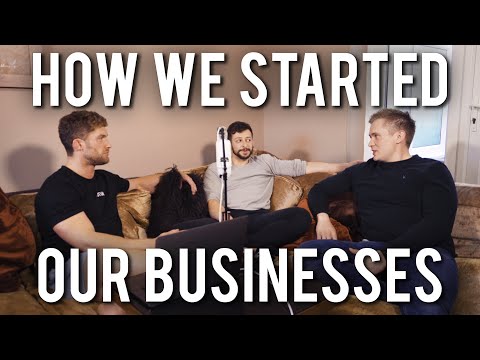
Business Principles 101
Chris Williamson (host), Jonny (guest), Yusef (guest), Guest (guest), Guest (guest)
In this episode of Modern Wisdom, featuring Chris Williamson and Jonny, Business Principles 101 explores from Blunt Truths To Real Tactics: Business Principles That Work Chris Williamson and guests Jonny and Yusef kick off a 'Business Principles 101' series by unpacking their combined 30+ years of hard‑won lessons from running and repeatedly failing at businesses.
From Blunt Truths To Real Tactics: Business Principles That Work
Chris Williamson and guests Jonny and Yusef kick off a 'Business Principles 101' series by unpacking their combined 30+ years of hard‑won lessons from running and repeatedly failing at businesses.
They argue that formal business education is largely useless compared to learning via doing, failing, and solving real problems, emphasizing execution over ideas and starting small rather than risking everything.
The conversation covers how their early ventures (fitness blogs, dropshipping batteries, nightclub promotion) evolved into real businesses through learning marketing, building systems, and gradually delegating.
Underlying everything is the claim that business is essentially professional problem‑solving, and that doing something you’re genuinely obsessed with gives you a massive advantage over those chasing the “entrepreneur” title alone.
Key Takeaways
Execution matters far more than the originality of your idea.
They mock the “sign an NDA before I tell you my idea” mindset, stressing that even simple, obvious ideas (like online retail) can win if executed obsessively well, while ‘genius’ ideas die without action.
Get the full analysis with uListen AI
Start small and avoid betting your entire life on your first business.
They strongly advise against remortgaging your house or putting 50% of your net worth into your first venture; instead, launch with low financial liability, learn in the trenches, and scale only once you understand the moving parts.
Get the full analysis with uListen AI
Treat business as professional problem‑solving and expect “controlled falling.”
They describe entrepreneurship as being pushed down an infinite staircase—every solution creates new problems, and your job is to continually adapt, debug, and refine systems as you go.
Get the full analysis with uListen AI
Learn every layer of your business from the ground up before you delegate.
Chris outlines the ideal path from “flyer boy” to director and emphasizes documenting solutions as you go; that way, when you delegate, you know what “good” looks like and can build reliable processes rather than chaos.
Get the full analysis with uListen AI
Formal business degrees are largely irrelevant; self‑directed learning is not.
All three did business‑related degrees and found the content practically useless for real operations; they recommend learning sales, copywriting, marketing, and systems from practitioners, books, and direct experimentation instead.
Get the full analysis with uListen AI
Passion and genuine interest create an unfair competitive advantage.
Referencing James Clear, Alan Watts, and examples like Steffi Graf, they argue that if work feels like play to you but work to others, you’ll outlast and outperform competitors who are forcing themselves through tasks they hate.
Get the full analysis with uListen AI
A real business works without you; otherwise, you own a fragile job.
Yusef’s and Jonny’s story—being sleep‑deprived, taking calls at 2 a. ...
Get the full analysis with uListen AI
Notable Quotes
“People love the idea of being an entrepreneur or a business owner more than they like the idea of doing business, because they want the title without the graft.”
— Chris Williamson
“If you want to become good at business, a formal education is in no way mandatory.”
— Chris Williamson
“We’re not actually that good at business, but we’ve made 13 years of mistakes that we only made once.”
— Chris Williamson
“If you just do for a living what you find intensely interesting, then immediately you have a massive advantage over everybody else.”
— Jonny (paraphrasing Alan Watts/James Clear ideas)
“If you’ve never run a business before and you’ve put 50% of your net worth into this business… it’s terrifying.”
— Chris Williamson
Questions Answered in This Episode
How can someone practically transition from a full‑time job into a small, low‑risk business without jeopardizing their financial stability?
Chris Williamson and guests Jonny and Yusef kick off a 'Business Principles 101' series by unpacking their combined 30+ years of hard‑won lessons from running and repeatedly failing at businesses.
Get the full analysis with uListen AI
What are the first systems or processes a solo operator should build if they eventually want their business to function without them?
They argue that formal business education is largely useless compared to learning via doing, failing, and solving real problems, emphasizing execution over ideas and starting small rather than risking everything.
Get the full analysis with uListen AI
In today’s crowded online landscape, how should a new creator or coach approach marketing when organic reach is so limited?
The conversation covers how their early ventures (fitness blogs, dropshipping batteries, nightclub promotion) evolved into real businesses through learning marketing, building systems, and gradually delegating.
Get the full analysis with uListen AI
How do you distinguish between necessary perseverance in a struggling business and the point where continuing becomes reckless or negligent?
Underlying everything is the claim that business is essentially professional problem‑solving, and that doing something you’re genuinely obsessed with gives you a massive advantage over those chasing the “entrepreneur” title alone.
Get the full analysis with uListen AI
If you don’t yet know what you’re ‘intensely interested’ in, how can you experiment intelligently to discover a business area that feels like play rather than work?
Get the full analysis with uListen AI
Transcript Preview
Today, we are starting a new series, Business Principles 101.
If you just want to replace your income by doing something you enjoy doing, you could absolutely sell some kind of expertise, or even sell what you're currently doing, but package it in a business.
If you want to become good at business, a formal education is in no way mandatory. People love the idea of being an entrepreneur or a business owner more than they like the idea of doing business.
Mm-hmm.
Because they want the title without the graft. If the title could be attained (snaps fingers) overnight, in that case it's not worth anything, so you shouldn't want it.
I've seen people set up a- a blog or a- a YouTube channel, and really plow money into it and try to get the production quality working, and just get nothing out of it, because you can't rely on organic traffic being a- a thing.
Not anymore, man.
If you just do for a living what you find intensely interesting, then immediately you have a massive advantage over everybody else.
We're not actually that good at business, but we've made 13 years of mistakes that we only made once. I'm joined by none other than Jonny and Yousaf from propanefitness.com.
Oh.
(laughs)
(laughs)
Welcome back, man.
Welcome back.
Welcome back.
Welcome back indeed. Um, today we are starting a new series, Business Principles 101. Uh, we have all had a lot of experience. I've done 13 years of business operating. You've had maybe a decade now?
11, yeah.
11. Jonny, something similar?
Same here.
It's like 30 years of combined running and failing at business between us.
Lots of failing.
Mostly failing.
(laughs)
Um, we are getting quite a lot of requests for advice for entrepreneurship and stuff like that, and I figured the, uh, wealth of experience that we have, both good and bad, could be pretty valuable to people, and there should be some golden stories that come out of this. Also, all of us did business degrees of one sort or another.
Sort of, yeah.
Accounting. What was your actual degree?
Economics.
Was it?
Yeah.
Okay. And then you did ...
Mine was maths and business. Both totally useless as far as application, but we can-
(laughs)
... certainly get into that.
(laughs)
(laughs)
I think something that's really useful as well, of hearing our failings that are to come, is that if you ever want to learn something from someone, I think if you've got a choice between learning from someone who's a natural and just struck lucky first time, compared to someone who was terrible or ma- failed multiple times and grew into a stage that- that you've seen this progression, there's so much more to be learned from that person. Like- like we were saying in Relationships 103, where the guy who's been divorced 15 times knows a lot more about marriage-
Install uListen to search the full transcript and get AI-powered insights
Get Full TranscriptGet more from every podcast
AI summaries, searchable transcripts, and fact-checking. Free forever.
Add to Chrome