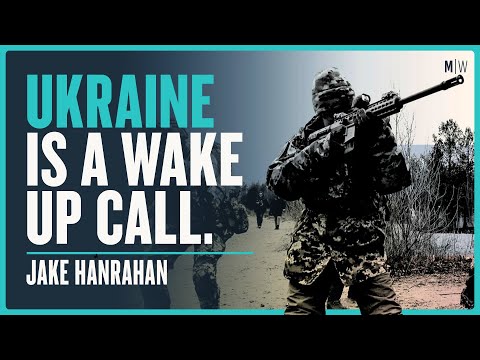
What Is Life Like On The Ground In Ukraine? - Jake Hanrahan
Jake Hanrahan (guest), Chris Williamson (host), Narrator
In this episode of Modern Wisdom, featuring Jake Hanrahan and Chris Williamson, What Is Life Like On The Ground In Ukraine? - Jake Hanrahan explores inside Ukraine’s Civilian Resistance: War, Reality, And Propaganda Collide Journalist Jake Hanrahan recounts his recent reporting from Ukraine, focusing on the lived reality of civilians suddenly thrust into war as Russia’s full‑scale invasion unfolds.
Inside Ukraine’s Civilian Resistance: War, Reality, And Propaganda Collide
Journalist Jake Hanrahan recounts his recent reporting from Ukraine, focusing on the lived reality of civilians suddenly thrust into war as Russia’s full‑scale invasion unfolds.
He describes inadequate pre-war preparations, indiscriminate Russian strikes on civilian areas, and rapidly forming citizen militias ranging from far-right units to Jewish and anti-fascist groups.
Hanrahan emphasizes that modern conflict blurs traditional rules of war, with guerrilla tactics, cyber operations, and grassroots information sharing via Telegram and social media playing central roles.
He also criticizes Western and Russian media narratives, online ideological wars, and the tendency to treat Ukrainians differently from other war-affected populations, while warning that the fighting will likely intensify and Kyiv may fall.
Key Takeaways
Civilians are bearing the brunt of the conflict in immediate, brutal ways.
Hanrahan details children dying from rocket strikes, cancer patients treated in basements, and food and medicine shortages (e. ...
Get the full analysis with uListen AI
Ukraine entered the war underprepared despite clear warning signs.
Government-designated bomb shelters were often locked, mismanaged, or repurposed (including one used as a strip club) with no supplies or heating, suggesting serious gaps between political rhetoric and practical civil defense.
Get the full analysis with uListen AI
A broad, improvised resistance movement is forming, but it’s messy and potentially explosive long-term.
From ex‑presidents with rifles to IT workers, 80‑year‑olds, boxers like Usyk and Lomachenko, and diverse militias (far‑right, Jewish, Chechen, anti‑fascist), almost everyone is mobilizing—yet widespread arms distribution and autonomous groups could fuel postwar infighting.
Get the full analysis with uListen AI
Guerrilla tactics will likely make any Russian occupation extremely costly.
Hanrahan predicts that if major cities fall, many fighters will go to ground, using IEDs, assassinations, Molotovs, DIY obstacles, and even weaponized drones, turning urban areas into a “meat grinder” for Russian forces.
Get the full analysis with uListen AI
Claims of ‘rules of war’ are largely fictional once large-scale conflict begins.
While the Geneva Conventions exist, Hanrahan cites examples from NATO allies and Russia alike—executed POWs, burned civilians, indiscriminate shelling—to argue that in practice, rules of engagement rapidly erode and war crimes often go unpunished.
Get the full analysis with uListen AI
Media narratives and online ideology are distorting how people perceive the war.
He attacks both Western and Russian propaganda, and the American-centric impulse to doubt everything as a conspiracy, stressing that thousands of journalists on the ground—and dead media workers—make mass fabrication implausible, even if bias and agendas exist.
Get the full analysis with uListen AI
The global reaction exposes deep double standards and racialized thinking about war.
Hanrahan contrasts empathy for Ukrainians with eight years of relative indifference to Eastern Ukraine, Syria, or Afghanistan, and calls out commentary about “civilized” or “blue‑eyed” refugees and discrimination against African and Indian students at borders as clear evidence of bias.
Get the full analysis with uListen AI
Notable Quotes
“On Monday they were the postman and on Tuesday they're a militant.”
— Jake Hanrahan
“When war happens, a lot of the rules go clean out the window.”
— Jake Hanrahan
“No one's coming to save them. NATO's not going to help them. They know that.”
— Jake Hanrahan
“I am not your PR. I'm a reporter, I'm a journalist, and that's that.”
— Jake Hanrahan
“People are normal everywhere… half the reason they become fighters is when our countries end up bombing somebody.”
— Jake Hanrahan
Questions Answered in This Episode
How should governments balance avoiding direct war with Russia against the moral imperative to protect Ukrainian civilians from indiscriminate attacks?
Journalist Jake Hanrahan recounts his recent reporting from Ukraine, focusing on the lived reality of civilians suddenly thrust into war as Russia’s full‑scale invasion unfolds.
Get the full analysis with uListen AI
What mechanisms could realistically prevent postwar Ukraine from descending into militia infighting after so many groups have been armed and empowered?
He describes inadequate pre-war preparations, indiscriminate Russian strikes on civilian areas, and rapidly forming citizen militias ranging from far-right units to Jewish and anti-fascist groups.
Get the full analysis with uListen AI
How can audiences distinguish between genuine on-the-ground reporting and propaganda or miscontextualized social media content during a fast-moving conflict?
Hanrahan emphasizes that modern conflict blurs traditional rules of war, with guerrilla tactics, cyber operations, and grassroots information sharing via Telegram and social media playing central roles.
Get the full analysis with uListen AI
In what concrete ways do racial and geographic biases shape which wars receive sustained global attention and empathy?
He also criticizes Western and Russian media narratives, online ideological wars, and the tendency to treat Ukrainians differently from other war-affected populations, while warning that the fighting will likely intensify and Kyiv may fall.
Get the full analysis with uListen AI
Given that rules of war are often ignored, what reforms or enforcement mechanisms, if any, could make international humanitarian law more than symbolic?
Get the full analysis with uListen AI
Transcript Preview
... people where war comes to their doorstep and on Monday, they were the postman and on Tuesday they're a militant. The same thing happened in Syria. You know, the same thing happens in Palestine, the same thing happens in Afghanistan. These people all have lives, these people all have aspirations, dreams. They're normal people. (wind blowing)
Jake Hanrahan, welcome to the show.
Thanks very much, mate. Thanks for having me.
You are recently back from Ukraine. You left the day before everything started, but that ... you didn't mean for that to happen. That was just, uh, fortunate timing, I guess.
I mean, it was kind of... I think it was, like, two days actually, but it was, it was one of these things where, you know, me and the guy I was working with, my mate, Johnny Pickup, we were there, we were like, "Shall we stay?" It's probably not gonna happen, you know, because it just... I don't know. It was- it just seemed almost inconceivable. I don't know why, but it did at the time. We had a, we- we'd been filming anyway. We'd been filming with, like, the training, the militia training, so it's like, we had a good film anyway, um, which we're editing now. And I was like, "You know what? I've got things to do. Um, I've got family commitments." He's the same. We said, "All right, we'll go back." And then, (laughs) you know, two days into the edit, I get a call in the morning, like, "They've done it. They've invaded." It's like, wow, Jesus.
Why did you think it wasn't gonna happen?
Honestly, it was, I think, maybe the mood in Kiev, you know, like, uh, like, four days before the invasion, we were out chatting to people at the pub, you know, stuff like that. You know, local Ukrainians in Kiev, and they were like, "No, there's no way. Like, it's not gonna happen." The government wasn't really preparing bomb shelters. Like, it- it... I know that, you know, Biden said it's gonna happen, and then all these other intelligence agencies did, but they said it was gonna be on this day, then this day, then this day. And I think the enormity of it just, you know, naively perhaps, I ... A lot ... Well, it wasn't just me. A lot of people just thought, "No, probably not gonna happen like that. Probably just the east." But lo and behold, you know, he went in, uh, you know, full pelt.
What is it like, then ... I know that you've been back since this fighting's fully started, but you are ... You've got Popular Front, which is your, uh, organization, conflict reporting, independent journalism and stuff, and you guys are putting out an unbelievable amount of videos, footage. You've got friends you've ... Literally, we've had to delay recording because one of your friends-
Mm-hmm.
... has rang from Kiev to say that there's been some heavy bombing going on. Can you try and explain to people what life is like for civilians in Ukraine at the moment?
Install uListen to search the full transcript and get AI-powered insights
Get Full TranscriptGet more from every podcast
AI summaries, searchable transcripts, and fact-checking. Free forever.
Add to Chrome