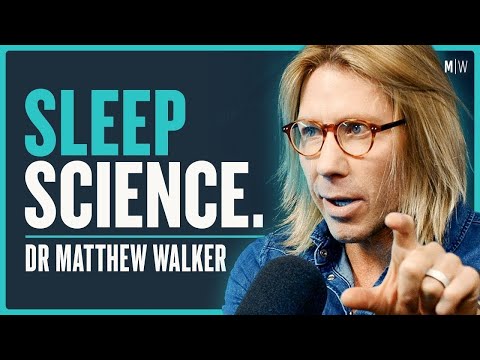
How To Fix Your Sleep & Supercharge Your Life - Dr Matthew Walker
Chris Williamson (host), Dr. Matthew Walker (guest)
In this episode of Modern Wisdom, featuring Chris Williamson and Dr. Matthew Walker, How To Fix Your Sleep & Supercharge Your Life - Dr Matthew Walker explores matthew Walker Reveals Four Pillars To Transform Sleep And Life Matthew Walker and Chris Williamson explore what truly defines good sleep, centering on Walker’s four ‘macros’: quantity, quality, regularity, and timing (chronotype). They explain how most people overestimate sleep duration, misunderstand insomnia, and ignore the massive role of stress, anxiety, caffeine, alcohol, and light in degrading sleep. Walker emphasizes that sleep regularity may predict mortality even more strongly than total hours slept, and that REM sleep and dreaming are critical for emotional health, creativity, and long‑term brain function. They also discuss interventions ranging from simple behavioral tools and supplements to cutting‑edge technologies like brain stimulation and acoustic/vibration devices designed to enhance sleep.
Matthew Walker Reveals Four Pillars To Transform Sleep And Life
Matthew Walker and Chris Williamson explore what truly defines good sleep, centering on Walker’s four ‘macros’: quantity, quality, regularity, and timing (chronotype). They explain how most people overestimate sleep duration, misunderstand insomnia, and ignore the massive role of stress, anxiety, caffeine, alcohol, and light in degrading sleep. Walker emphasizes that sleep regularity may predict mortality even more strongly than total hours slept, and that REM sleep and dreaming are critical for emotional health, creativity, and long‑term brain function. They also discuss interventions ranging from simple behavioral tools and supplements to cutting‑edge technologies like brain stimulation and acoustic/vibration devices designed to enhance sleep.
Key Takeaways
Treat sleep as four pillars: quantity, quality, regularity, and timing, not just hours in bed.
Good sleep isn’t only “7–9 hours”; it also requires high sleep efficiency, consistent bed/wake times, and alignment with your chronotype. ...
Get the full analysis with uListen AI
Sleep efficiency matters: eight hours in bed is rarely eight hours asleep.
Most good sleepers only spend 85–90% of time in bed actually asleep, so to reliably get 7 hours of sleep you may need 8–8. ...
Get the full analysis with uListen AI
Regularity may be more important for longevity than total sleep duration.
Large‑scale data show that irregular sleep timing predicts higher all‑cause, cancer, and cardiovascular mortality, even after controlling for total sleep time. ...
Get the full analysis with uListen AI
Stress, anxiety, and “wired but tired” physiology are major hidden sleep killers.
Chronic activation of the sympathetic nervous system and HPA axis (cortisol, adrenaline) raises heart rate, blood pressure, and temperature, making it very hard to fall or stay asleep. ...
Get the full analysis with uListen AI
Substances commonly used as sleep aids often backfire by degrading sleep architecture.
Caffeine’s long half‑life fragments sleep and suppresses deep sleep; alcohol sedates rather than induces true sleep, fragments the night, and severely reduces REM and deep sleep. ...
Get the full analysis with uListen AI
Snoring and possible sleep apnea are serious health issues, not just annoyances.
Obstructive events can occur dozens of times per hour, dropping oxygen saturation and destroying sleep quality, which raises risk for cardiovascular disease, metabolic disease, and mortality. ...
Get the full analysis with uListen AI
REM sleep and dreaming are crucial for emotional healing and creativity.
During REM, noradrenaline drops and emotional memories are reprocessed, stripping the emotional charge while preserving the memory—an “overnight therapy” that fails in PTSD. ...
Get the full analysis with uListen AI
Notable Quotes
“Sleep is something that happens to us, it’s not something that we make happen.”
— Dr. Matthew Walker
“The shorter your sleep, the shorter your life.”
— Dr. Matthew Walker
“Human beings seem to be the only species that will deliberately deprive themselves of sleep for no apparent good reason.”
— Dr. Matthew Walker
“In the past 20 years of studying, we have not been able to discover a single psychiatric condition in which sleep is normal.”
— Dr. Matthew Walker
“The best bridge between despair and hope is a good night of sleep.”
— Dr. Matthew Walker (quoting E. Joseph Cossman)
Questions Answered in This Episode
How can someone realistically improve sleep regularity if their job or parenting schedule forces irregular hours?
Matthew Walker and Chris Williamson explore what truly defines good sleep, centering on Walker’s four ‘macros’: quantity, quality, regularity, and timing (chronotype). ...
Get the full analysis with uListen AI
What’s the most practical way to distinguish between true insomnia and a simple mismatch with your chronotype?
Get the full analysis with uListen AI
Given the health risks, how should heavy caffeine and alcohol users prioritize cutting back without disrupting their lifestyle overnight?
Get the full analysis with uListen AI
What would a “minimum effective dose” evening routine look like to reduce stress‑driven ‘tired but wired’ insomnia?
Get the full analysis with uListen AI
How far can emerging technologies like electrical brain stimulation and acoustic or vibration devices actually go in safely compressing or enhancing human sleep?
Get the full analysis with uListen AI
Transcript Preview
You might be the British man with the best hair that I know-
(laughs)
... at the moment.
I think it is the greatest cry of a mid-life crisis that you are ever going to see. It's a total train wreck. I'm suggesting that no one tell me the pandemic was over, and that you can get your hair cut.
Right.
This is the consequence of it. So, um, for anyone who is watching, any therapy pill, uh, bills that you have to, uh, have after seeing me and being fronted by me-
(laughs)
... send them to me. I will pay for them. Oh my goodness.
Fantastic. Well, uh-
What a good opening to it. (laughs)
Look, it is, it is, it is what it is. Um, talking about sleep today. We've had a lot of conversations about it on the show previously, but I really wanna dig into some sort of more rare insights that people probably know that they need to know, but don't yet know. So just to get started, w- how do you come to think about what good sleep is? How do we conceptualize good sleep?
Yeah, it's, it's an interesting question because I think everyone most mornings, let's say you've got a significant other, you come down the stairs and you say, you know, "How'd you sleep?" And they'll say, "I slept well," or, "I didn't sleep well." So everyone themselves has a subjective estimate of what this thing called good versus bad sleep is. Science is a little different though, and medicine teaches us that there are essentially what I would describe as the four macros of good sleep, and so three macros of food, fat, carbohydrate, and protein, four of sleep, and you can remember it by the acronym QQRT, quantity, quality, regularity, timing. And there's all sorts of stuff on the internet about, you know, take this supplement, do this particular thing and, and it's the Shangri-La of all good sleep, and you'll have this utopian blissful night. Honestly, if you just focus on these four main principles, you're 80% of the way there. So quantity is what we used to espouse in sleep as the measure of good sleep, which is somewhere between seven to nine hours for the average adult, and there is variability. Um, the next one is quality, and I think this is probably-
Actually, I need to jump in on the quantity before you even move on.
Yeah.
Quantity of sleep, time in bed, time asleep?
Mm. Astute question. Most of us conflate the former for the latter, and it's potentially dangerous. So if you are a good sleeper, you will have what we call a sleep efficiency of at least 85%, which means, uh, so sleep efficiency of the time that you're in bed, what percent of that time are you asleep? And really good sleepers will have, let's say, 80 to 90% sleep efficiency. So even if you're in bed for seven hours, you're not getting seven hours of sleep.
Install uListen to search the full transcript and get AI-powered insights
Get Full TranscriptGet more from every podcast
AI summaries, searchable transcripts, and fact-checking. Free forever.
Add to Chrome