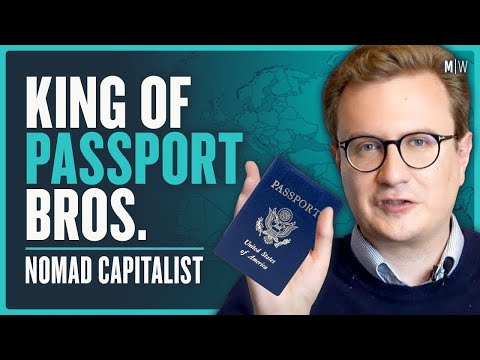
How To Travel The World & Pay No Tax - Nomad Capitalist
Chris Williamson (host), Andrew Henderson (guest), Narrator
In this episode of Modern Wisdom, featuring Chris Williamson and Andrew Henderson, How To Travel The World & Pay No Tax - Nomad Capitalist explores global citizenship strategies to cut taxes, diversify life, and options Andrew Henderson of Nomad Capitalist explains his philosophy of “go where you’re treated best,” encouraging people to decouple their life, business, and identity from their birth country. He contrasts high-tax, increasingly restrictive Western systems—especially the U.S.—with more competitive jurisdictions that offer lower taxes, friendlier immigration, and better lifestyle value. The conversation breaks down key levers like residency, citizenship, corporate structure, banking, dating, and education, and how to combine countries into coherent strategies (trifectas, global citizen “sandwiches”). Overall, he argues for treating governments and locations like competing service providers, using passports and residencies as tools to increase freedom, resilience, and opportunity.
Global citizenship strategies to cut taxes, diversify life, and options
Andrew Henderson of Nomad Capitalist explains his philosophy of “go where you’re treated best,” encouraging people to decouple their life, business, and identity from their birth country. He contrasts high-tax, increasingly restrictive Western systems—especially the U.S.—with more competitive jurisdictions that offer lower taxes, friendlier immigration, and better lifestyle value. The conversation breaks down key levers like residency, citizenship, corporate structure, banking, dating, and education, and how to combine countries into coherent strategies (trifectas, global citizen “sandwiches”). Overall, he argues for treating governments and locations like competing service providers, using passports and residencies as tools to increase freedom, resilience, and opportunity.
Key Takeaways
Treat countries like service providers, not inheritances.
Henderson argues you shouldn’t feel bound to the country you were born in; instead, compare jurisdictions on tax, safety, opportunity, and quality of life, then move or diversify toward those that serve you better.
Get the full analysis with uListen AI
Understand the difference between citizenship, residency, and passports.
A passport is a travel document that flows from citizenship, while residency is permission to live in a country—often with different paths and timelines to eventual citizenship and very different tax consequences.
Get the full analysis with uListen AI
Tax optimization requires aligning where you live with where your business is based.
Simply incorporating in a tax haven (e. ...
Get the full analysis with uListen AI
Americans face unique constraints and opportunities in going offshore.
The U. ...
Get the full analysis with uListen AI
Second passports and residencies are powerful “Plan B” tools.
Dual citizenship, alternative residencies, or even having children in certain countries can provide future mobility, safety, and business advantages—especially as more states talk about tightening tax and movement rules.
Get the full analysis with uListen AI
Best-value living often differs from best-value banking or investing.
Henderson’s “global citizen sandwich” separates where he lives (e. ...
Get the full analysis with uListen AI
Lifestyle design can be geographically engineered, not just financially optimized.
Concepts like the “trifecta” (three home bases across regions) and conscious choices about where to date, educate children, or network show that geography can be used to improve personal relationships, mindset, and opportunities—not only tax bills.
Get the full analysis with uListen AI
Notable Quotes
“I help people go where you're treated best.”
— Andrew Henderson
“What you wish existed already exists somewhere—just go there.”
— Andrew Henderson
“The place where you're from is probably not the best at anything.”
— Andrew Henderson
“I don't think any country is worth 40 or 50 percent of your income.”
— Andrew Henderson
“Out of eight billion people, the person that matches you happened to also be born in Cleveland, Ohio? That seems ridiculous to me.”
— Andrew Henderson
Questions Answered in This Episode
If you weren’t tied to your current country by habit or fear, how would you redesign your life, business, and tax situation geographically?
Andrew Henderson of Nomad Capitalist explains his philosophy of “go where you’re treated best,” encouraging people to decouple their life, business, and identity from their birth country. ...
Get the full analysis with uListen AI
What specific benefits—beyond “home” and familiarity—does your current country actually provide that justify its tax and regulatory burden for you?
Get the full analysis with uListen AI
Which part of the global citizen approach appeals to you more: reducing taxes, increasing freedom of movement, or improving lifestyle and relationships?
Get the full analysis with uListen AI
What would be your first practical step toward a Plan B—second residency, second passport, offshore company, or simply a multi-month test stay elsewhere?
Get the full analysis with uListen AI
How would your views on education, politics, and risk change if your children (or future children) had multiple citizenships and could live anywhere?
Get the full analysis with uListen AI
Transcript Preview
How do you describe what you do for work when you meet someone at a cocktail party?
I like to say that I help people go where you're treated best. Those are five magic words. I learned them from my father at a very young age. He gave me a permission slip, I did not have to stick around where I'm from. Um, I didn't have to stick around and take care of my parents 'cause they didn't want their kids taking care of them. They wanted their kids to go where the best opportunities were, and he thought back in the 1990s where I grew up in the United States that there would be better opportunities by the time I got around to being in business. And so, what I've discovered is if you live in the United States or if you live in a country like it, you're probably paying way too much in tax. I'm not saying you should pay zero, but you're probably paying too much for what you're getting. Um, there's probably some things holding you back. Uh, I think what we're seeing now is there's a lot of opportunities in business around the world, and increasingly this multi-polarity where the US is pitted against other places, and so there's gonna be a choice, which market do you want to sell to? Uh, and so we help people at Nomad Capitalists reduce taxes, become dual citizens, find opportunities around the world that most people don't talk about. Uh, 'cause I'm a pretty contrarian guy, and I think that what we think is the best is often not.
It's strange, having read and listened to a good bit of your work, it's... (laughs) From first principles, it's kind of weird that people presume, "Well, this is the place that I was born, so this is the place that I'm supposed to work and live and die and bank and pay taxes and date." All of these things.
Date. Mm-hmm. Yeah. Well, uh, you know, I was born in Cleveland, Ohio in the US, uh, right on the lake and right across the lake from Canada. And I look and I say, "What if, you know, I'd been born right across that lake?" I mean, in the grand scheme of things, that lake is a pretty small, pretty small thing. And if you're a Canadian, uh, you can leave your country and you can leave your tax burden behind for one thing. You don't have to follow Canadian regulations when you live overseas, uh, you have a passport that for years... I mean, it's, it's the joke, uh, that people respect you a lot more and people are more open to giving you a bank account in other countries. Just take, like, life as a global citizen's a lot easier. Life just as a Canadian traveling is a lot easier. Um, you know, people aren't picking on you. And to say that you're born that close to where your identity would've been different, I mean, to me just shows, uh, the miracle of birth. But not only, you know, if you... The movie Midnight in Paris talked about, you know, were we born in the wrong part of, you know, Earth's history, you know? Would you rather have been born 50 years ago? You know, we can't change when we were born, but we can certainly change where we were born. And if we weren't born in a place that we want, um, we can change that. I also happen to think, as my father said, sure, when I was born in 1984, the United States, according to the sur- the studies that do this, it was the best place to be born, but there wasn't a lot of competition. I'm talking to you from Malaysia. I think it's the best value destination in the world for someone who can work from anywhere, and you would've never even been talking about it in 1984, but you can talk about it today. And so there's a lot more competition. The world changes, the world evolves. And even if you were born in the right place, maybe it's not the right place today.
Install uListen to search the full transcript and get AI-powered insights
Get Full TranscriptGet more from every podcast
AI summaries, searchable transcripts, and fact-checking. Free forever.
Add to Chrome