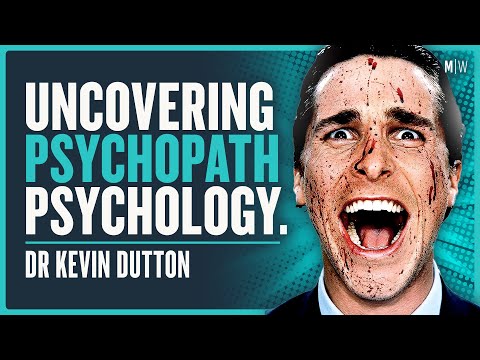
Understanding The Wisdom Of Psychopaths - Dr Kevin Dutton
Dr Kevin Dutton (guest), Chris Williamson (host)
In this episode of Modern Wisdom, featuring Dr Kevin Dutton and Chris Williamson, Understanding The Wisdom Of Psychopaths - Dr Kevin Dutton explores psychopathy, Persuasion, And Categories: How Minds Shape Modern Reality Dr. Kevin Dutton explains psychopathy as a spectrum of traits—ruthlessness, fearlessness, emotional detachment, charm—that can be highly adaptive in certain roles like surgery, business, law, and special forces when dialed to the right level and context. He broadens the conversation into how our brains evolved to categorize a continuous world into sharp boxes, how that underpins tribalism, extremism, hoarding, and social media dynamics, and why simplicity and fluency feel like truth to us. Dutton then unpacks the psychology of persuasion, drawing on con men, sales tactics, and political campaigns to show how liking, self‑interest framing, and “super‑categories” like us/them and right/wrong power influence. Throughout, he and Chris Williamson connect these ideas to everyday examples—from football penalty shootouts and restaurant menus to online culture wars and accent prejudice.
Psychopathy, Persuasion, And Categories: How Minds Shape Modern Reality
Dr. Kevin Dutton explains psychopathy as a spectrum of traits—ruthlessness, fearlessness, emotional detachment, charm—that can be highly adaptive in certain roles like surgery, business, law, and special forces when dialed to the right level and context. He broadens the conversation into how our brains evolved to categorize a continuous world into sharp boxes, how that underpins tribalism, extremism, hoarding, and social media dynamics, and why simplicity and fluency feel like truth to us. Dutton then unpacks the psychology of persuasion, drawing on con men, sales tactics, and political campaigns to show how liking, self‑interest framing, and “super‑categories” like us/them and right/wrong power influence. Throughout, he and Chris Williamson connect these ideas to everyday examples—from football penalty shootouts and restaurant menus to online culture wars and accent prejudice.
Key Takeaways
Treat psychopathic traits as dials, not diagnoses.
Characteristics like ruthlessness, fearlessness, and emotional detachment are not inherently bad; tuned to the right level and applied in the right context (e. ...
Get the full analysis with uListen AI
Match personality traits to role demands, not moral stereotypes.
Roles that require extreme focus, risk-taking, or emotional disengagement (surgeons, fighter pilots, elite soldiers, trial lawyers) benefit from “precision-engineered psychopathy,” whereas the same profile can be disastrous in everyday social life or peaceful contexts.
Get the full analysis with uListen AI
Design your world with categorization and cognitive load in mind.
Because our brains carve a continuous world into categories to save effort, simplifying choices—standard wardrobes, clear pass/fail thresholds, intuitive groupings (e. ...
Get the full analysis with uListen AI
Favor simplicity and fluency if you want to be believed.
We unconsciously equate ease of processing with truth: fluent speech, simple fonts, clear stories, and straightforward framing make information feel more credible and actions (like ordering a dish or accepting an argument) seem easier and more appealing.
Get the full analysis with uListen AI
Use ethical persuasion: likability plus self-interest framing.
Influence works best when people like you (humor, rapport, shared identity) and when what you’re asking is clearly framed as serving their interests, not yours; this formula underlies successful con artists, salespeople, and effective negotiators.
Get the full analysis with uListen AI
Watch for super-category language weaponizing your instincts.
Political and marketing campaigns that lean on ancient super-categories—fight/flight, us/them, right/wrong—(e. ...
Get the full analysis with uListen AI
Guard against low-complexity, high-closure thinking in yourself.
A low need for cognitive complexity (few facts needed) combined with a high need for closure (fast, final answers) predisposes people toward extremism and ideological capture; deliberately seeking nuance and delaying closure can protect against becoming a rigid partisan or “NPC.”
Get the full analysis with uListen AI
Notable Quotes
“Persuasion ain't about getting people to do what they don't want to do. It's about giving people a reason to do what they do want to do.”
— Dr. Kevin Dutton (quoting his father)
“Our brains conflate simplicity for truth. The simpler that I can make it for you to do something, the more likely you are going to do it.”
— Dr. Kevin Dutton
“We evolved to categorize a world of soup with a fork. Our brains think the way lawnmowers cut—fast, straight lines through a sea of green.”
— Dr. Kevin Dutton
“Information travels around the brain like electricity around a circuit. It takes the path of least resistance.”
— Dr. Kevin Dutton (quoting a London QC)
“The culture war is largely two armies of NPCs being ventriloquized by a handful of actual thinkers.”
— Gwyneth Bogle (quoted by Chris Williamson)
Questions Answered in This Episode
How can individuals deliberately harness ‘good psychopathic’ traits—like fearlessness or emotional detachment—without sliding into harmful behavior?
Dr. ...
Get the full analysis with uListen AI
In what concrete ways can we redesign online platforms to reduce tribal epistemology and reward nuance over simple us-versus-them narratives?
Get the full analysis with uListen AI
How do we distinguish between healthy cognitive closure (deciding efficiently) and the kind of low-complexity, high-closure thinking that leads to extremism?
Get the full analysis with uListen AI
What ethical boundaries should guide the use of powerful persuasion techniques in politics, marketing, and law, given how easily they exploit evolved biases?
Get the full analysis with uListen AI
Could understanding accent-based prejudice and in-group signaling be used constructively—for example, to improve cross-cultural integration—rather than to deepen divides?
Get the full analysis with uListen AI
Transcript Preview
Imagine you've got the skillset to be a top surgeon, but you lack the ability to emotionally disengage from the people that you're operating on. You're not going to cut it, are you? Ruthlessness, fearlessness, mental toughness, self-confidence, coolness under pressure, emotional detachment, focus, charm. None of those traits is necessarily a problem in itself. In fact, all of them, dialed up at the right levels, can actually prove rather useful.
(wind blowing) Kevin Dunn, welcome to the show.
Cheers, Chris. Thanks for having me, mate. How are you?
I'm well, thank you. How do you describe what you do for work? What is your area of expertise, if there is one?
Well, I'm a psychologist. That's number one. Um, I'm talking to you, uh, from down under, mate, in, uh, in Adelaide, uh, where it's 8:30 in the morning at the moment, um, so bright and early. Uh, and I'm Professor of the Public Understanding of Psychology at the University of Adelaide. So that is Australia's first professor of such a thing. So I'm Australia's first Professor of the Public Understanding of Psychology, which basically means that I, uh, bring psychology to the general public. Uh, so psychology is a very broad church. It's got loads of sub-disciplines and, and different areas of study, everything from forensic, to social, to developmental, to educational, to sport. Uh, all those kinds of things. And so what my job is, uh, down here is to, uh, collate the best of that kind of, uh, information and, um, make it accessible to the general public. So that's what I do for a living. That's my day job. Uh, my area of expertise, um, as most people will probably recognize me for, is psychopaths. Uh, so, um, many years ago, about 10 years ago now, I wrote a, a book called The Wisdom of Psychopaths, uh, which became very controversial. Um, and it's still, I think, the only book that, um, suggests that psychopaths aren't all bad, that, um, actually, you know, we have this stereotype of psychopaths being rapists and serial killers and what have you. But actually, if you were to look inside the realms of special forces, for example, you would also find people who are high on what I call the psychopathic spectrum. Um, so when I wrote Wisdom of Psychopaths, as I say, it became a controversial book, um, uh, became quite well-known. And it was on the basis of that, really, that I suppose, you know, if you can say this kind of thing, I kind of made my name in psychology.
So you would be the current Australian equivalent in psychology of Brian Cox for physics in the UK?
Oh, uh, well, I don't... L- listen. Don't put me down like that, mate.
(laughs)
Don't you dare. Don't you dare put me down like that. What are they knowing? They... Actually, Brian's over here doing a big tour at the moment.
Install uListen to search the full transcript and get AI-powered insights
Get Full TranscriptGet more from every podcast
AI summaries, searchable transcripts, and fact-checking. Free forever.
Add to Chrome