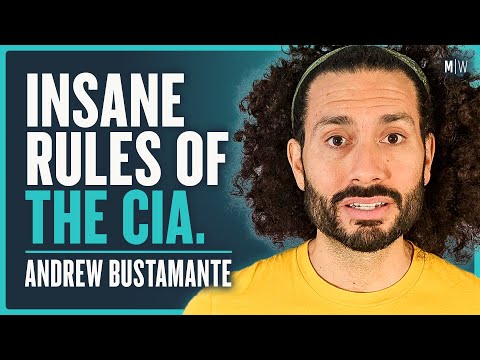
The Double Life Of A CIA Spy - Andrew Bustamante
Andrew Bustamante (guest), Chris Williamson (host)
In this episode of Modern Wisdom, featuring Andrew Bustamante and Chris Williamson, The Double Life Of A CIA Spy - Andrew Bustamante explores inside CIA Secrets, Nuclear Protocols, Snowden, Conspiracies, And Apex Predators Former CIA covert officer Andrew Bustamante explains how the CIA is structured, the difference between overt, covert, and contractor roles, and how security clearances and compartmentalization actually work. He walks through nuclear command-and-control in detail, including the president’s “football,” launch procedures, and the psychological design that prevents or bypasses conscientious objectors.
Inside CIA Secrets, Nuclear Protocols, Snowden, Conspiracies, And Apex Predators
Former CIA covert officer Andrew Bustamante explains how the CIA is structured, the difference between overt, covert, and contractor roles, and how security clearances and compartmentalization actually work. He walks through nuclear command-and-control in detail, including the president’s “football,” launch procedures, and the psychological design that prevents or bypasses conscientious objectors.
Bustamante analyzes the Edward Snowden leaks, arguing Snowden did the right thing the wrong way by exposing illegal surveillance but also stealing unrelated, deeply damaging cyber capabilities, and discusses the implications of his Russian citizenship. He breaks down how conspiracies form cognitively, how foreign actors exploit existing social divisions, and why most polarization is domestically generated rather than scripted from abroad.
The conversation also covers spy recruitment, psychological screening, deep cover risks, cover legends, and why genuinely forgettable people make the best spies. Bustamante contrasts apex-predator ultra-wealthy operators with normal life, defends the functional usefulness of “dangerous” people and institutions, and finishes with a framework for separating real from perceived risk when deciding to step into the public eye.
Key Takeaways
CIA’s biggest soft spot is often contractors, not staff officers.
Overt and covert staff are trained to be paranoid about foreign recruitment, but large numbers of private intelligence contractors inside CIA facilities are commercially motivated, less security-conscious, and thus prime targets for infiltration.
Get the full analysis with uListen AI
Security clearances stack and compartmentalize far beyond ‘Top Secret.’
Most people start at Secret; Top Secret then branches into numerous Special Compartmented Information (SCI) silos by mission (nuclear, HUMINT, Russia, counter‑narcotics, etc. ...
Get the full analysis with uListen AI
U.S. nuclear launch systems are designed to minimize individual veto power.
The president authenticates with physical codes in the ‘football,’ which triggers emergency action messages to hundreds of missile officers; any one valid key-pair can launch assigned missiles, so no single conscientious objector can block a strike, unlike Russia’s senior‑officer model.
Get the full analysis with uListen AI
Snowden’s real damage was stealing offensive cyber blueprints, not just exposing surveillance.
While many in the intelligence community accept that exposing illegal domestic collection had merit, Bustamante argues that taking additional compartmented programs as ‘insurance’ forced NSA to redesign core tools and methods, and his Russian citizenship now risks making him an active combatant asset.
Get the full analysis with uListen AI
Conspiracies thrive in the gap between a real event and missing information.
Bustamante outlines that a factual trigger, followed by an information vacuum, plus speculative explanations drive the brain to ‘close the loop’—so people start treating plausible stories (e. ...
Get the full analysis with uListen AI
The best spies are forgettable, loyal, and comfortable with cognitive compartmentalization.
CIA screens heavily for loyalty to a cause, tolerance for authority they respect, and the ability to segment identities—using rituals to enter and exit cover—because long-term deep cover can blur reality, cause mental health issues, or even flip officers if not carefully managed.
Get the full analysis with uListen AI
Most social discord is self-generated; foreign actors just pour fuel on existing fires.
Rather than inventing new narratives, adversaries cheaply amplify both sides of existing issues (gender, race, politics, incels, etc. ...
Get the full analysis with uListen AI
Notable Quotes
“Convenience and security sit at opposite ends of a spectrum. The more secure you are, the less convenient life is.”
— Andrew Bustamante
“None of those presidential candidates know what the hell they’re talking about. They’re just talking.”
— Andrew Bustamante
“He did the right thing the wrong way. You don’t end up a Russian citizen by doing the right thing the right way.”
— Andrew Bustamante on Edward Snowden
“Clandestine means so secret that people don’t even realize you are a threat when you’re in front of them.”
— Andrew Bustamante
“We would care far less about what other people think about us if we realized how rarely they do.”
— Chris Williamson
Questions Answered in This Episode
Given the contractor vulnerability Bustamante describes, how should intelligence agencies realistically balance speed, cost, and security in outsourcing work?
Former CIA covert officer Andrew Bustamante explains how the CIA is structured, the difference between overt, covert, and contractor roles, and how security clearances and compartmentalization actually work. ...
Get the full analysis with uListen AI
Does the U.S. nuclear launch system’s design to bypass conscientious objectors cross an ethical line, or is it a necessary safeguard in deterrence strategy?
Bustamante analyzes the Edward Snowden leaks, arguing Snowden did the right thing the wrong way by exposing illegal surveillance but also stealing unrelated, deeply damaging cyber capabilities, and discusses the implications of his Russian citizenship. ...
Get the full analysis with uListen AI
If Snowden ‘did the right thing the wrong way,’ what would a viable, safer path for whistleblowing about illegal classified programs actually look like?
The conversation also covers spy recruitment, psychological screening, deep cover risks, cover legends, and why genuinely forgettable people make the best spies. ...
Get the full analysis with uListen AI
How can ordinary people practically distinguish between healthy skepticism and getting trapped in conspiratorial thinking when information is missing or delayed?
Get the full analysis with uListen AI
If apex-predator leaders are functionally useful but often personally destructive, what mechanisms—legal, cultural, or institutional—best keep their power aligned with public interest?
Get the full analysis with uListen AI
Transcript Preview
Presidential candidates on the campaign trail make all these promises that they know nothing about because they don't have the clearance to get a top secret SCI clearance. So, they're just promising what they're going to do against Iran and, "We're not going to take any more crap from, you know, people crossing the border," and, "There's no threat from the Middle East," whatever, whatever they're saying. They have no idea until they basically get to the last four people. The last four actually get an intelligence briefing. (whoosh)
For the people who aren't familiar with you and what you do, what's your background?
Yeah. Uh, I'm an ex-CIA, uh, covert intelligence officer. I spent seven years undercover and I left CIA to start a family, start a business, and that's what brings me to where I am today, teaching spy skills to people for, uh, for everything from business to personal life.
What's a covert intelligence officer?
Yeah. So, people don't realize that CIA actually has two types of intelligence officers. So, CIA has overt, O-V-E-R-T, overt officers, and covert, C-O-V-E-R-T, covert officers. Overt officers make up about 90% of CIA. They're all the people who work for CIA. Their tax return says CIA, they go to their, you know, parties on Friday night and they say, "Hey, I work for the CIA." You know, they do disguise stuff, they do, uh, accounting, they do, uh, financial investigations. They do, you know, you name it, analysis. But then you have covert CIA. Covert officers are actually undercover. They, their IRS, uh, receipts, their tax does not say they work at CIA. None of their footprint says they work at CIA. CIA takes a great deal of effort to kind of erase them from the internet and make sure they don't have a footprint that is affiliated with CIA or Washington DC or the US federal government. So, uh, about 10% of all of CIA officers are covert, and that was, that was my 10%.
When it comes to a vector for infiltration, are those equally used? I'm going to guess the 90% must be significantly more visible, they must be the ones that are easier for some nasty foreign actor to try and get into?
Yeah. You know, what's interesting is there's actually a third vector that we haven't even talked about, um, because inside the federal government, the softest underbelly is actually in what's known as private intelligence contractors. So, private intelligence contractors work for a different company altogether. They work for Raytheon or Booz Allen or CACI! and, but they actually work at CIA headquarters. So, that vector is the, uh, is the most susceptible vector for foreign intelligence because those are just commercial employees. Uh, those are, you know, they have a clearance but they don't necessarily make a career at CIA, and, uh, and your overt officers are very paranoid about being approached by foreign actors. Your covert officers are also highly paranoid about being approached by a foreigner. But in the middle, you've got this entire, this huge base of contractors that support everything from tech operations to covert action. Uh, and they're not paranoid about being approached because they're just normal everyday contractors and they're always looking for the next big contract that they can sign to.
Install uListen to search the full transcript and get AI-powered insights
Get Full TranscriptGet more from every podcast
AI summaries, searchable transcripts, and fact-checking. Free forever.
Add to Chrome