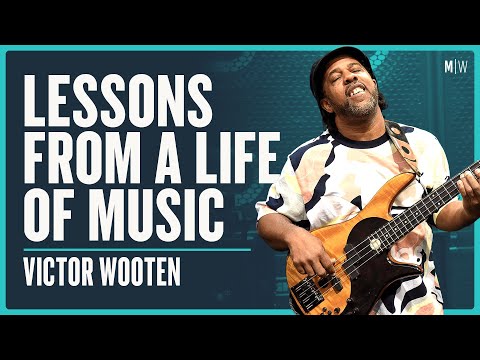
The Spirit Of Music - Victor Wooten | Modern Wisdom Podcast 304
Victor Wooten (guest), Chris Williamson (host), Narrator
In this episode of Modern Wisdom, featuring Victor Wooten and Chris Williamson, The Spirit Of Music - Victor Wooten | Modern Wisdom Podcast 304 explores victor Wooten Warns of Fast Music Age, Calls For Reconnection Victor Wooten discusses his book *The Spirit of Music* as a warning that our modern relationship with music is becoming shallow, compressed, and disconnected—much like a societal shift toward “fast food” instead of real nourishment.
Victor Wooten Warns of Fast Music Age, Calls For Reconnection
Victor Wooten discusses his book *The Spirit of Music* as a warning that our modern relationship with music is becoming shallow, compressed, and disconnected—much like a societal shift toward “fast food” instead of real nourishment.
He explains how technology, distribution, and commercial incentives have diluted sound quality, rhythmic and pitch nuance, and the communal experience of listening, while also reshaping pop music around hooks and instant gratification.
Wooten argues that listeners and artists alike share responsibility: we must “vote with our ears and actions,” seek deeper, more authentic music, and re-learn how to feel and experience music fully.
The conversation broadens into lessons on coincidence and accidents, confidence, preparation, education, and spiritual connection—using music as a lens to examine how we live, learn, and relate to others.
Key Takeaways
Modern music consumption has become nutritionally thin, like fast food.
Wooten likens MP3s, auto-tune, and over-compression to processed food: they can taste or sound good, but much of the subtle “nutritional” information—frequencies, dynamics, micro-rhythms and pitch inflections—is stripped away, reducing music’s depth and impact on the whole body.
Get the full analysis with uListen AI
Listeners “vote with their ears and actions” and shape the industry.
He stresses that labels and pop formulas only dominate because consumers reward them; if audiences deliberately support deeper, more authentic artists and are willing to pay for quality, the musical landscape will shift to reflect that demand.
Get the full analysis with uListen AI
Authentic artistry can replace manufactured hooks as the main draw.
Historically, artists like Aretha Franklin or Bob Dylan didn’t need engineered hooks or spectacle; the power and realness of their performance was the hook. ...
Get the full analysis with uListen AI
Reconnecting with music starts by feeling it again, not just analyzing it.
He urges both musicians and listeners to treat music as a living presence to join with, not just notes to control—feeling it on the skin and from within, like a child moving instinctively to a song, rather than overthinking technique or theory.
Get the full analysis with uListen AI
Accidents and coincidences are signals—whispers and shouts from life.
Wooten frames coincidences as wanted surprises and accidents as unwanted ones, both arising from unseen causes; if we reflect on them, they reveal where we weren’t paying attention and offer chances to course-correct and grow, individually and collectively (as with the pandemic).
Get the full analysis with uListen AI
Radical preparation is a straightforward antidote to performance fear.
Using examples from Chick Corea’s band and Chris’s TEDx talk, they show that intense preparation—beyond what’s seemingly necessary—shrinks the space where fear can exist, allowing flow states where you can listen, respond, and perform freely.
Get the full analysis with uListen AI
Great teaching amplifies students’ gifts instead of policing their flaws.
Describing his brother Reggie’s methods, Wooten explains how reframing “mistakes” as cool, advanced choices (e. ...
Get the full analysis with uListen AI
Notable Quotes
“We've kind of entered into the age of fast music, and I'm trying to put out the reminder and even the warning signs of where we could be headed.”
— Victor Wooten
“When we were young, television was free, but we paid for our music. Now it's exactly opposite.”
— Victor Wooten
“Music says, 'I'm dying. People don't feel me anymore. I have a more intimate relationship with computers than I do with humans anymore.'”
— Victor Wooten
“We vote with our ears and our actions. A fast food restaurant can't exist unless we support them.”
— Victor Wooten
“People won't remember what you played when they walk out of here. They're gonna remember what it felt like.”
— Victor Wooten
Questions Answered in This Episode
In practical terms, how can an average listener rebuild a deeper, more communal relationship with music in an age of playlists and algorithms?
Victor Wooten discusses his book *The Spirit of Music* as a warning that our modern relationship with music is becoming shallow, compressed, and disconnected—much like a societal shift toward “fast food” instead of real nourishment.
Get the full analysis with uListen AI
What would a modern music platform look like if it were designed around nourishment and depth rather than hooks and retention metrics?
He explains how technology, distribution, and commercial incentives have diluted sound quality, rhythmic and pitch nuance, and the communal experience of listening, while also reshaping pop music around hooks and instant gratification.
Get the full analysis with uListen AI
How can artists balance the need to survive in a hook-driven attention economy with the desire to create timeless, substantive work?
Wooten argues that listeners and artists alike share responsibility: we must “vote with our ears and actions,” seek deeper, more authentic music, and re-learn how to feel and experience music fully.
Get the full analysis with uListen AI
What specific practices can music educators adopt to systematically focus on students’ gifts rather than their mistakes?
The conversation broadens into lessons on coincidence and accidents, confidence, preparation, education, and spiritual connection—using music as a lens to examine how we live, learn, and relate to others.
Get the full analysis with uListen AI
If we applied Wooten’s ideas about accidents and learning to broader societal crises, what changes would we need to make to avoid repeating them?
Get the full analysis with uListen AI
Transcript Preview
I'd like to say this, I can't remember where I heard it, but I heard it many years ago, that when we were young, television was free, but we paid for our music. And now it's exactly opposite. We're happy to pay for television and then complain about there being nothing to watch, but we want our music free. (airplane soaring)
As a champion of the power of music, what is it that you can communicate in a book that you can't communicate in a song?
Well, w- uh, a book, people can take their time through it, where a song is meant to be heard not note by note, where a book can be read literally word for word, and it goes at the reader's speed. A book is meant to, for you to kind of, like, hear my vision in its entirety, whether it's three minutes or 10. Right? So it, it, it's, it's y- you kind of taking on my journey, at my time, my speed. Um, but they both have their, their pluses and their minuses. With the book, you can go at your own speed. You can read a word and put it down, come back, read another word if you, if you want, and, but you'll still get the same story.
Why were you compelled to write this one?
Because it reaches people in different ways. Yeah. Just to be able to take these messages, I could put these messages in a song, but a song is, is meant to give one message. Like, you know, you have a, you have what they call now a hook, you have your chorus line, and then you kind of describe that line. But the book is a, is allowed to take you on a story. Th- that, that's like a movie. It can take you, you know, the, a book can, can span years within its pages, where a song is usually a message. And a story, uh, a small story might help describe that message, but a, a, a song is meant to be shorter, a shorter message, more, uh, um, concrete, more, you know, fixed on a message. Where the book is a journey, is a, is a bigger journey.
What's the story of The Spirit of Music, then?
Um, it's my call to people, not just musicians, to really connect with music again. The, uh, and to raise an awareness that we may be losing that connection, and we may be losing ... Uh, it's like if, if the only thing we ate was fast food, someone would need to remind us that there's food from the ground, from a garden. There might be healthier food. Someone would need to remind us of that. Well, I think we've kind of entered into the age of fast music, and I'm trying to put out the, the reminder, and even the warning signs of where we could be headed.
Install uListen to search the full transcript and get AI-powered insights
Get Full TranscriptGet more from every podcast
AI summaries, searchable transcripts, and fact-checking. Free forever.
Add to Chrome