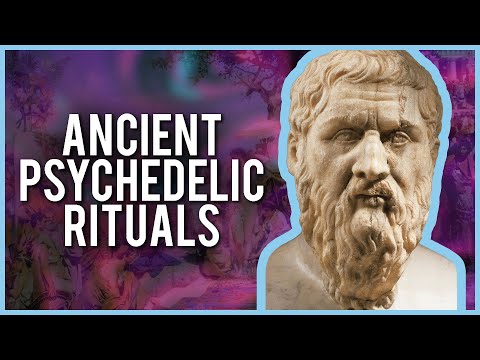
The Psychedelic Origins Of Western Civilisation - Brian Muraresku | Modern Wisdom Podcast #276
Brian Muraresku (guest), Chris Williamson (host), Narrator
In this episode of Modern Wisdom, featuring Brian Muraresku and Chris Williamson, The Psychedelic Origins Of Western Civilisation - Brian Muraresku | Modern Wisdom Podcast #276 explores did Psychedelics Shape Ancient Greece, Early Christianity, And Us Today? Brian Muraresku discusses his 12‑year investigation into whether psychedelic sacraments underpinned the Greek mysteries at Eleusis and were later inherited by early Christianity. He argues that visionary, drug-assisted experiences may have been central to how ancient Greeks and first Christians understood death, immortality, and direct contact with the divine. Drawing on literary evidence, archaeochemistry, and fieldwork from Spain to the Vatican, he explores the “pagan continuity” between Greek mystery cults, Dionysian wine rituals, and the Christian Eucharist. The conversation also considers why these traditions disappeared, why they were kept secret, and what their rediscovery could mean for modern spirituality, medicine, and meaning-making.
Did Psychedelics Shape Ancient Greece, Early Christianity, And Us Today?
Brian Muraresku discusses his 12‑year investigation into whether psychedelic sacraments underpinned the Greek mysteries at Eleusis and were later inherited by early Christianity. He argues that visionary, drug-assisted experiences may have been central to how ancient Greeks and first Christians understood death, immortality, and direct contact with the divine. Drawing on literary evidence, archaeochemistry, and fieldwork from Spain to the Vatican, he explores the “pagan continuity” between Greek mystery cults, Dionysian wine rituals, and the Christian Eucharist. The conversation also considers why these traditions disappeared, why they were kept secret, and what their rediscovery could mean for modern spirituality, medicine, and meaning-making.
Key Takeaways
Psychedelics may have been central to Greek and early Christian religious practice.
Muraresku frames two key questions—whether ancient Greeks used drugs to find God and whether early Christians inherited that practice—and argues that affirmative answers would mean Western civilization rests partly on visionary, psychedelic experiences.
Get the full analysis with uListen AI
The Eleusinian Mysteries likely involved a psychoactive sacrament linked to death–rebirth.
Eleusis hosted an annual, state-run initiation where thousands underwent a secret, life-changing ‘vision’ after drinking a sacred potion; literary hints and modern chemistry suggest this “magic beer” may have contained ergot, the fungus behind LSD.
Get the full analysis with uListen AI
Hard scientific evidence for ancient psychoactive drinks is emerging but still sparse.
Archaeochemical work has identified ergotized beer in a Greek sanctuary in Spain and complex additive wines in the Near East, supporting earlier theories that ancient sacraments were pharmaceutically enhanced, though precise doses and recipes remain unknown.
Get the full analysis with uListen AI
Early Christian rituals may have reinterpreted and domesticated pagan mystery practices.
Muraresku highlights overlaps between Dionysian wine cults and the Eucharist—both described as divine blood conferring immortality—and suggests Jesus’ Last Supper narrative can be read as bringing an “immortality potion” from temple and forest into the home.
Get the full analysis with uListen AI
Secrecy and later suppression obscured these traditions from the historical record.
The Mysteries relied on strict secrecy to preserve the power of the experience, wrote down little doctrine, and were later marginalized or extinguished by Christian emperors and shifting political realities, leading to a generational loss of knowledge.
Get the full analysis with uListen AI
Modern psychedelic science echoes ancient claims about life’s most meaningful experiences.
Studies from Johns Hopkins show that about 75% of participants rate a single psilocybin session among the most meaningful events of their lives, paralleling ancient testimonies from Eleusis that initiation resolved death anxiety and guaranteed an afterlife.
Get the full analysis with uListen AI
Revisiting these roots could reshape how we see religion, medicine, and identity today.
By reconnecting Greek rationalism, Christian mysticism, and psychedelic technology, Muraresku suggests we may heal an old sacred–secular split and open new avenues for treating existential distress amid contemporary crises of meaning.
Get the full analysis with uListen AI
Notable Quotes
“If you die before you die, you won't die when you die.”
— Brian Muraresku (quoting an inscription from Mount Athos)
“You went to Eleusis to test the god hypothesis.”
— Brian Muraresku
“Whoever eats my flesh and drinks my blood has eternal life… right here, tonight.”
— Brian Muraresku (on Jesus’ words in Greek about the Eucharist)
“What if this is the real religion of the ancient Greeks?”
— Brian Muraresku
“If what you say is true… then we have a lot of catching up to do.”
— Chris Williamson
Questions Answered in This Episode
If psychedelics truly underpinned early Christian practice, how should modern churches respond to that revelation?
Brian Muraresku discusses his 12‑year investigation into whether psychedelic sacraments underpinned the Greek mysteries at Eleusis and were later inherited by early Christianity. ...
Get the full analysis with uListen AI
To what extent can we ethically and accurately recreate ancient sacraments like the Eleusinian kykeon using modern science?
Get the full analysis with uListen AI
How might acknowledging a psychedelic foundation to Western civilization change our current debates about drug policy and mental health treatment?
Get the full analysis with uListen AI
Are direct, drug-assisted mystical experiences fundamentally compatible with institutional religion, or do they inevitably undermine hierarchical structures?
Get the full analysis with uListen AI
What risks arise when powerful visionary technologies are revived in a modern culture that lacks the rigorous initiation frameworks of the ancient mysteries?
Get the full analysis with uListen AI
Transcript Preview
... I call it the best kept secret in history, are essentially two questions. Number one, did the ancient Greeks use drugs to find God? And number two, did the earliest Christians inherit part of that tradition? If the answer to both of those questions is yes, then it means that western civilization as we know it was somewhat founded on a visionary experience, and Christianity, the world's biggest religion today with two-and-a-half billion people, might be tapping into those same psychedelic waters.
You're a qualified lawyer. Why are you talking about the psychedelic origins of western civilization?
That's the great question. I feel like, uh, I'm, I'm still a barrister, still barr- Do you- Is that what you call it, barristering?
Uh, l- lawyering? Law- Being a, being a barrister-
(laughs) I'm not a lawyer.
... being a b- barristering, yeah. If anyone can tell us if the verb is to barrister, uh ... (laughs)
(laughs) So I still do that, believe it or not. Um, I'm still in good standing in New York State and Washington D.C. for the moment, and, uh, I don't know, I don't know. I just, I started reading about psychedelics and I couldn't stop.
But weren't tempted to try them? You actually o- oh, sorry, decided not to try them. You remained as psychedelically un-, uh, initiated throughout the writing of your book.
My virginity was and remains intact.
Is that going to change at any point soon?
Um, soon, in the coming years. I'm not sure exactly when. But as it becomes legal and as the facilities come online where you can have an experience that is, uh, you know, responsible and scientifically rigorous, and also for me, authentically sacred and historical, I think that'll be my moment.
It's gonna be so fascinating to see what happens to you having spent over a decade thinking, reflecting, uh, uh, considering, and then also going into wondering what other people's experiences are, like the, the meta-experience. What did they think? What did they feel? Man, whatever it is that you end up going through, is, are you gonna be shot into another universe?
I can't wait. Uh, I'm always, part of me is always thinking the great irony of all of this would be if absolutely nothing happened. (laughs)
(laughs) All this time, all this time.
(laughs) I was wrong.
Fucking what a waste. It was all a big troll. Uh, is there a movie coming out?
(laughs)
Is there a movie coming out about the book?
Um, we, we hope so, um, at least a, a documentary series. So w- we're busy pitching that to different networks and streamers, uh, here in the US. But obviously it'll have a, a global audience.
Dude, that's so cool.
Yeah, man. We have, that, that's, that's been a, you know, a big part of my, my job the past few weeks and months.
Install uListen to search the full transcript and get AI-powered insights
Get Full TranscriptGet more from every podcast
AI summaries, searchable transcripts, and fact-checking. Free forever.
Add to Chrome