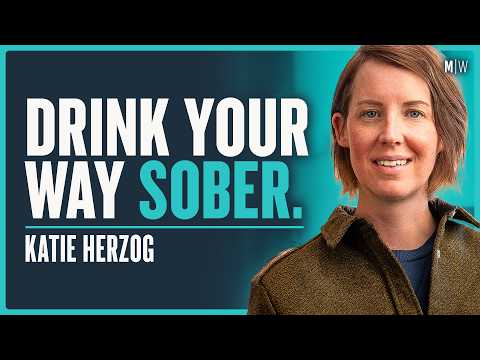
A Controversial New Cure for Alcohol Dependence - Katie Herzog
Chris Williamson (host), Katie Herzog (guest), Narrator
In this episode of Modern Wisdom, featuring Chris Williamson and Katie Herzog, A Controversial New Cure for Alcohol Dependence - Katie Herzog explores journalist Reveals Little-Known Pill That Quietly Erased Alcohol Cravings Katie Herzog describes a decades-long progression from teenage binge drinking to secret, compulsive alcohol use that dominated her thoughts and sabotaged her life. She and Chris Williamson unpack how culture normalizes heavy drinking, why most people naturally age out while some don’t, and why traditional treatments like AA and therapy repeatedly failed her. Herzog then explains discovering the Sinclair Method, a protocol using the opioid blocker naltrexone taken before drinking to extinguish the brain’s reward from alcohol. Over seven months this method virtually eliminated her cravings, allowing her to stop drinking without white‑knuckled abstinence and inspiring her to write a pragmatic self-help book about it.
Journalist Reveals Little-Known Pill That Quietly Erased Alcohol Cravings
Katie Herzog describes a decades-long progression from teenage binge drinking to secret, compulsive alcohol use that dominated her thoughts and sabotaged her life. She and Chris Williamson unpack how culture normalizes heavy drinking, why most people naturally age out while some don’t, and why traditional treatments like AA and therapy repeatedly failed her. Herzog then explains discovering the Sinclair Method, a protocol using the opioid blocker naltrexone taken before drinking to extinguish the brain’s reward from alcohol. Over seven months this method virtually eliminated her cravings, allowing her to stop drinking without white‑knuckled abstinence and inspiring her to write a pragmatic self-help book about it.
Key Takeaways
Heavy drinking is often culturally rewarded, which hides genuine addiction.
Wild drunken stories are treated as funny rites of passage, making it harder for problem drinkers to recognize their behavior as abnormal or feel justified in seeking help.
Get the full analysis with uListen AI
Most young binge drinkers ‘age out’ naturally, but a minority don’t.
Herzog highlights ‘natural recovery’—many people simply reduce drinking as adult responsibilities grow—while those with genetic risk, early exposure, and repeated use often remain stuck in harmful patterns.
Get the full analysis with uListen AI
Knowing alcohol is a problem isn’t enough if cravings dominate decision-making.
She describes waking up determined not to drink, only to be overpowered by craving by midday, illustrating how addiction can override values, love for family, and rational intentions.
Get the full analysis with uListen AI
AA’s abstinence and spiritual framework helps some but leaves many behind.
Herzog found AA didn’t reduce her cravings, clashed with her skeptical temperament, and required introspective ‘step work’ she resisted—showing why a one-size-fits-all recovery model is insufficient.
Get the full analysis with uListen AI
Naltrexone can extinguish alcohol’s reward for certain ‘reward drinkers.’
Taken an hour before drinking, the opioid blocker prevents the endorphin high, gradually training the brain that alcohol is no longer pleasurable; over months her desire to drink largely disappeared.
Get the full analysis with uListen AI
The Sinclair Method requires strict adherence and behavior change to work.
You must only drink on naltrexone, allow it to fully kick in, increase alcohol-free days, and deliberately seek other sources of pleasure, or you risk reinforcing the addiction instead of weakening it.
Get the full analysis with uListen AI
Medical and systemic barriers keep effective medications underused.
Minimal addiction training in medical school, legal fears about ‘prescribing drinking,’ lack of pharma marketing for cheap generics, and AA’s cultural dominance all contribute to naltrexone’s low visibility.
Get the full analysis with uListen AI
Notable Quotes
“I knew that I was a problem drinker from a very young age, but my hope was that some future me would just be able to take it or leave it. That never happened.”
— Katie Herzog
“I don’t think I loved booze more than I loved my wife. It’s that I had no control over it.”
— Katie Herzog
“The fundamental paradox is: I need to quit, but I don’t want to stop. I love this thing, but I hate this thing.”
— Katie Herzog
“This is one of those cases where you can get better information from Facebook groups and Reddit than from your own GP.”
— Katie Herzog
“It feels like the whole alcoholic world has been over‑moralized and under‑medicalized.”
— Chris Williamson
Questions Answered in This Episode
How can someone realistically determine whether they’re a ‘reward drinker’ who might benefit from naltrexone versus a ‘relief drinker’ for whom it likely won’t help?
Katie Herzog describes a decades-long progression from teenage binge drinking to secret, compulsive alcohol use that dominated her thoughts and sabotaged her life. ...
Get the full analysis with uListen AI
What safeguards or protocols could address doctors’ legal and ethical concerns about prescribing the Sinclair Method, given that it explicitly involves continued drinking?
Get the full analysis with uListen AI
If AA and abstinence-first models remain dominant, how can we integrate medication-assisted approaches without creating a culture war inside recovery communities?
Get the full analysis with uListen AI
What are the potential downsides or risks of the Sinclair Method that might not be obvious to someone desperate to try ‘the pill that makes you not want to drink’?
Get the full analysis with uListen AI
As Gen Z drinks less but socializes less in person, what should we be building to replace the community and social skills that alcohol-centered spaces used to provide?
Get the full analysis with uListen AI
Transcript Preview
Talk to me about your relationship with alcohol.
Oh, gosh, it's a complicated question. So my relationship with alcohol started very young. I started drinking ... or I had my first drink when I was in middle school. I don't know if this is something that 12-year-olds do these days, but, uh, but back in my day, 12-year-olds drank, or at least they did in my school. And I, I loved it. I loved it from the very beginning, um, even before I was sort of old enough to appreciate the, the taste of a good glass of wine or a cold beer. I liked the effect. And so I drank in, in high school, I drank more in college, and by the time I was out of college, I was a bar fly. So I spent a lot of time sitting on bar stools from 4:00 PM until late at night, oftentimes with men who were (laughs) ... 'cause these were the sort of people who would, who would be at bars drinking during the day, like men in their 50s and 60s. These were, these were my people. Um, and I, I lived like that for a really long time. I was a party girl, so I was a lot of fun back in those days. I gradually got less fun the more my drinking accelerated. By the time I, I quit in my late 30s/early 40s, I wasn't a party girl anymore. Most of my drinking was done solo and in secret. Um, but that was it. And this was not, this was not abnormal among my, my peers and my friends. I ... My life was lived in bars. This is what my friends and I did. And there were, of course, consequences to this, some of them pretty terrible. Um, I went to the hospital a couple times. I, uh, I very memorably burned down a porch at one point. I had trouble k- ... I see, I see your, your brow is sort of furrowing here. Do you wanna know how I, how I burned down a porch?
Yes.
So (laughs) this was actually one of the times when I was ... I thought I was being a good girl, so I stayed home on, like, a, a weekday night, which was rare to me at this period of my life. This was in my late twen- or my mid-20s. I spent e- ... When I say I went to ... I was a bar fly, I was at the bar almost every day. And luckily, this was at a time when, when Pabst Blue Ribbon was a buck 50, you tipped 50 cents, so I was not ... didn't ha- ... My bar tabs were hefty for the amount of money that I was making, but still, my drinks were cheap. And so I stayed home one night, thinking I'm doing the right thing, and I was also a smoker, and I, uh ... And ironically, I was, I was watching, uh, this, this fantastic television show. I can't remember what it was called, but it was about the, the NY ... It was the New York City Fire Department. Uh, Denis Leary was in it. So I was drinking at home by myself, taking regular cigarette breaks, and watching this TV show. And on one of my cigarette breaks, I, uh, failed to extinguish a cigarette. I just, like, left it burning outside, and I lived in an apartment building. I, I walked outside, I saw some smoke and, like, a, a fairly significant hole in the wall where the vinyl siding had started to melt. I went and got a glass of water first, tried that, splashed it on, it didn't work. Went and got the fire extinguisher, tried that, that didn't quite work. It was still burning. And then I called 911, and they said, you know, "This is 9- this is 911, what's your emergency?" And I said, "Well, I'm not really sure if this is an emergency. I'm really more looking for advice." And so I wanted them to reassure me that ... I don't know what I wanted. I just didn't want to get in trouble, basically. Eventually, they did come, and I had to bang on all of my neighbors' doors and tell them that the apartment building was on fire, and, um, while the fire department was in my house dragging a hose through my carpeted living room floor out to the balcony out my bedroom, I was outside in a patch of woods drinking vodka. And the next day, all of my friends knew about this, I lived in a really small town, I woke up to a friend of mine shouting from outside, "What the fuck did you do?" Um, so everybody knew about this, and frankly thought it was hilarious, because that's the sort of community that I lived in. And I thought it was hilarious too. I mean, terrible, but also hilarious. So I had lots of sort of misadventures like that. I had trouble holding onto jobs. I dropped out of college once, I dropped out of grad school once. I did finish college, I didn't finish grad school. And alcohol just really dominated my life for my teens, 20s, and well into my 30s. Um, and it got ... Gradually, it got less fun, and it got kind of more depressing as the, as the sort of friendships evaporated, as everybody else kind of got their shit together or didn't get their shit together and, and died. Frankly, a lot of people I know from those days, from those days are dead. Um, and at some point, I realized I was just sort of drinking alone, you know, the last one at the bar, except the bar wasn't a bar, it was my house, and I was by myself scrolling on my phone during COVID, drinking alone as much as I could.
Install uListen to search the full transcript and get AI-powered insights
Get Full TranscriptGet more from every podcast
AI summaries, searchable transcripts, and fact-checking. Free forever.
Add to Chrome