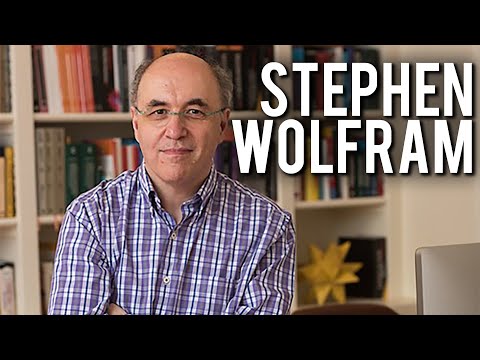
Stephen Wolfram | The At Home CEO
Stephen Wolfram (guest), Chris Williamson (host), Narrator
In this episode of Modern Wisdom, featuring Stephen Wolfram and Chris Williamson, Stephen Wolfram | The At Home CEO explores stephen Wolfram Reveals Systems Behind His Hyper-Productive Remote Life Stephen Wolfram discusses how he has engineered his life, company, and environment to maximize deep work and minimize friction. He explains his “thinking in public” approach, remotely leading an 800-person tech company through live, highly candid screen-share meetings that are often livestreamed to the public. He details his personal infrastructure—from treadmill and walking desks to sleep clocks and inbox analytics—along with his philosophy of automation, delegation, and building long-lived project “matrices.” The conversation closes by connecting his productivity mindset to his broader mission: creating computational language and tools like Wolfram|Alpha to turn human questions and contracts into computable, automatable processes.
Stephen Wolfram Reveals Systems Behind His Hyper-Productive Remote Life
Stephen Wolfram discusses how he has engineered his life, company, and environment to maximize deep work and minimize friction. He explains his “thinking in public” approach, remotely leading an 800-person tech company through live, highly candid screen-share meetings that are often livestreamed to the public. He details his personal infrastructure—from treadmill and walking desks to sleep clocks and inbox analytics—along with his philosophy of automation, delegation, and building long-lived project “matrices.” The conversation closes by connecting his productivity mindset to his broader mission: creating computational language and tools like Wolfram|Alpha to turn human questions and contracts into computable, automatable processes.
Key Takeaways
Automate anything you repeatedly do that could be done by a machine.
Wolfram relentlessly looks for processes where many people spend months on tasks that can be encoded once and run forever, creating huge leverage with a relatively small team of 800 employees.
Get the full analysis with uListen AI
Understand every significant part of your business or it will underperform.
His experience is that any area he doesn’t truly understand is where quality and motivation degrade, because staff sense what leadership cares about and he can’t effectively assess or correct issues there.
Get the full analysis with uListen AI
Use “thinking in public” to solve complex problems with your team.
Instead of disappearing to think alone, he solves problems live in meetings, typing into shared notebooks and even livestreaming sessions, which accelerates decisions, builds shared understanding, and invites real-time expert feedback.
Get the full analysis with uListen AI
Design physical and digital environments to eliminate friction and stagnation.
From pull-out desk surfaces to prevent piles, to treadmill and outdoor walking desks for frustrating meetings, to sleep clocks and inbox graphs, he builds small systems that make the desired behavior the path of least resistance.
Get the full analysis with uListen AI
Delegate aggressively—but not blindly—and teach by doing in public.
He delegates everything he reasonably can, but keeps tasks that he can do in minutes and others would struggle with for weeks, often solving them live while others watch so they learn how to handle them next time.
Get the full analysis with uListen AI
Choose projects that fit into long-lived “matrices” so work compounds.
He avoids one-off efforts (like writing a random play) and instead channels ideas into existing structures—technology stack, historical writing, scientific programs—so each project benefits from and strengthens prior work.
Get the full analysis with uListen AI
Think computationally about life: formalize processes so they can be automated.
The same instinct that led him to build Wolfram Language and Wolfram|Alpha also shapes his personal systems; once a process (sleep tracking, contracts, email triage) is specified precisely, it can be delegated to code and scaled.
Get the full analysis with uListen AI
Notable Quotes
“If there's some part I don't understand, that's the part that's gonna get messed up.”
— Stephen Wolfram
“So long as you can handle directness, directness is much more efficient.”
— Stephen Wolfram
“Any flat surface on your desk is a potential stagnation point for accumulating piles of stuff.”
— Stephen Wolfram (paraphrasing his written principle, discussed in the interview)
“The things I do are things I really like to do. I like to do the things I like, and not be distracted by things I don’t need to be distracted by.”
— Stephen Wolfram
“Our goal is that any question that can be answered on the basis of knowledge our civilization has should be automatable.”
— Stephen Wolfram
Questions Answered in This Episode
How could an ordinary knowledge worker begin to apply Wolfram’s “thinking in public” method without livestreaming everything?
Stephen Wolfram discusses how he has engineered his life, company, and environment to maximize deep work and minimize friction. ...
Get the full analysis with uListen AI
Where is the line between healthy automation and over-optimizing life to the point of rigidity or burnout?
Get the full analysis with uListen AI
What are practical ways for non-technical people to start “thinking computationally” about their own processes and decisions?
Get the full analysis with uListen AI
How might widespread use of computational contracts change power dynamics and job roles in law, business, and government?
Get the full analysis with uListen AI
What trade-offs does Wolfram make between responsiveness to his existing systems and carving out time for entirely new, decade-scale projects?
Get the full analysis with uListen AI
Transcript Preview
I mean, I have a pretty complicated company, but I try and understand, you know, every aspect of what we do, and I also know very well that if there's some part I don't understand, that's the part that's gonna get messed up. I mean, the one, one thing that happens in a company like mine, which is a tech company, is that, you know, I've also been pushing for another thing, which is automate everything I can. So you know, we've, we've got only 800 employees, but you know, the productivity that we manage to generate is a, a vast multiple of what you would expect from that number because over the years, you know, any process that I've seen where I can say, "Why do we have 20 people working on this for six months? This is something that can be automated." And while it's gonna take some effort to automate it, but once it's automated, you can just crank it out all the time. (wind blows)
I'm joined today by Stephen Wolfram. Stephen, welcome to the show.
Thank you.
I, uh, am particularly excited to speak to you today. Um, one of your blog posts that was released earlier this year, Seeking the Productive Life, was shared around in a number of different group chats, and when that happens, when it appears in a few different spheres of awareness, I think it's usually a pretty good, uh, pretty good idea that it's, uh, it's gonna be something interesting. So, I wanted to talk to you today about your approach to productivity and personal analytics before we actually get into what it is that you do. The, the work you do is, is interesting, but the way that you do it is almost as fascinating to me, which is (laughs)
I, I like to think it's interesting. I've been doing it for, for decades, so-
(laughs)
... it better be interesting, or I'm-
(laughs) Right?
... or I'm, uh, should be embarrassed, but yes. The, the, um, but yeah, you know, the main thing is that I like to do the things I like to do, and I like to not be distracted by things I don't need to be distracted by. And so I tend to build all these systems to try to automate as much as possible to try to, you know, be as concentrated as I can in actually doing the work I want to do. And so I've, I've, uh, and I would say the, the number one tool, which is not for everybody, that I've built to get, um, my work done is I built a company over the last 32 years that has, you know, 800 people in it. And it's sort of, uh, intended to be a machine for taking ideas that I have and turning them into real things. And so that, uh, but one of the things that is probably more, uh, uh, sort of generalizable is one of the ways that I tend to work is I'm, I'm, you know, on any given day, I'm trying to create things, I'm trying to have ideas, and I'm trying to turn them into real things. And, uh, I tend to follow the sort of approach of, uh, spending a lot of my time doing what I tend to call thinking in public, which means, you know, you're working with a team of people, and some people would imagine that, you know, when you're gonna go figure out what to do, you go off on your own, you hide away, you figure out what to do. That's not what I tend to do. What I tend to do is it's like I'm doing some meeting with the people who are involved, and that's the actual time when we figure out what we're gonna do. It's not something which is happening sort of behind the scenes. And I found that, you know, I have been a remote CEO for 29 years now, which is another bizarre feature, so most of my, uh, uh, you know, interaction with people is screen sharing plus audio. I usually avoid video. So like, the experience we're having right now is unusual for me. I'm, I'm usually a, uh, you know, I've got audio-
Install uListen to search the full transcript and get AI-powered insights
Get Full TranscriptGet more from every podcast
AI summaries, searchable transcripts, and fact-checking. Free forever.
Add to Chrome