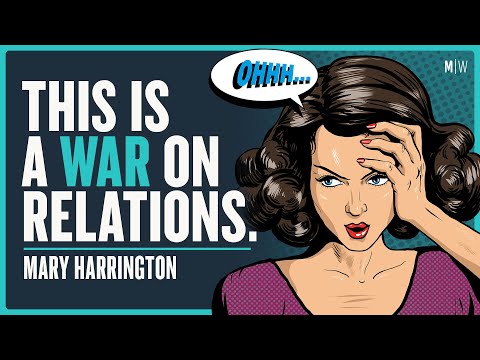
Modern Society Is Failing Men & Women - Mary Harrington
Mary Harrington (guest), Chris Williamson (host)
In this episode of Modern Wisdom, featuring Mary Harrington and Chris Williamson, Modern Society Is Failing Men & Women - Mary Harrington explores war On Relationships: Feminism, Tech, Porn And Broken Modern Intimacy Chris Williamson and Mary Harrington explore how modern feminism, technology, and market forces have unintentionally eroded organic human relationships, especially between men and women. Harrington argues that dismantling chivalry, liquefying sexual norms, and pushing everything through digital or commercial channels has produced loneliness, intimate violence, and widespread pornified dysfunction rather than liberation. They connect online culture wars, youth internet subcultures, porn dynamics, and COVID-era policies to a broader “war on relationships” that replaces embodied community with optimized, monetized interactions. The discussion ends with tentative prescriptions: re‑sacralizing marriage and family, recreating single‑sex spaces, and acknowledging persistent sex differences and power dynamics instead of pretending humans are infinitely malleable.
War On Relationships: Feminism, Tech, Porn And Broken Modern Intimacy
Chris Williamson and Mary Harrington explore how modern feminism, technology, and market forces have unintentionally eroded organic human relationships, especially between men and women. Harrington argues that dismantling chivalry, liquefying sexual norms, and pushing everything through digital or commercial channels has produced loneliness, intimate violence, and widespread pornified dysfunction rather than liberation. They connect online culture wars, youth internet subcultures, porn dynamics, and COVID-era policies to a broader “war on relationships” that replaces embodied community with optimized, monetized interactions. The discussion ends with tentative prescriptions: re‑sacralizing marriage and family, recreating single‑sex spaces, and acknowledging persistent sex differences and power dynamics instead of pretending humans are infinitely malleable.
Key Takeaways
Eroding chivalry removed informal constraints on male aggression that many women relied on.
Harrington argues that attacking chivalrous norms (like codes against harming women) was a catastrophic feminist ‘self‑own’, especially for women in less privileged, more violent environments who benefited most from simple, widely understood guardrails.
Get the full analysis with uListen AI
The sexual revolution decoupled sex from consequences, often to women’s and children’s detriment.
Widespread contraception and abortion increased total sexual encounters, leading to more unplanned pregnancies, fewer ‘shotgun’ marriages, and social pressure on women to accept loveless or degrading sex because pregnancy was now seen as their responsibility to avoid or resolve.
Get the full analysis with uListen AI
Porn consumption tends toward escalation, reshaping desire and sabotaging intimacy.
Harrington’s ‘law of fap entropy’ claims that what initially arouses someone will soon become boring, pushing users toward more extreme content; this can rewire arousal patterns so far that normal relationships feel unsatisfying or impossible without intense, specific stimuli.
Get the full analysis with uListen AI
Digital culture creates parallel realities and meme-fueled extremism with real-world stakes.
From trans debates to Ukraine narratives, the same facts are curated into mutually exclusive worldviews, turning conflicts into zero-sum fandoms that can ‘meme’ societies toward extreme positions, including casual talk of nuclear war by people detached from its consequences.
Get the full analysis with uListen AI
Modern systems increasingly monetize and mediate all human connection through markets and screens.
Dating apps, OnlyFans, Zoom calls, and policies like South Korea’s ‘untact’ strategy channel desire and socializing into commercial or automated systems, crowding out unstructured, unpaid interactions like family gatherings, church, playgrounds, and informal community life.
Get the full analysis with uListen AI
Young women are beginning to rebel against hypersexualization and ‘sex-positive’ norms.
After experiencing ‘don’t kink-shame me’ culture and coercive or violent sexual encounters, some Gen Z women are embracing more modesty, sex-negativity, or withdrawal from hookup culture, seeking safety and dignity over experimentation.
Get the full analysis with uListen AI
Rebuilding relational health likely requires re-valuing marriage, single-sex spaces, and sex differences.
Both speakers suggest putting marriage and family back on a pedestal, accepting stable power dynamics (including in the bedroom), and restoring male-only and female-only spaces to support healthy development—rather than pretending complete interchangeability between the sexes.
Get the full analysis with uListen AI
Notable Quotes
“Attacking chivalry as a certain social code has been the biggest self‑own that feminism could possibly have come up with. It’s been absolutely catastrophic.”
— Mary Harrington
“Once you start seeing the war on relationships, you can’t unsee it.”
— Mary Harrington
“We’re gonna meme ourselves into international nuclear war, and that’s fucking terrifying.”
— Mary Harrington
“The consequence of liquefying all courtship rituals and sexual norms wasn’t a feminist paradise of non‑exploitative sex, but endemic intimate violence and a multi‑billion dollar porn industry.”
— Mary Harrington (quoted by Chris Williamson from her writing)
“People don’t have ideas. Ideas have people.”
— Chris Williamson
Questions Answered in This Episode
If chivalry functioned as a social safety mechanism for women, what alternative norms or institutions could constrain male aggression in a post‑chivalry world?
Chris Williamson and Mary Harrington explore how modern feminism, technology, and market forces have unintentionally eroded organic human relationships, especially between men and women. ...
Get the full analysis with uListen AI
How can societies realistically ‘re‑sacralize’ sex and marriage without reverting to oppressive or impractical legal restrictions on contraception, abortion, or divorce?
Get the full analysis with uListen AI
What would a policy agenda look like that prioritizes non‑market, in‑person relationships (family, community, friendship) over purely economic productivity and digital optimization?
Get the full analysis with uListen AI
Given the escalation dynamics of porn, are there any sustainable ‘harm‑reduction’ strategies, or does meaningful reform require radical cultural and technological shifts?
Get the full analysis with uListen AI
How can we create single‑sex and youth spaces that support healthy development without slipping into exclusionary practices that simply recreate old injustices for women or minorities?
Get the full analysis with uListen AI
Transcript Preview
Attacking chivalry as a certain social code has been the biggest self-oh that feminism could possibly have come up with. It's been absolutely catastrophic. It was an incredibly stupid idea. (wind blowing)
Mary Harrington, welcome to the show.
Thank you for having me.
I spent a couple of days in New York with a friend. I'm not around young children. I don't have any children, at least ones that I'm aware of. And I got to see the tyranny that is bedtime. Uh, and-
(laughs)
... from my perspective, you can tell me if this is true, right? To me, it seems like a daily game theoretic litigative negotiation with a tiny drunk tyrant, uh-
(laughs)
... that happens every single day on an evening at pretty much the same time. How accurate of a representation is that?
Uh, uh, yes, maybe, sometimes. Uh, it depends a lot on your child's personality, and it depends a little bit on how you roll as a parent as well. Um, what I mean by that is, um, if you, if you treat small children as rational beings who need to be negotiated with, then you're, you're letting yourself in for a world of pain. Um, but if you treat them as something a little bit more like dogs that need to be trained, and I say that with love, um, as a mother who really very profoundly loves her daughter, um, and you, and you start doing that very lovingly and very firmly from a young age, you know, with luck and patience, um, you'll have a child who likes a bedtime routine, who's familiar with it, and who's, when they get to a point of tiredness, just goes, "Oh, okay, now I'm in the groove. Now I know what's coming next." And they'll just chill out, and then bedtime becomes a relaxing thing. So, it depends on a number of different factors. I mean, also how many kids you have. You know, if you've got three, then, you know, that harmonious sort of twinkly, twinkly twinkly kind of thing isn't quite so straightforward because they all want different things. And, you know, my dear friend who has three under five, um, you know, it's, it's, uh, it's, it is a little bit more like crowd control. Um, you know, you've got one, one screaming for milk while the other one is, um, throwing poo at the wall or whatever, you know.
(laughs)
So, it, it's, it's a different ball game. But, but I think, but the idea, the goal is, is to have a routine that everybody just kind of falls into and you know where you are with things. And, and actually, it's more like, it's more like, uh, it's, it, it's, it, it's about training the unconscious mind so that you can, you can think less about the stuff that doesn't matter. You know, in that way, it's like doing a kata in martial arts. You know, it's just teaching, teaching the body to react instinctively. And I think that's very much, that's very much the approach that I'm in favor of when it comes to very small children.
Install uListen to search the full transcript and get AI-powered insights
Get Full TranscriptGet more from every podcast
AI summaries, searchable transcripts, and fact-checking. Free forever.
Add to Chrome