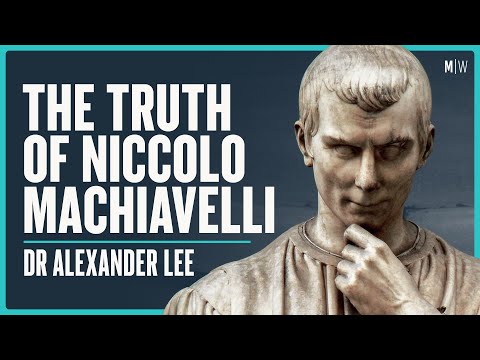
The Story Behind Machiavelli's Philosophy - Dr Alexander Lee | Modern Wisdom Podcast 321
Dr Alexander Lee (guest), Chris Williamson (host)
In this episode of Modern Wisdom, featuring Dr Alexander Lee and Chris Williamson, The Story Behind Machiavelli's Philosophy - Dr Alexander Lee | Modern Wisdom Podcast 321 explores human, Flawed, And Misread: Rethinking Machiavelli’s True Political Legacy Dr. Alexander Lee and Chris Williamson explore how Niccolò Machiavelli’s real life sharply contrasts with the cold, hyper-competent ‘Machiavellian’ stereotype. Far from a flawless mastermind, Machiavelli was a fallible, often blundering bureaucrat navigating chaotic Florentine politics, whose greatest strengths were self-awareness and observational insight rather than political success.
Human, Flawed, And Misread: Rethinking Machiavelli’s True Political Legacy
Dr. Alexander Lee and Chris Williamson explore how Niccolò Machiavelli’s real life sharply contrasts with the cold, hyper-competent ‘Machiavellian’ stereotype. Far from a flawless mastermind, Machiavelli was a fallible, often blundering bureaucrat navigating chaotic Florentine politics, whose greatest strengths were self-awareness and observational insight rather than political success.
They unpack how The Prince emerged as a context-specific, semi-disguised job application to the Medici, yet was later decontextualized and turned into a timeless manual of amorality, fueling his notorious reputation. Lee contrasts The Prince with Machiavelli’s republican Discourses, showing that both works grapple with the same core problem: how states survive amid fortune’s instability.
The conversation also humanizes Machiavelli through stories of his drinking, affairs, bawdy humor, failures on diplomatic missions, and emotional lows, underscoring how relatable he is compared to carefully self-mythologized historical figures. Finally, Lee extracts cautiously “universal” lessons about adaptability to fortune, the political dangers of wealth inequality, and the value of resilient self-honesty.
Key Takeaways
Context radically changes how The Prince should be read.
The Prince was written as a discreet job application to the newly restored Medici regime amid Italian wars and Florentine factionalism, not as a timeless evil manifesto. ...
Get the full analysis with uListen AI
Machiavelli advocates conditional ruthlessness, not blanket immorality.
He argues that rulers must *be able* to act against conventional virtue—cruel, parsimonious, deceptive—when necessary for state survival, while also warning that excessive cruelty or fear provokes rebellion. ...
Get the full analysis with uListen AI
Fortune’s unpredictability demands flexibility and decisive action.
Across his works, Machiavelli personifies Fortune as a capricious woman who cannot be appeased by virtue or piety. ...
Get the full analysis with uListen AI
Great disparities of wealth undermine political stability.
Drawing on Florentine divisions between the popolo and the ‘fat cats’ (grassi), Machiavelli observes that oligarchs seek to dominate while the people seek not to be dominated. ...
Get the full analysis with uListen AI
Machiavelli’s life shows intellectual brilliance can coexist with repeated failure.
He misreads situations, mishandles missions, picks losing sides, and is repeatedly on the wrong end of regime changes, unlike more adaptable contemporaries. ...
Get the full analysis with uListen AI
Humanizing canonical thinkers makes their ideas more usable and criticizable.
Seeing Machiavelli as a witty, randy, self-mocking ‘bit of a lad’ who drinks, gambles, writes bawdy plays, and suffers depressive lows removes his Olympian aura. ...
Get the full analysis with uListen AI
Not all of Machiavelli’s prescriptions worked in practice, even then.
His enthusiasm for citizen militias as superior to mercenary forces largely failed on the ground, as Florence’s militia underperformed in key crises. ...
Get the full analysis with uListen AI
Notable Quotes
“If I were to describe Machiavelli in a word, I would say that he was a bit of a lad.”
— Dr. Alexander Lee
“Fortune is what rules the world around us... She is very unpredictable and very capricious.”
— Dr. Alexander Lee (describing Machiavelli’s view)
“He is always making blunders... He’s better, I think, on paper than he is in his own political career.”
— Dr. Alexander Lee
“Knowing that he was a very human chap, who got down, who had a laugh, et cetera, I think is somehow... it makes it seem as if these Olympian figures aren’t so far beyond our reach.”
— Dr. Alexander Lee
“By humanizing any political philosopher, it becomes easier to engage with their works at a meaningful substantive level critically, rather than viewing them as works of some Olympian genius far beyond our reach.”
— Dr. Alexander Lee
Questions Answered in This Episode
If we fully accept the specific historical context of The Prince, what—if anything—remains genuinely ‘universal’ in Machiavelli’s political advice?
Dr. ...
Get the full analysis with uListen AI
How should modern leaders ethically navigate the Machiavellian tension between maintaining power and upholding moral or democratic norms?
They unpack how The Prince emerged as a context-specific, semi-disguised job application to the Medici, yet was later decontextualized and turned into a timeless manual of amorality, fueling his notorious reputation. ...
Get the full analysis with uListen AI
In contemporary politics, who tends to play the role of Machiavelli’s ‘people’ versus his ‘fat cats,’ and how should that shape institutional design?
The conversation also humanizes Machiavelli through stories of his drinking, affairs, bawdy humor, failures on diplomatic missions, and emotional lows, underscoring how relatable he is compared to carefully self-mythologized historical figures. ...
Get the full analysis with uListen AI
Does seeing Machiavelli as a flawed, sometimes unsuccessful operator increase or decrease the persuasive force of his political theories?
Get the full analysis with uListen AI
What other canonical thinkers might be similarly distorted by decontextualized readings, and how would reframing them as fallible humans change our current political debates?
Get the full analysis with uListen AI
Transcript Preview
A central theme running through all of Machiavelli's writings is fortune and the vicissitudes of fortune. Fortune, he says, is what rules the world around us. But she, it's always... he always imagines her as a, as a woman. She is very unpredictable and very capricious. You never know when she's going to rise you up to the highest heights and when she's going to knock you down on your knees.
Why is an Italian man from the 15th century worth writing about?
Um, I think there are, uh, at least two good reasons, uh, for that. Um, on the one hand, Machiavelli, uh, has, uh, exerted, uh, an influence over the development of Western political thought, um, like very few others. Um, there are not many discussions about, uh, realpolitik, uh, the nature of rulership, uh, the role of virtue or the lack thereof in public life, which do not, at some point, come back to Machiavelli in his writings. The second reason is closely connected with that. When we think of Machiavelli, um, it's quite natural for us to think of the adjective Machiavellian. Uh, that is to say someone who is shrewd, cunning, a little bit amoral, willing to do things that they probably shouldn't do in other areas of life. Uh, and that, uh, association, uh, which I'm sure we'll discuss in, in further detail later on in the show, um, has often colored the way we perceive the man. His life, however, uh, is quite different or gives us a quite different idea of, uh... or gives us a quite different impression. Um, although he often did things which were, um, questionable, he was far from being this infallible political genius, uh, that we may think of. Uh, in actual fact, uh, he was, uh, a very human person, uh, a flawed personality who was often getting things wrong, who was often finding himself in the wrong place at the wrong time, doing the wrong thing with the wrong people and getting found out. Um, so I think, yeah, uh, on the one hand we should look at Machiavelli from the point of view of his, uh, enduring relevance. So, I'm not really keen on the, the idea of relevance as a, as a criterion of historical study. If he's relevant to, to political discourse and on the other hand, because of the extent to which his life does, uh, sort of jars with that a little bit.
It seems like some of the established thought was that he was kind of born with this immutable characteristics, this, uh, amazing political thinker. And yet upon reading about his life, it seems like he kind of blunders and blunders and slowly gets less worse and less worse and less worse, and then eventually ends up at some degree of capability.
Um, I, I, um... Less worse. Uh, uh, he is always making blunders. Uh, from the beginning of his political career to the last moment, he is always getting things wrong. It doesn't... That's not to say, that's not to say he doesn't get thing, a lot of things right, but he is always making miscalculations. He's better, I think, on paper than he is in his own political career. Um, but it is certainly true that because of Machiavelli's enduring, uh, resonance, uh, within the field of political thought or history of political thought, um, many people even today, um, have been inclined to believe that he was born, um, you know, uh, (laughs) like Athena from the head of, uh, the, uh, of the philosophy gods, um, with this great insight. And, and it is... I mean, I'm not saying it's, it's completely wrong because one can detect the genesis of his ideas, um, in his thinking from a comparatively early date. But it is, I think, mistaken to believe that he was a man without flaws, without personal failings, uh, without, um, problems and difficulties. But for me, as I hope I've shown in the book, that makes him all the more relatable, all the more engaging and personable. I often say that, you know, I, uh... there are very few political thinkers in the world that I'd like to go for a, a pint with, but Machiavelli is certainly one of them.
Install uListen to search the full transcript and get AI-powered insights
Get Full TranscriptGet more from every podcast
AI summaries, searchable transcripts, and fact-checking. Free forever.
Add to Chrome