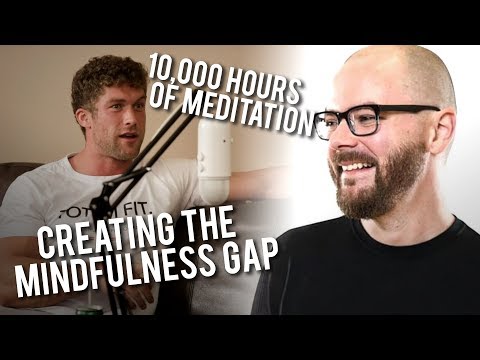
The Fundamentals Of Meditation | Cory Allen
Chris Williamson (host), Cory Allen (guest), Narrator
In this episode of Modern Wisdom, featuring Chris Williamson and Cory Allen, The Fundamentals Of Meditation | Cory Allen explores meditation Demystified: Practical, Secular Mindfulness for Modern Busy Minds Chris Williamson interviews meditation teacher and author Cory Allen to strip meditation back to its fundamentals and remove the intimidation around starting a practice.
Meditation Demystified: Practical, Secular Mindfulness for Modern Busy Minds
Chris Williamson interviews meditation teacher and author Cory Allen to strip meditation back to its fundamentals and remove the intimidation around starting a practice.
They explain why meditation is often misrepresented, emphasize a secular, experience-based approach, and outline simple, realistic ways for beginners to start without pressure to become “masters.”
The conversation explores how consistent practice creates both short-term (state) and long-term (trait) benefits, such as a gap between stimulus and response, reduced reactivity, and richer everyday awareness.
They also touch on psychedelics, technology, evolutionary psychology, and modern suffering to frame meditation as a practical tool for navigating an overwhelming, hyperconnected world.
Key Takeaways
Focus on method, not mystical experiences.
Most confusion comes from people trying to describe their internal experiences; instead, beginners should focus on clear, simple techniques (like breath counting) that reliably lead to their own direct experience.
Get the full analysis with uListen AI
Start tiny and don’t make meditation a big deal.
Begin with 5 minutes of comfortable sitting and counting 10 breaths, restarting when distracted. ...
Get the full analysis with uListen AI
Consistency beats intensity for real life change.
Meditating daily (or ~5x/week) for 20 minutes creates compounding “trait” shifts—more space between thought and reaction, less reactivity, and more presence—whereas occasional long sits mainly give short-lived “state” changes.
Get the full analysis with uListen AI
You are not your thoughts; you are your actions.
Intrusive or negative thoughts are normal and don’t define you; meditation trains you to acknowledge them, let them move on, and choose which ones you actually embody in behavior.
Get the full analysis with uListen AI
Meditation is compatible with a fully secular worldview.
You don’t need religious or spiritual beliefs to meditate; it can be framed purely as training attention and relating differently to your mind, which makes it more accessible in modern, pluralistic societies.
Get the full analysis with uListen AI
Use meditation proactively, not just as an emergency fix.
Practicing before stressful events (interviews, dates, hard conversations) gives a calm, clear baseline going in, instead of treating meditation only as a crisis antidote when stress is already high.
Get the full analysis with uListen AI
Altered states are less important than a better baseline.
While psychedelics can highlight how perception can change, Cory argues that a stable, richly aware everyday consciousness—cultivated through meditation—is ultimately more valuable than chasing repeated, dramatic state shifts.
Get the full analysis with uListen AI
Notable Quotes
“Meditation is an experience. It's an internal thing of the mind. It's not something you can describe.”
— Cory Allen
“The point is not to become a master. The point is to do just enough practice to feel a balance and a change that works for you.”
— Cory Allen
“You aren't your thoughts; you are what thoughts you put into action.”
— Cory Allen
“People often look for optimizing solutions when they’re in negative circumstances, but the real gain from meditation comes from doing it when you already feel fine.”
— Cory Allen
“There’s nothing to fear about meditation. You’re doing it every night—you just have to realize you’re doing it and point it in the right direction.”
— Cory Allen
Questions Answered in This Episode
How would my daily behavior actually change if I consistently created that small gap between thoughts and reactions?
Chris Williamson interviews meditation teacher and author Cory Allen to strip meditation back to its fundamentals and remove the intimidation around starting a practice.
Get the full analysis with uListen AI
What beliefs or expectations do I currently hold about meditation that might be making it feel more complicated or intimidating than it needs to be?
They explain why meditation is often misrepresented, emphasize a secular, experience-based approach, and outline simple, realistic ways for beginners to start without pressure to become “masters.”
Get the full analysis with uListen AI
Could I reframe meditation in my life the way Cory suggests—as basic hygiene for the mind, like brushing my teeth is for my body?
The conversation explores how consistent practice creates both short-term (state) and long-term (trait) benefits, such as a gap between stimulus and response, reduced reactivity, and richer everyday awareness.
Get the full analysis with uListen AI
In what ways might social media and constant connectivity be amplifying my own sense of insignificance or anxiety, and how could meditation buffer that?
They also touch on psychedelics, technology, evolutionary psychology, and modern suffering to frame meditation as a practical tool for navigating an overwhelming, hyperconnected world.
Get the full analysis with uListen AI
If I’ve used psychedelics or intense experiences to change my state, what would it look like to invest instead in improving my everyday baseline of awareness?
Get the full analysis with uListen AI
Transcript Preview
(wind blowing) Good morning. This week, I am joined by none other than Corey Allen. He is an author, a meditation teacher, and host of the Astral Hustle podcast. He's also the creator of my favorite guided meditation course, Release Into Now, and has completed literally thousands and thousands of hours of mindfulness practice during his life. My intention was to get someone who is of the highest caliber, as a meditation expert, that I could find, and get them to explain the absolute basics on a podcast. The thinking behind that was kind of like if you wanted to learn how to throw a jab and you got taught by Floyd Mayweather, you might actually think, "Well, his body of knowledge is significantly wider than this, but if he can distill down all of that knowledge into the fundamentals, I am going to get the best start within this discipline that I can." Hopefully going to break down some of the barriers and preconceptions that you may have about meditation if you've never done it before. And if you have done it before, Corey is going to be able to explain how to deepen your practice. And focusing on the fundamentals, irrelevant of however many hours you've put in, is never a bad thing to do. So here we go. Corey Allen. (electronic music) Corey Allen, welcome to Modern Wisdom.
Thank you. Thanks for having me, man.
Very good to hear from you. It's really strange to hear your voice for once without there being binaural beats in the background.
(laughs)
It's-
Well, I could put some on if you'd like.
(laughs) That would be funny. Yeah, the, um, the meditation course, Release Into Now, that you did through Aubrey Marcus has been, um ... I think I can pretty much recite it now, verbatim. I could, I could probably do it back and give my best Corey Allen impression-
(laughs)
... and actually, (laughs) actually give it back to you.
That's funny, is that I would probably barely recognize it. I, I have vague memories of what's in it at this point.
Mm-hmm.
But, um, you know how that goes.
Yeah, for sure, for sure. So, uh, a lot of listeners will have heard me dance around the topic of mindfulness practice and, and meditation over the last few months. And I think what I, what I really wanted to do was get someone like yourself, who has a wealth of experience with practice and understands it from the ground floor up, and really just start to un-package it. I think meditation, for a lot of people, is like, kinda like maybe a stretching routine. It's something that they know that they probably should be doing, but that it sounds like there's maybe quite a lot of barriers to entry. Uh, it's maybe a little bit complicated, they're not sure if they can complete the practice on their own. And for a common person who hasn't ever been exposed to mindfulness or meditation before, I do think that it can be, um, it can be a daunting prospect to go into something which is, which is, from the outside looking in, very complex. I don't know whether, in your circles now, whether you know, uh, whether you regularly interact with anyone who doesn't do mindfulness practice (laughs) anymore, but certainly on my side, there is. There's a lot of people who I think would really benefit from it, so hopefully today we can, um, we can explain and we can unpack just what mindfulness practice is and, and how everybody can benefit from it.
Install uListen to search the full transcript and get AI-powered insights
Get Full TranscriptGet more from every podcast
AI summaries, searchable transcripts, and fact-checking. Free forever.
Add to Chrome