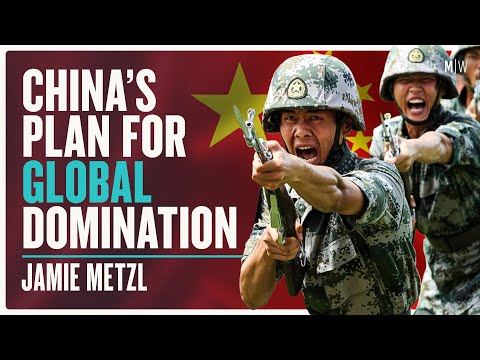
China's Plan For Global Domination - Jamie Metzl
Jamie Metzl (guest), Chris Williamson (host)
In this episode of Modern Wisdom, featuring Jamie Metzl and Chris Williamson, China's Plan For Global Domination - Jamie Metzl explores china’s Global Ambitions, COVID Origins, And The Future Of Democracy Jamie Metzl argues that while COVID’s exact origin remains unproven, the circumstantial case for a lab-related incident in Wuhan is now very strong, and China’s subsequent cover‑up likely magnified the scale of the pandemic. He details how Beijing has blocked serious international investigations, weaponized global institutions, and punished countries that push for transparency. Beyond COVID, Metzl outlines China’s broader strategy for achieving global leadership by 2049: reshaping information flows, controlling data and algorithms, expanding in the South China Sea, and exporting a governance model incompatible with liberal democracy. He contends that open societies can still prevail, but only if they reinvest in their own democratic health, build strong coalitions, and confront China’s abuses and disinformation with coordinated, values‑driven responses.
China’s Global Ambitions, COVID Origins, And The Future Of Democracy
Jamie Metzl argues that while COVID’s exact origin remains unproven, the circumstantial case for a lab-related incident in Wuhan is now very strong, and China’s subsequent cover‑up likely magnified the scale of the pandemic. He details how Beijing has blocked serious international investigations, weaponized global institutions, and punished countries that push for transparency. Beyond COVID, Metzl outlines China’s broader strategy for achieving global leadership by 2049: reshaping information flows, controlling data and algorithms, expanding in the South China Sea, and exporting a governance model incompatible with liberal democracy. He contends that open societies can still prevail, but only if they reinvest in their own democratic health, build strong coalitions, and confront China’s abuses and disinformation with coordinated, values‑driven responses.
Key Takeaways
The COVID origin debate is unresolved, but evidence increasingly points toward a lab incident.
Metzl cites the early Wuhan cases without market links, the Wuhan Institute of Virology’s unique bat coronavirus work, vanished viral databases, and leaked grant proposals to engineer furin cleavage sites as reasons the lab-leak hypothesis now has strong, though still circumstantial, support.
Get the full analysis with uListen AI
China’s cover‑up and suppression of inquiry likely cost millions of lives globally.
Regardless of whether the virus emerged from a lab or nature, Metzl argues that censorship of whistleblowers, destruction of samples, data gag orders, and punishment of questioners delayed the world’s response and turned a local outbreak into a global catastrophe.
Get the full analysis with uListen AI
Global institutions failed on COVID origins because they are structurally vulnerable to state capture.
He describes how China and some European states steered WHO processes away from a genuine origins probe toward a narrow, China‑controlled study, illustrating how existing multilateral mechanisms can be blunted or co‑opted by powerful members.
Get the full analysis with uListen AI
China is advancing a comprehensive power strategy: territorial expansion, data dominance, and narrative control.
From militarizing reefs in the South China Sea and asserting the “Nine-Dash Line,” to hoarding and weaponizing data, tightening algorithm rules, and disciplining celebrities like Jack Ma and Peng Shuai, Beijing is engineering both physical and informational environments to cement long‑term advantage.
Get the full analysis with uListen AI
Open societies won’t automatically win; they must prove they can deliver for their citizens.
Metzl warns that democracy is a means, not an end: if Western states allow inequality, polarization, and dysfunction to fester, authoritarian models may look more “effective” to many, especially when adversaries amplify internal divisions with disinformation.
Get the full analysis with uListen AI
China’s rise exploits Western missteps as much as its own strengths.
He notes that moves like the U. ...
Get the full analysis with uListen AI
Future outcomes range from Chinese‑centric hegemony to war to a reformed cooperative order.
Metzl sketches four trajectories: a world increasingly shaped by Chinese power and norms; a robust, value‑based coalition that pressures China to play constructively; major‑power war; or a more utopian “One Shared World” model that balances national interests with global responsibilities.
Get the full analysis with uListen AI
Notable Quotes
“We have an outbreak of a virus with a horseshoe bat backbone happening not where the bats are, but where China’s biggest bat coronavirus lab is—and from day one it’s ready to transmit easily between humans.”
— Jamie Metzl
“Lots of countries make mistakes. I’m not pinpointing China as the only country to ever have a cover‑up, but in this case the consequences are pretty awful.”
— Jamie Metzl
“China’s participation in a lot of these international organizations isn’t designed to strengthen the organizations, but to blunt and block them.”
— Jamie Metzl
“Democracy is not an end in itself. It’s a means to the end of good and accountable governance.”
— Jamie Metzl
“You can’t have countries building all of the tools for a massive world war and just assume it’s never going to happen.”
— Jamie Metzl
Questions Answered in This Episode
If China continues to obstruct a full COVID origins investigation, what concrete mechanisms—legal, diplomatic, economic—could realistically compel greater transparency without tipping into open conflict?
Jamie Metzl argues that while COVID’s exact origin remains unproven, the circumstantial case for a lab-related incident in Wuhan is now very strong, and China’s subsequent cover‑up likely magnified the scale of the pandemic. ...
Get the full analysis with uListen AI
How can democracies reform their information ecosystems so that healthy debate isn’t drowned out by outrage‑driven algorithms and foreign disinformation?
Get the full analysis with uListen AI
Where is the line between pragmatic economic engagement with China and complicity in enabling authoritarian expansion and human rights abuses?
Get the full analysis with uListen AI
What would an effective, modernized global governance system look like that could credibly address pandemics, climate change, and great‑power rivalry at the same time?
Get the full analysis with uListen AI
In practice, how can Western societies demonstrate that liberal democracy is not only more humane but also more effective than China’s authoritarian model in the 21st century?
Get the full analysis with uListen AI
Transcript Preview
Let me just use this opportunity to condemn John Cena. John Cena, if you're listening to this podcast, you are a scoundrel. You're supposed to be a tough guy. That's your entire brand, and China criticizes you, and you get on your hands and knees and bark like a dog? Show some backbone. I challenge you, John Cena, to come on this podcast with me and let's have the conversation about China. (air whooshing)
So you were one of the first guys to really get onto the lab leak story. Where are we at with that now, 18 months hence?
Yeah. So I'll start in the beginning. It was late January of last year. Like everybody else, I was deeply concerned about this emerging pandemic and thinking, "Well, where does this come from?" And like most people, I thought, "Well, it sounds pretty similar to the last SARS, uh, outbreak," which we knew happened, uh, and it came from nature through markets. But then in late January of last year, I saw, um, a report in The Lancet which showed that more than a third of the, uh, earliest people being infected, um, had no contact with that now infamous, uh, seafood market in, uh, in Wuhan. Um, and then I, I kind of had, I have two perspectives, one as a person who's deeply immersed in the world of science, and another, as the other part of my life deeply immersed in Asia and China and, and geopolitics. And so something just didn't feel right when the Chinese government, um, kept talking about a, a market origin, um, when it was pretty clear to me that the evidence suggested otherwise. And then I just started digging. I really, I dove in, and the more I learned, uh, the more questions were raised about the possibility of, of a lab incident origin. And it's still not 100% proven that that's where this pandemic, um, comes from. Um, but the circumstantial evidence is just incredibly strong, and everything we learn, at least it seems to me, that it's, uh, that it's getting stronger. So we, and we'll, we'll dig into the details of this, but where we are now, uh, is in my mind, there's a very strong but still circumstantial case suggesting a very likely, uh, but not certain lab incident origin of the, uh, pandemic. Uh, China and, is really just outrageously preventing any kind of, uh, investigation into the origins of the pandemic. They're still engaged in just a massive and outrageous coverup involving destroying samples, hiding records, imprisoning people in China for asking questions. They have a gag order preventing Chinese scientists from saying or writing anything about pandemic origins without prior, uh, government approval. Um, there are some efforts to dig deeper, but we need, we need a lot more.
Is that not likely to be potentially the most evidence that we get, the purely coincidental, anecdotal, this is what it seems? Because if the Chinese government continues to stonewall as effectively as it is at the moment, then maybe we're never actually going to find out anything that's concrete. It's all just going to be best-case scenarios.
Install uListen to search the full transcript and get AI-powered insights
Get Full TranscriptGet more from every podcast
AI summaries, searchable transcripts, and fact-checking. Free forever.
Add to Chrome