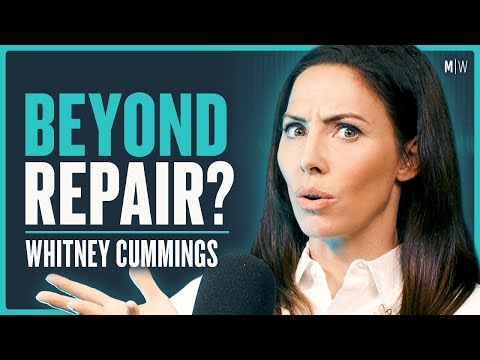
Why Is Everyone So Emotionally Fragile? - Whitney Cummings
Chris Williamson (host), Whitney Cummings (guest)
In this episode of Modern Wisdom, featuring Chris Williamson and Whitney Cummings, Why Is Everyone So Emotionally Fragile? - Whitney Cummings explores motherhood, Codependency, And Why Our Culture Feels So Fragile Whitney Cummings and Chris Williamson explore how motherhood pushed Whitney into a full-life reset, from quitting Botox and birth control to rethinking authenticity, attraction, and the chemicals in her body. The conversation moves into emotional fragility, codependency, and why so many people—especially online—operate from victimhood and control rather than responsibility and resilience. They dissect modern dating, gender dynamics, over-optimization culture, and the addictive pull of drama, politics, and social media. Throughout, Whitney uses personal stories and recovery concepts to argue for radical self-accountability, clearer communication, and service to others as paths out of emotional chaos.
Motherhood, Codependency, And Why Our Culture Feels So Fragile
Whitney Cummings and Chris Williamson explore how motherhood pushed Whitney into a full-life reset, from quitting Botox and birth control to rethinking authenticity, attraction, and the chemicals in her body. The conversation moves into emotional fragility, codependency, and why so many people—especially online—operate from victimhood and control rather than responsibility and resilience. They dissect modern dating, gender dynamics, over-optimization culture, and the addictive pull of drama, politics, and social media. Throughout, Whitney uses personal stories and recovery concepts to argue for radical self-accountability, clearer communication, and service to others as paths out of emotional chaos.
Key Takeaways
Authenticity filters out incompatible partners more effectively than optimization.
Whitney realized Botox, heavy makeup, and laser hair removal were attracting the wrong kind of men—people who wanted an edited version of her. ...
Get the full analysis with uListen AI
Chemicals and hormones can massively distort mood, clarity, and relationships.
Going off birth control, Botox, weed and paying attention to water quality and microplastics left Whitney feeling clearer, calmer, less emotional, and more communicative. ...
Get the full analysis with uListen AI
Codependency is often an addiction to control disguised as kindness.
She defines codependency as the inability to tolerate others' discomfort and the compulsion to manage their feelings, choices, or perceptions. ...
Get the full analysis with uListen AI
Most people mistake pity, guilt, and obligation for love and loyalty.
Whitney notes that staying in relationships out of fear of hurting someone, going to events from obligation, or dating people you "feel bad for" are all codependent patterns. ...
Get the full analysis with uListen AI
Self-esteem comes from esteemable actions, especially service, not from success metrics.
Despite career wins, Whitney’s self-worth dropped when her life became "me, me, me". ...
Get the full analysis with uListen AI
Over-optimization and constant self-monitoring can become their own fragile cage.
They discuss how elaborate morning routines, protocols, and productivity systems can turn into a new religion of control: if everything isn’t done perfectly, people feel unable to function. ...
Get the full analysis with uListen AI
Clear, concise communication beats sugarcoating and emotional mind-reading.
Whitney shows how apologetic, over-explained requests (“sorry, maybe if you don’t mind…”) create confusion and resentment. ...
Get the full analysis with uListen AI
Notable Quotes
“In trying to care for my son and protect him from microplastics and chemicals, I accidentally took care of myself.”
— Whitney Cummings
“Codependence is the inability to tolerate the discomfort of others—or the discomfort you imagine they’re feeling.”
— Whitney Cummings
“I actually like myself when I only think about myself an hour a day. When I think about myself 24 hours a day, that’s when my self-esteem plummets.”
— Whitney Cummings
“If you can’t take criticism, that to me is the ultimate red flag. We’re in a world where everyone’s more sensitive, and the new discomfort is being okay with hurting someone’s feelings.”
— Whitney Cummings
“We try to measure what we value, but we end up valuing what we can measure.”
— Chris Williamson
Questions Answered in This Episode
How can someone practically distinguish between genuine kindness and covertly codependent behavior in their day-to-day life?
Whitney Cummings and Chris Williamson explore how motherhood pushed Whitney into a full-life reset, from quitting Botox and birth control to rethinking authenticity, attraction, and the chemicals in her body. ...
Get the full analysis with uListen AI
What small "service" actions could you add to your week that are truly expectation-free and not about being seen as a good person?
Get the full analysis with uListen AI
If you dropped all your aesthetic or personality "optimization" for 90 days, who in your life would likely drift away—and who would move closer?
Get the full analysis with uListen AI
In what ways might your news, social media, or content diet be desensitizing you to real-world events and distorting your emotional baseline?
Get the full analysis with uListen AI
Where are you using productivity, self-improvement, or monk-mode-style isolation to avoid facing low self-esteem or uncomfortable relationships?
Get the full analysis with uListen AI
Transcript Preview
What has changed since becoming a mother?
I stopped getting Botox.
Okay. Is that-
(laughs) That's the main headline.
... that's the big thing?
Stop smoking weed. Stop getting Botox.
Okay.
You know, a lot of things. Um, I start with the sort of, you know, more facetious ones, but I'm obviously off birth control, you know. After having a kid I went off, and I can't believe how much clearer I am, less emotional I am, less judgmental I am, uh, less attracted to gay men I am. Uh, and then I was like, "Okay, what else am I putting in my body?" You know, 'cause as soon as you have a baby in utero, you care about your own health, you know? And then I'm like, "I'm not gonna drink tap water anymore." Instead of spending money on stupid shoes that are gonna give me blisters, why don't I spend it on glass bottle water? Whatever, you know? And in trying to care for my son and protect him from microplastics and chemicals and stuff, I accidentally took care of myself, and cannot believe how much better I felt. And I spend so much time now thinking of like when I see my girlfriends acting crazy or women acting crazy, I'm like, "Maybe Amber Heard just wore too much deodorant."
(laughs)
Do we... (laughs) Maybe we need to get, we need to get Rose McGowan off tap water. You know, like what are all the chemicals? And I know this is very in the zeitgeist right now. You talk about it, Hugh Grant talks about it, there's people that actually know what they're talking about. But in my own, you know, research on myself, I'm like, I cannot believe how many chemicals I was putting in my body before, and how much better I feel now that I'm not. The Botox thing was more of a, you know, you can't get Botox when you're pregnant. And once I was pregnant, I couldn't believe how much better I was all of a sudden at communicating, and I was like, "Oh, this must just be 'cause I'm compassionate now, and it's hormonal, and like I'm, I'm connecting with people more." But we're designed to read micro-expressions, and I look at all my past toxic relationships where we had, like, trouble communicating or, you know, I expected the person to read my mind or just, like, know what I meant on my face or something, and they... (laughs)
Meanwhile you've got a stone face.
I know, I'm just like, like, "No, what do you mean? Everything's fine." Like, I just am now like women are, and men I think, are having a harder time communicating than ever, and we're just adding more and more things to make it more and more difficult. (laughs)
Like Botox that literally stops you from having facial expressions.
Correct, correct. And so I was like, "Let me just stop," because also, look, I lasered my entire body in my 20s. I have no pubes, I have no nothing. Like, if I don't have any wrinkles either, I'm just gonna be attracting pedophiles, so why don't I ju-
Install uListen to search the full transcript and get AI-powered insights
Get Full TranscriptGet more from every podcast
AI summaries, searchable transcripts, and fact-checking. Free forever.
Add to Chrome