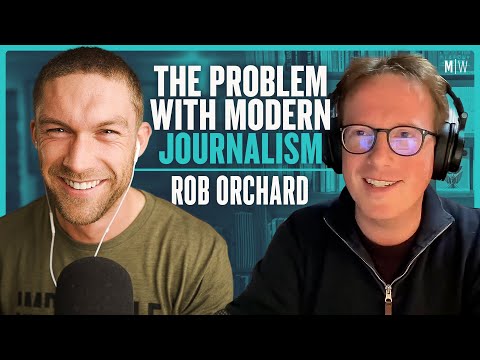
Terrible Journalism & Interesting Statistics - Rob Orchard
Rob Orchard (guest), Chris Williamson (host), Narrator
In this episode of Modern Wisdom, featuring Rob Orchard and Chris Williamson, Terrible Journalism & Interesting Statistics - Rob Orchard explores slow journalism fights clickbait: data, media incentives, and consequences Chris Williamson and editor Rob Orchard discuss 'slow journalism' as an antidote to fast, click-driven news that prioritizes novelty over accuracy, depth, and closure. Orchard explains how Delayed Gratification revisits major stories months later, adding context, follow‑ups, and data‑rich infographics to show what really happened next. They unpack the broken economics of free online content, perverse incentives for journalists, and the psychological impact on audiences of constant, unresolved, anxiety-inducing news. The conversation expands into data storytelling—from COVID search trends to fertility rates and space travel—showing how well-used statistics can illuminate culture, politics, and the future.
Slow journalism fights clickbait: data, media incentives, and consequences
Chris Williamson and editor Rob Orchard discuss 'slow journalism' as an antidote to fast, click-driven news that prioritizes novelty over accuracy, depth, and closure. Orchard explains how Delayed Gratification revisits major stories months later, adding context, follow‑ups, and data‑rich infographics to show what really happened next. They unpack the broken economics of free online content, perverse incentives for journalists, and the psychological impact on audiences of constant, unresolved, anxiety-inducing news. The conversation expands into data storytelling—from COVID search trends to fertility rates and space travel—showing how well-used statistics can illuminate culture, politics, and the future.
Key Takeaways
Slow journalism closes narrative loops the 24/7 news leaves open.
Most outlets focus on breaking stories and then rapidly move on, rarely explaining long‑term consequences; slow journalism revisits events months later to provide context, follow‑up, and deeper understanding (e. ...
Get the full analysis with uListen AI
Click-based economics structurally reward shallow, fast content.
When monetization is driven by pageviews and targeted ads, it’s rational for editors to commission dozens of short, sensational pieces rather than a few costly, in‑depth investigations, pushing journalism toward celebrity gossip and outrage.
Get the full analysis with uListen AI
The internet massively undervalued content, and anchoring now traps us.
Early norms that news, podcasts, and online writing should be free set price expectations; attempts to charge later clash with anchoring bias, forcing outlets into freemium/paywall models instead of simply making people pay for quality from the start.
Get the full analysis with uListen AI
The training pipeline for serious journalists is being hollowed out.
With local news collapsing and few stable staff jobs, aspiring reporters have fewer places to learn and be mentored, pushing many into churn‑style content roles or precarious independent projects and weakening the overall ecosystem.
Get the full analysis with uListen AI
Speed-first news production increases the risk of serious errors.
The Amanda Knox misreporting by the Daily Mail—publishing a fully written, incorrect verdict story with fabricated color—illustrates how prewritten templates plus pressure to publish first can put outright falsehoods into the permanent record.
Get the full analysis with uListen AI
Constant exposure to unresolved, negative stories harms public psyche.
A relentless stream of alarming headlines without closure (wars, pandemics, political crises) creates anxiety and helplessness, especially since most issues are beyond individual control, driving some people to avoid news altogether.
Get the full analysis with uListen AI
Well-crafted infographics can make complex data engaging and less polarizing.
By visually presenting facts—on topics like COVID searches, CO₂ emissions, fertility, or Oscar winners—infographics offer an accessible, often disarming entry point to contentious issues, allowing readers to absorb evidence without heavy-handed commentary.
Get the full analysis with uListen AI
Notable Quotes
“We’re the seagulls following the trawler. Our slogan is ‘Last to breaking news.’”
— Rob Orchard
“If you sat down to construct a news ecosystem from scratch, it wouldn’t be this.”
— Rob Orchard
“When we began content creation on the internet, we misjudged what you should be paying for and what you should expect for free.”
— Chris Williamson
“Good news costs money. You’re sending people to difficult and scary places on your behalf so you can get information.”
— Rob Orchard
“I don’t know a single person whose relationship with technology doesn’t need work.”
— Chris Williamson
Questions Answered in This Episode
How could mainstream news organizations integrate slow-journalism principles without sacrificing their ability to cover breaking events?
Chris Williamson and editor Rob Orchard discuss 'slow journalism' as an antidote to fast, click-driven news that prioritizes novelty over accuracy, depth, and closure. ...
Get the full analysis with uListen AI
What concrete alternative business models might sustainably fund high-quality reporting while avoiding invasive ad-driven incentives?
Get the full analysis with uListen AI
To what extent should audiences bear responsibility for the clickbait ecosystem, given our own preferences for novelty and outrage?
Get the full analysis with uListen AI
How might societies repair public trust in big tech enough to unlock the potential of health or epidemiological data without repeating current abuses?
Get the full analysis with uListen AI
If global fertility continues to decline, how should governments rethink immigration, social welfare, and work to adapt to shrinking, aging populations?
Get the full analysis with uListen AI
Transcript Preview
... journalists come in in the morning and they're given a list of the stories that were trending online overnight, which is why, you know, these poor, poor buggers, they come into work and they're like, "Write, write something about this." "Who is this?" "I don't know." "It's an American celebrity. She was on some kind of series that you've not heard of." "Then what's happened to her?" "I don't know. She's breaking up with her boyfriend." "Who's her boyfriend?" "I don't know. It doesn't matter, just write something."
(wind blowing) Rob Orchard, welcome to the show.
Nice to be here, Chris. Nice to be here. Thanks very much for inviting me.
My pleasure. How do you describe what you do for work?
Uh, so I'm an editor. Uh, I edit a beautiful quarterly news magazine called Delayed Gratification, uh, which I launched, uh, with my co-editor, Marcus, back in 2010 with an idea of providing a sort of an antidote to knee-jerk, uh, Twitter-driven news reporting, uh, which doesn't give journalists enough time to really get to grips with stories. So we kind of go the opposite way. Once every three months, we produce a beautiful magazine, news magazine, which looks back over the big events of the quarter, uh, with the benefit of hindsight and asks the question of what happened next.
So that's slow journalism that you've coined?
(laughs) Yeah, yeah. So I wouldn't... I'm, I'm not gonna claim ownership of it. It's, um... You know, a lot of people have been talking about it for a long time, but I think ours is the first magazine, or ours was the first magazine to put a flag in the sand and say, "Yes, this is a slow journalism magazine." And the idea is it's a bit like, um, slow food and slow travel, right? So taking your time to do something of quality and, and kind of providing a counter, a counterbalance to sort of life getting terribly speedy and, and news getting terribly speedy and everything getting terribly speedy.
What's the big difference between slow and fast journalism?
Well, there's all sorts of different things. So what tends to happen in terms of the way that we, we, we process our news is that, um, it's coming at us from all directions. You know, it's on our phones. It's kind of quite often the first thing that we do in the morning, right? Instead of turning to our loved one, we turn on our phones. We, and we check and make sure nothing horrible has happened overnight. Um, and last thing at night as well, and throughout the day and on our socials, and it's, it's, it's kind of this, this white noise of news. And what, what tends to happen as well is that it moves in, in kind of cycles. So you get an intense concentration on a massive story for a few days, and then suddenly the news agenda moves on, and you're quite often left with a, the sort of the feeling of not having really got to grips with what the story was or, or wanting to know what happened next. Um, but, but, you know, the, the news cycle feeds on novelty, and so it's kind of constantly moving on. So to take an example, um, uh, Afghanistan, we were all glued to the story, um, over the summer in August, um, August 15th, the fall of Kabul and the, kind of the few days leading up to that and the few, few days after that. But since then, the coverage of what's been happening in Afghanistan has completely fallen off a cliff, um, and we happened to have in the next issue a very, um, a very well-written, a very well-considered piece from a female journalist who's been there for the last year and who, who continued, very bravely continued, didn't leave with everybody else, stayed there, um, and has got this incredible 6,000-word read for us, really getting to grips with what has happened in the country since then. So I suppose when it works well, what it is, is you open up the, the magazine or, or, you know, wherever you read it. You open up the magazine and you think, "God, yeah, that story. What the hell happened with that? I remember that." And we tell you, you know? And in amongst that, we also tell you the stories that you missed, and we have this kind of slightly cheesy line of, "The stories other missed or others missed or mistold." Um, so this idea of in the kind of the heat of, of, you know, like 24/7 rolling news, there's, there's stuff that gets missed and there's stuff that gets, that gets put out there, uh, wrongly. So this is ideally, in its best form, it's an antidote to that.
Install uListen to search the full transcript and get AI-powered insights
Get Full TranscriptGet more from every podcast
AI summaries, searchable transcripts, and fact-checking. Free forever.
Add to Chrome