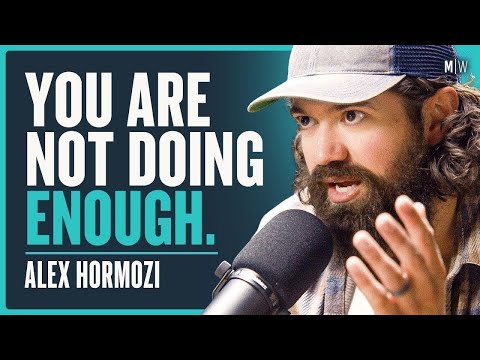
How To Move 10x Faster In Life - Alex Hormozi (4K)
Chris Williamson (host), Alex Hormozi (guest), Narrator
In this episode of Modern Wisdom, featuring Chris Williamson and Alex Hormozi, How To Move 10x Faster In Life - Alex Hormozi (4K) explores alex Hormozi Explains How Brutal Honesty Unlocks 10x Life Speed Alex Hormozi and Chris Williamson unpack how death-awareness, agency, and independent thinking let you move dramatically faster in life by shrinking the gap between deciding and acting. Hormozi traces his journey from terrified, approval-seeking consultant and gym owner to decisive entrepreneur, showing how slaying one “big dragon” (like defying his father or ending bad partnerships) created proof he could face bigger ones. They argue that pain, insecurity, and regret can be alchemized into fuel, while unmade decisions and people-pleasing are what actually keep you stuck in a mediocre life. Throughout, they emphasize doing the work, saying no to the wrong people and opportunities, and measuring yourself by actions rather than feelings as the path to a self-respecting, high-agency life.
Alex Hormozi Explains How Brutal Honesty Unlocks 10x Life Speed
Alex Hormozi and Chris Williamson unpack how death-awareness, agency, and independent thinking let you move dramatically faster in life by shrinking the gap between deciding and acting. Hormozi traces his journey from terrified, approval-seeking consultant and gym owner to decisive entrepreneur, showing how slaying one “big dragon” (like defying his father or ending bad partnerships) created proof he could face bigger ones. They argue that pain, insecurity, and regret can be alchemized into fuel, while unmade decisions and people-pleasing are what actually keep you stuck in a mediocre life. Throughout, they emphasize doing the work, saying no to the wrong people and opportunities, and measuring yourself by actions rather than feelings as the path to a self-respecting, high-agency life.
Key Takeaways
Use death as a lens to shrink fear of judgment.
Hormozi constantly reminds himself that in three generations everyone—including naysayers—will be dead and forget him, so other people’s opinions are a terrible reason to live a life you don’t want. ...
Get the full analysis with uListen AI
Independent thinking is a muscle you build by acting against norms.
Each time you choose what you actually want—where to live, who to date, what work to do—instead of defaulting to family, culture, or friends, you strengthen your “agency muscle. ...
Get the full analysis with uListen AI
The heaviest stress in life is unmade decisions, not overload.
Unmade decisions continually tax your mental bandwidth (“anxiety cost”) because you keep rethinking them instead of acting. ...
Get the full analysis with uListen AI
Hard conversations are the gate to the life you actually want.
From telling his father he was leaving to dissolving bad business partnerships after a DUI, Hormozi shows that anxiety, resentment, and burnout often signal a conversation you’re avoiding. ...
Get the full analysis with uListen AI
Pain and insecurity can either poison you or propel you.
They contrast heroes and villains: both start with pain, but heroes decide “I’ll use this so others don’t suffer,” while villains decide “I’ll hurt the world back. ...
Get the full analysis with uListen AI
Success is built on extreme consistency and doing boring work well.
Hormozi measures projects in “hundreds of hours,” does dozens of full run-throughs of talks, and treats preparation like game tape. ...
Get the full analysis with uListen AI
Self-respect comes from holding yourself to a higher standard than anyone else.
He rejects “self-acceptance” as passive; instead, self-love is believing more in your potential than anyone else and demanding behavior that matches it. ...
Get the full analysis with uListen AI
Notable Quotes
“A friendly reminder that in three generations everyone who knew us will be dead, including the people whose opinions stopped you from doing what you wanted all along.”
— Alex Hormozi
“The life you want is on the other side of a few hard conversations and you’re living a life you hate because you’re too afraid to have them.”
— Alex Hormozi
“You don’t gain confidence by shouting affirmations in the mirror, but by giving yourself a stack of undeniable proof that you are who you say you are. Outwork your self-doubt.”
— Alex Hormozi
“In life we must choose our regrets.”
— Christopher Hitchens (via Douglas Murray, retold by Chris Williamson)
“The work works on you more than you work on it.”
— Alex Hormozi
Questions Answered in This Episode
Which single hard conversation am I currently avoiding that, if I had it this week, would most change my life trajectory?
Alex Hormozi and Chris Williamson unpack how death-awareness, agency, and independent thinking let you move dramatically faster in life by shrinking the gap between deciding and acting. ...
Get the full analysis with uListen AI
If I stopped caring about my parents’, friends’, or culture’s approval, what three concrete decisions about work, relationships, or location would I make differently?
Get the full analysis with uListen AI
Looking back, which painful event in my life ultimately created a disproportionate positive change—and what similar ‘region beta’ comfort zones am I stuck in right now?
Get the full analysis with uListen AI
Where am I using cynicism, “must be nice,” or self-pity as a safety blanket to avoid confronting my own lack of effort or inconsistency?
Get the full analysis with uListen AI
What would my 85-year-old self be begging me to fully commit to and work relentlessly on over the next decade, and what proof could I start stacking today?
Get the full analysis with uListen AI
Transcript Preview
Today, we're gonna go through as many of your lessons as we can-
Okay.
... in about three hours, and we're gonna see what we can get through. First one, "A friendly reminder that in three generations everyone who knew us will be dead, including the people whose opinions stopped you from doing what you wanted all along. Imagine that someone you know achieves every dream and hits every goal they have. Years later, they get old and die. Two years after that. How much do you care? About as much as everyone else will if you accomplish your goals and dreams. Do it for you."
(sighs) So I think about death all the time because it's- it's probably the central theme. It's probably the thing that I think the most about, and I think that influences how I see time, and also how I think- how it- how it influences agency, like, what actions I'm willing to take despite the judgment of others. And so, a lot of times, and it might be because I have more insecurity than everyone, that I think, like, "Man, I wanna do this thing," and then I hear all these other voices of reasons why I shouldn't do it or why somebody else will say, like, "That's bad," or "You're bad," or, like, "That's wrong," whatever. And so I think I've had to come up with a lot of these devices to get around my own insecurities to take action despite those insecurities. And the biggest one that I think about is that it doesn't matter whether I achieve all of my goals or I don't achieve all of the goals. In three generations, I'll be forgotten, and the only people who were naysaying a- a- against me will also be dead. And so then it's like, just do it for me, and then when I wake up every day, there's only one voice I have to listen to.
But that means that you need to be able to work out what to do from first principles. You now no longer have societal norms or assistants or role models or archetypes or expectations, and that's also difficult in a different way.
(sighs) I think that the more you flex whatever that muscle is, of like independent thinking, the more it becomes the default way that you think. And then everyone else's actions just start looking more and more insane to you.
What like? What's an example of that that you can think of?
I mean, shoot, just the most basic ones of, like, living the life that you don't want, not wearing what you wanna wear, not dating who you wanna date, um, not living where you wanna live. Like, you're living at home, and you wanna move, and your parents say no, and you don't make the move. Or you're dating a girl because y- she's socially accepted, you know, by your friend group. She's safe, but, like, there's always some distance in between you, but you're like, "I don't wanna risk it," right? Or, like, you're in the- the job and every day you go there, and you're like, "I mean, it's okay." And the idea of just living an okay life just sounds so terrifying to me, that the freedom to fail over and over again is still more fulfilling to me. At least it feels like it's real than walking through kind of on autopilot. And so I think that's a lot of the choices that other people make that seem insane to me now but didn't ins- didn't seem insane to me a decade ago. You know what I mean? I think it's just, like, as you practice taking more agency, taking more responsibility for the decisions, then you just get better and better at it, and then it just seems more and more ridiculous. You're like, you're like, "I just can't quit my job." And you're like, "Why?" Like, no, physically, why? Like, why can't you quit your job? Like, (gasps) like, you know what I mean? They start hyperventilating, and it's like, "You could- could you move in with your parents? Could you move in with a friend? Could you split rent?" "I mean, I could, but, I mean, other people who are gonna die in 100 years would think what?" And one of my favorite ones is, um... And I say this all the time to Layla, like, whenever we're getting to some sort of, like, mini complaint. It's like, "You know if you zoom out far enough you can't see the Earth?" So we're talking about, like, "Oh, man, they're gonna mess up this order on this vendors," blah, blah, blah. I was like, "You know if you zoom out far enough you can't see the Earth?" It's just like- it just puts everything immediately into perspective of how ridiculous some of the things that we're concerned about are.
Install uListen to search the full transcript and get AI-powered insights
Get Full TranscriptGet more from every podcast
AI summaries, searchable transcripts, and fact-checking. Free forever.
Add to Chrome