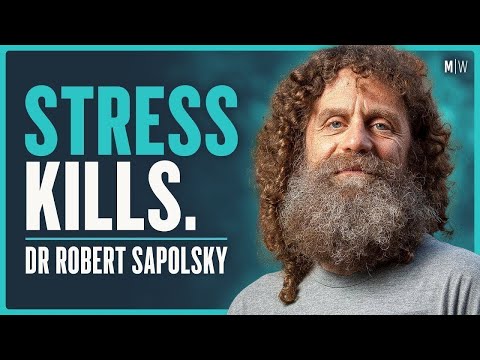
What Chronic Stress Does To Your Body - Dr Robert Sapolsky
Chris Williamson (host), Dr Robert Sapolsky (guest)
In this episode of Modern Wisdom, featuring Chris Williamson and Dr Robert Sapolsky, What Chronic Stress Does To Your Body - Dr Robert Sapolsky explores chronic Stress, Empathy Erosion, and Why Free Will Is Illusory Dr. Robert Sapolsky explains how chronic stress, originally evolved for short-term physical threats, now damages our brains, bodies, and social behavior by becoming a constant psychological burden.
Chronic Stress, Empathy Erosion, and Why Free Will Is Illusory
Dr. Robert Sapolsky explains how chronic stress, originally evolved for short-term physical threats, now damages our brains, bodies, and social behavior by becoming a constant psychological burden.
He focuses on how stress hormones impair empathy-related brain regions, narrow our moral concern, and interact with socioeconomic factors, early life adversity, and genetics through epigenetic mechanisms.
Sapolsky also challenges the notion of free will, arguing that behavior is entirely determined by biology and environment, which should radically reshape how we think about punishment, meritocracy, and responsibility.
Despite the unsettling implications, he proposes that a deterministic view can make us more compassionate, less judgmental, and more focused on prevention and structural change than on blame and self-congratulation.
Key Takeaways
Chronic stress erodes empathy by disrupting the anterior cingulate cortex.
Stress hormones impair the brain region that lets us feel others’ pain, making stressed people less generous, more self-focused, and more likely to cheat or narrow their moral concern to their in‑group.
Get the full analysis with uListen AI
The stress system is ancient and built for short-term crises, not modern rumination.
The same hormones that once helped animals survive three-minute life-or-death threats now get activated for months or years by traffic, news, social media, and anxiety, leading to cardiovascular wear-and-tear and psychological illness.
Get the full analysis with uListen AI
Early-life and even fetal stress shape lifelong brain and stress responses.
A mother’s chronic stress and low socioeconomic status elevate fetal exposure to stress hormones, altering frontal cortex and amygdala development; by age five, these kids already show higher baseline stress hormones and weaker impulse control on average.
Get the full analysis with uListen AI
Genes rarely determine behavior; they set vulnerabilities that depend on environment.
Genetic variants linked to depression or other traits often only increase risk in the presence of early stress or adversity, illustrating that what genes “do” is inseparable from the environments in which they operate.
Get the full analysis with uListen AI
Epigenetics is how experience programs gene regulation across a lifetime—and sometimes generations.
Experiences like chronic stress don’t change DNA sequences but modify the on/off switches controlling genes, producing durable changes in brain circuits (e. ...
Get the full analysis with uListen AI
Reward is driven more by anticipation than by payoff, fueling endless wanting.
Dopamine spikes when we expect a reward—especially under uncertainty—more than when we receive it; this makes the “almost” and the pursuit feel better than the having, and underlies both innovation and chronic dissatisfaction.
Get the full analysis with uListen AI
A deterministic view undermines blame and merit, pushing us toward compassion and prevention.
If all behavior is the product of biology and environment, punishment-as-retribution and pride in being “self-made” are irrational; instead, Sapolsky argues for quarantine-style protection from harm, focus on root causes, and small daily efforts to judge others less harshly.
Get the full analysis with uListen AI
Notable Quotes
“When people are stressed, they become less generous, more likely to cheat, and their moral compass goes out the window.”
— Robert Sapolsky
“We’re smart enough to get sick from psychological stress.”
— Robert Sapolsky
“Epigenetics is just the trendy term for saying the interesting stuff about genes is much less the genes themselves than their regulation, and what environment does is change the regulation of your genes.”
— Robert Sapolsky
“It’s not the pursuit of happiness, but the happiness of the pursuit.”
— Robert Sapolsky
“None of us are entitled to anything more than any other human on Earth.”
— Robert Sapolsky
Questions Answered in This Episode
If chronic stress so powerfully narrows empathy, what realistic societal changes could systematically lower stress levels rather than just treating individuals?
Dr. ...
Get the full analysis with uListen AI
How should schools, healthcare systems, and social policies change if we take seriously the evidence that fetal and early childhood stress shape adult self-control and health?
He focuses on how stress hormones impair empathy-related brain regions, narrow our moral concern, and interact with socioeconomic factors, early life adversity, and genetics through epigenetic mechanisms.
Get the full analysis with uListen AI
Where is the line between using determinism to build compassion and slipping into fatalism or passivity about changing ourselves and our systems?
Sapolsky also challenges the notion of free will, arguing that behavior is entirely determined by biology and environment, which should radically reshape how we think about punishment, meritocracy, and responsibility.
Get the full analysis with uListen AI
How might our criminal justice systems be redesigned if we fully embraced a quarantine-and-prevention model instead of punishment and moral blame?
Despite the unsettling implications, he proposes that a deterministic view can make us more compassionate, less judgmental, and more focused on prevention and structural change than on blame and self-congratulation.
Get the full analysis with uListen AI
Given hedonic adaptation and dopamine’s focus on anticipation, how can individuals structure their lives to stay motivated while remaining content with what they already have?
Get the full analysis with uListen AI
Transcript Preview
What do you wish more people knew about how stress impacts the human body?
Um, that while it's worth paying attention to the fact that it does crummy things to your heart, and blood pressure, and bladder, and everything else, uh, for me, most meaningful thing is it does crummy things to your brain. The worst is that it makes you less empathic. It makes you less tolerant. It makes you less willing to take somebody else's perspective. It narrows your tunnel of concerns, and I think what we see is in a world full of stress, uh, people are crummier to each other on the average.
Why does stress cause that reduction in empathy?
All sorts of interesting stuff, various places in the brain, but in one region, uh, we think, we, colleagues and I and lots of other people in the field, um, think we've gotten a sense of the brain region that's relevant, something called the anterior cingulate cortex, and if you wanna summarize it, uh, this is the part of the brain where you feel someone else's pain. Sit someone down, stick them in a brain scanner, poke their finger with a pin, and like all sorts of ouch parts of the brain activate, and as part of that, this part of the brain, anterior cingulate, also activates and it's got a lot to do with interpreting what the pain means, that sort of thing. Like, you poke somebody with a pin after you've told them they've just had this very powerful anesthetic cream smeared over their finger, when in actuality it's, like, cream cheese or something, and they don't feel the pain. The parts of their brain that are saying, "Ouch, that was in my finger," are still going on, but anterior cingulate is gone silent, because you have fallen for a placebo effect. It's, it's about the interpretation of the pain rather than the nuts and bolts features of it. So now stick the person in the brain scanner, and don't poke their finger with a pin, make them watch their loved one have their finger poked, and the pain-o-meter brain regions have nothing to say because, like, nobody's doing anything to your fingertip, but the anterior cingulate activates. And neurons there on this very, like, simplistic level can't tell the difference between your pain and someone else's pain. Um, big amazing sort of footnote in there, uh, typically people suffering from major depression, this part of the brain is overactive. It's just pain 24/7 wherever you look and that kind of thing. Okay, so it turns out that when people are stressed, they become less generous, they're more likely to cheat in a economic game, their moral compass goes out the window, their, their range of concern narrows down to people who look just like me and pray like me and eat like me and all that sort of stuff that we're way familiar with. Um, and it turns out what stress hormones are also doing is disrupting the functioning of this part of the brain, and there's, like, a drug you can give to rats or give to college freshmen volunteers which will block the effects of the stress hormone, and when you throw that in there, uh, they maintain their empathy despite being stressed. They maintain all sorts of physiological markers of it. We're feeling less capacity to look at somebody else's pain and somebody else's perspective on the world when we're stressed because what matters has turned into a very self-interested focus for most people. So, like, amid stress doing terrible things to your memory and your executive function and judgment and all sorts of stuff, this increasingly strikes me as this, this is the outpost that's really interesting.
Install uListen to search the full transcript and get AI-powered insights
Get Full TranscriptGet more from every podcast
AI summaries, searchable transcripts, and fact-checking. Free forever.
Add to Chrome