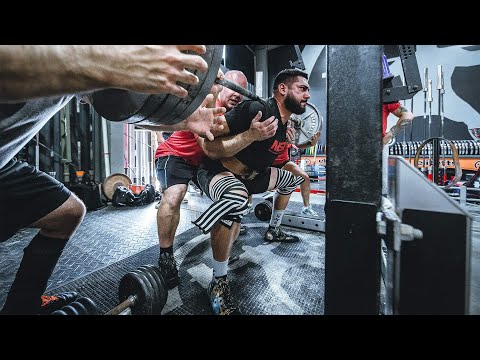
What Is Strength? | Brett Jones | Modern Wisdom Podcast 112
Brett Jones (guest), Chris Williamson (host)
In this episode of Modern Wisdom, featuring Brett Jones and Chris Williamson, What Is Strength? | Brett Jones | Modern Wisdom Podcast 112 explores redefining Strength: Skill, Patience, and Smarter Training for Life Brett Jones, Director of Education at StrongFirst, explains strength as both a physical skill—producing force efficiently—and a broader life quality with purpose beyond the gym. He emphasizes that strength is the foundational ‘glass’ into which all other physical qualities like endurance and power are poured, and argues that fitness should serve life, not exist as an end in itself.
Redefining Strength: Skill, Patience, and Smarter Training for Life
Brett Jones, Director of Education at StrongFirst, explains strength as both a physical skill—producing force efficiently—and a broader life quality with purpose beyond the gym. He emphasizes that strength is the foundational ‘glass’ into which all other physical qualities like endurance and power are poured, and argues that fitness should serve life, not exist as an end in itself.
Jones breaks strength down into neurological skill and structural adaptation, stressing continuity of practice, patient technique, and avoiding constant exercise variation. He contrasts linear, maximal-effort mindsets with wave-like programming centered around submaximal work (~70% 1RM), which builds capacity, preserves health, and improves performance over time.
He dives into practical topics such as the role of kettlebells, the mechanics of powerful swings and breathing, progressive overload with variability, and different frequency models from Russian high-frequency training to classic once-a-week heavy lifts. Throughout, he warns against chronic overreaching, glorified suffering, and treating testing as training.
Ultimately, the conversation encourages listeners to choose methods they can sustain, distinguish between building capacity and merely increasing pain tolerance, and align strength training with long-term health and real-world goals.
Key Takeaways
Treat strength as a skill, not just a brute output.
Jones stresses that efficient strength comes from smooth neurological coordination between muscle groups, built by practicing the same key lifts over time rather than constantly rotating exercises.
Get the full analysis with uListen AI
Build strength to increase endurance and work capacity indirectly.
By becoming stronger and more neurologically efficient, you reduce the motor units required for a given task, leaving more in reserve and effectively improving endurance without traditional ‘endurance’ training alone.
Get the full analysis with uListen AI
Use wave-like, mostly submaximal programming instead of constant maxing out.
Drawing on Russian systems, he recommends doing most work around 70% of 1RM, varying loads session-to-session, which builds skill, strength, and tissue resilience while allowing recovery and long-term progress.
Get the full analysis with uListen AI
Separate training from testing and stop equating progress with suffering.
Conditioning should focus on building capacity, not just tolerance for discomfort; constantly training like a test or chasing ‘struggle’ leads to burnout, injuries, and stalled performance.
Get the full analysis with uListen AI
Master patience and breathing for powerful kettlebell swings.
True power in the swing comes from waiting for the arms to reconnect to the ribs, allowing a full hinge, and keeping the arms pinned to the body while the hips drive, synced with a well-timed inhale on the backswing and forceful exhale as the hips finish.
Get the full analysis with uListen AI
Choose fundamental lifts based on your context and what you can recover from.
For most, a hinge (deadlift or heavy swing), a major squat or deadlift pattern, a press (bench or military), and a pull (like pull-ups) form a durable base, but the optimal mix and frequency depend on training age, structure, and recovery capacity.
Get the full analysis with uListen AI
Program recovery into your training instead of chasing fixes afterward.
Jones argues that proper programming—appropriate volume, intensity, rest, and respect for life stress—is the best ‘recovery strategy’; if you constantly need exotic recovery methods, you’re probably doing too much.
Get the full analysis with uListen AI
Notable Quotes
“Strength is the glass. Every other quality you want to develop goes in that glass.”
— Brett Jones (quoting Eric Cressey)
“True power means you're patient enough to allow that power to come to fruition.”
— Brett Jones
“Strength is a skill. People spend 20, 30, 40 years trying to get better at one or two exercises.”
— Brett Jones
“The only place fitness comes before health is in the dictionary.”
— Brett Jones
“If you’re always trying to figure out how to recover from your training, the simplest answer is: do less.”
— Brett Jones
Questions Answered in This Episode
How can an intermediate lifter practically determine whether they’re a ‘high volume’ or ‘low volume’ responder without overtraining in the process?
Brett Jones, Director of Education at StrongFirst, explains strength as both a physical skill—producing force efficiently—and a broader life quality with purpose beyond the gym. ...
Get the full analysis with uListen AI
In a world where fitness has become an end in itself, how should individuals redefine the ‘greater purpose’ of their own strength training?
Jones breaks strength down into neurological skill and structural adaptation, stressing continuity of practice, patient technique, and avoiding constant exercise variation. ...
Get the full analysis with uListen AI
What objective indicators, beyond RPE and bar speed, can people use at home to know when a session is tipping from capacity-building into counterproductive fatigue?
He dives into practical topics such as the role of kettlebells, the mechanics of powerful swings and breathing, progressive overload with variability, and different frequency models from Russian high-frequency training to classic once-a-week heavy lifts. ...
Get the full analysis with uListen AI
For athletes heavily invested in high-intensity styles like CrossFit, how can they integrate StrongFirst-style submaximal, skill-focused strength work without losing the conditioning edge they value?
Ultimately, the conversation encourages listeners to choose methods they can sustain, distinguish between building capacity and merely increasing pain tolerance, and align strength training with long-term health and real-world goals.
Get the full analysis with uListen AI
How should someone adjust their exercise selection and training frequency across the lifespan—as they move from novice to advanced, or from performance-focused to health-focused goals?
Get the full analysis with uListen AI
Transcript Preview
If I were to give one piece of advice ... Well, we'll make it two. Number one is patience. True power means you're patient enough to allow that power to come to fruition. So it means at the top of my swing, and if it's, if it is the Games and you are doing the overhead swing-
Mm-hmm.
... fine, you got to do what's required for the competition. You have to wait for those arms to reconnect for your, to your ribs before you hinge. Then you have to allow yourself th- the time to hinge before you hit the quick turnaround, and now you got to be patient keeping the arms against the body as long as you can so you have this full transfer of energy from the hips and midsection to the arms and the bell. And so, what I see a lot of people do is they rush that. They hinge too early on the way down, they're trying to come up too quick on the way up-
Mm.
... and they're letting the arms disconnect before they fully express the power from their hips. So if they were to display patience at those three stages, wait long enough for the arms to reconnect on the way down, give yourself time to hinge, and then keep the arms against the ribs as long as possible as you're producing power through the ground, you're gonna find a much more powerful swing and better transfer of energy.
I'm joined by Brett Jones, Director of Education at StrongFirst. Brett, welcome to the show.
Excellent. It's great to be with you today, and really looking forward to speaking with you and your audience.
Yeah. Me too. We, uh, we haven't touched on strength that much yet. Not in it's, not in its purity. We've, we've circled around it a little bit, but we're talking all things strong today, right?
Absolutely. Um, there's... Strength has been, uh, it's, um, been a, something I've pursued, uh, for most of my, uh, adult life, uh, in, in various forms, and, uh, I, I look forward to the conversation on it.
Yeah. It's gonna be good. We'll have some CrossFitters, some powerlifters tuning in, uh, amongst people that just want to be able to lift the shopping a bit, the, the shopping a little bit heavier, I guess, as well, so they might benefit as well. Um-
Absolutely.
Talking about strength, how do you, as someone who spends his entire time thinking about strength, how do you define strength?
So strength can be ... So if we first go with this, uh, this idea of physical strength, um, that can be your ability to produce tension, your ability to produce force against an outside object, or to manipulate your own body, um, g- against a given leverage or position. So it's the ability to produce tension, to produce force against an object, um, and manipulate an object or your own body, uh, like I said. So that, that's kind of the, the 30,000-foot view. Um, when you, d- if you get into the mechanics of it, there's obviously a lot more going on.
Install uListen to search the full transcript and get AI-powered insights
Get Full TranscriptGet more from every podcast
AI summaries, searchable transcripts, and fact-checking. Free forever.
Add to Chrome