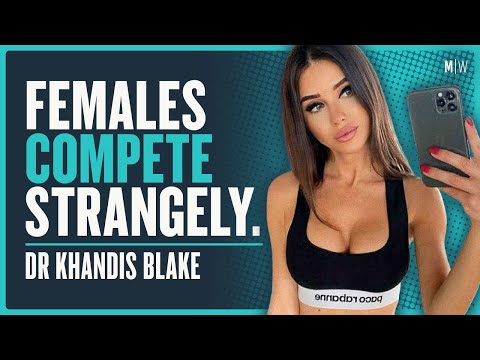
Why Do Women Take Sexy Selfies? - Dr Khandis Blake
Dr Khandis (Candice) Blake (guest), Chris Williamson (host)
In this episode of Modern Wisdom, featuring Dr Khandis (Candice) Blake and Chris Williamson, Why Do Women Take Sexy Selfies? - Dr Khandis Blake explores sexy selfies, status, and inequality: Rethinking female competition today Dr. Khandis Blake argues that women’s sexualized self-presentation online is driven less by patriarchy and more by status-seeking in unequal economies. Using large-scale social media data and lab experiments, she shows that economic inequality predicts increases in sexy selfies, cosmetic spending, and beauty-focused behavior, which can also raise women’s sense of assertiveness. Blake and Williamson then connect mating-market imbalances, female and male intrasexual competition, and incel ideology to broader issues like domestic violence, radicalization, and social stability. They close by critiquing adversarial gender narratives and calling for integrated biological and sociocultural approaches to gender and mating problems.
Sexy selfies, status, and inequality: Rethinking female competition today
Dr. Khandis Blake argues that women’s sexualized self-presentation online is driven less by patriarchy and more by status-seeking in unequal economies. Using large-scale social media data and lab experiments, she shows that economic inequality predicts increases in sexy selfies, cosmetic spending, and beauty-focused behavior, which can also raise women’s sense of assertiveness. Blake and Williamson then connect mating-market imbalances, female and male intrasexual competition, and incel ideology to broader issues like domestic violence, radicalization, and social stability. They close by critiquing adversarial gender narratives and calling for integrated biological and sociocultural approaches to gender and mating problems.
Key Takeaways
Sexy selfies are primarily a status strategy, not just patriarchal oppression.
Blake’s cross-national Twitter data show that sexualized selfies correlate more strongly with income inequality than with gender inequality; when both are modeled, the gender-inequality effect disappears, suggesting women are actively using beauty to compete for status rather than merely conforming to male pressure.
Get the full analysis with uListen AI
Economic inequality reliably increases women’s investment in beauty online and offline.
In more unequal regions and US counties, there are higher rates of sexy selfies, greater spending in women’s salons, and more cosmetic purchases, indicating that when status gaps widen, appearance becomes a more salient competitive resource, especially for women.
Get the full analysis with uListen AI
Beautification can make women feel more agentic and assertive.
Lab experiments where women prepared for a ‘hot date’ versus a casual hangout found that those who beautified more reported and implicitly displayed higher assertiveness, suggesting that appearance-enhancement can function as a psychological empowerment tool, not just self-objectification.
Get the full analysis with uListen AI
Sex ratio seems less important for women’s beautification than theory predicts.
Both correlational and experimental manipulations of local sex ratios failed to change women’s interest in using appearance to get ahead, implying that female competition is less about sheer quantity of mates and more about status dynamics and economic context.
Get the full analysis with uListen AI
Poor men and rich women are structurally disadvantaged in modern mating markets.
Simulation models under hypergamy show that low-income men and high-income women have the hardest time pairing, especially in unequal but gender-egalitarian economies, helping explain rising singlehood among educated women and disenfranchisement among poorer men.
Get the full analysis with uListen AI
Incel ideology tracks inequality and predicts real-world harms.
Blake’s data link economic inequality and narrowing male–female income gaps to more incel discourse and misogyny online; regional spikes in misogynistic chatter forecast increases in domestic/family violence, suggesting social media sentiment can be an early-warning indicator for policy and policing.
Get the full analysis with uListen AI
Online porn and games may be ‘sedating’ potential unrest among sexless men.
Williamson posits that, given historically high male sexlessness, we should see more violence than we do, and hypothesizes that porn and video games provide substitute status and sexual-reward channels that blunt young male syndrome, an idea Blake finds plausible and consistent with dominance-seeking in gaming.
Get the full analysis with uListen AI
Notable Quotes
“Sexualization is not actually manifesting from patriarchal pressure where men force women to beautify. It's manifesting from a state of the economy that has people want to strive to do better, to out-compete their peers.”
— Dr. Khandis Blake
“It didn't seem to me to be something that was done to women, but very much something that women were owning and using quite strategically.”
— Dr. Khandis Blake
“We compete in a different way than what people have traditionally considered to be competition. Status gives us different benefits. It doesn't mean it's not really critically important, though.”
— Dr. Khandis Blake
“If one sex loses, both sexes lose. As far as I can see, sexlessness is increasing amongst men… It’s not good for anybody at the moment.”
— Chris Williamson
“I was pissed off not because there was this whole framework in biology… I was pissed off that I'd spent an entire gender studies degree looking at it and no one had told me about it.”
— Dr. Khandis Blake
Questions Answered in This Episode
If beautification is a rational status strategy in unequal economies, how should parents and educators talk to young women about beauty without simply telling them to ‘opt out’?
Dr. ...
Get the full analysis with uListen AI
What concrete policies could realistically reduce the mating disadvantages faced by poor men and rich women without rolling back women’s educational and economic gains?
Get the full analysis with uListen AI
How could governments or platforms ethically use social media sentiment (e.g., misogyny, incel ideology) as an early-warning system without drifting into Minority Report–style overreach?
Get the full analysis with uListen AI
If porn and video games do ‘sedate’ frustrated young men, are they ultimately helpful safety valves or harmful traps that prolong social and romantic stagnation?
Get the full analysis with uListen AI
How might integrating evolutionary psychology into gender studies—and vice versa—change public debates around patriarchy, hypergamy, and sexual politics?
Get the full analysis with uListen AI
Transcript Preview
Sexualization is not actually manifesting from this kind of patriarchal pressure, where men force women to beautify. It's actually manifesting as a result of a state of the economy that has people want to strive to do better, to out-compete their peers, to keep up with the Joneses. It's linking beautification with status-seeking and not with the patriarchy.
Why do women take sexy selfies?
Ah, we're starting at the big ones, the big questions. Um, so this has been something that's been really fascinating for me for a while, partly because, um, I'm a woman, you know? And I've been through all of those teenage years and my 20s where beauty was, was really important to me. Um, and then I've kind of passed that. And whilst beauty still is i- important in your 30s as well, um, you know, you just see so many women taking these selfies and, and it seems to be so, so important to them. And, um, one of the kind of strongest arguments about this, one of the most dominant arguments about this is basically that women really care about their appearance, they really care about beauty, uh, because of the patriarchy, you know, capital P. Uh, and the idea there is that gender oppression leads women to value their bodies more than they value their other qualities. And psychologists call that self-objectification. That's the kind of techy term for it. Um, and, uh, you know, I think there is s- some truth to that. There's certainly a bunch of people who have been talking about it for many years. But in my kind of opinion when I first started looking at this topic of research, I thought that was doing a bit of a disservice to women. Um, because from what I could see, having kind of been in that world and having known many women in that world, there was something really uber competitive about women engaging in sexy selfies and, and beautifying their appearance as well. Like, it didn't seem to me to be something that was done to women, but very much something that women were owning and using quite strategically. Um, so th-that's kind of the background of what had me start to look at that question and why I was so animated by it. Um, and we have found in a range of different studies now, um, that women take sexy selfies to, to seek status, that this is a status-seeking thing. You know, they're interested in gaining a status in social hierarchies. It can be a very agentic and assertive behavior. Um, and that saying they're only doing it because they're oppressed and the patriarchy tells them they have to is really kind of, uh, only showing a small part of the picture of that kind of motivation.
Are you suggesting that, uh, beautification and enhanced attractiveness and displays of attractiveness are one of the primary methods through which women can gain status?
Install uListen to search the full transcript and get AI-powered insights
Get Full TranscriptGet more from every podcast
AI summaries, searchable transcripts, and fact-checking. Free forever.
Add to Chrome