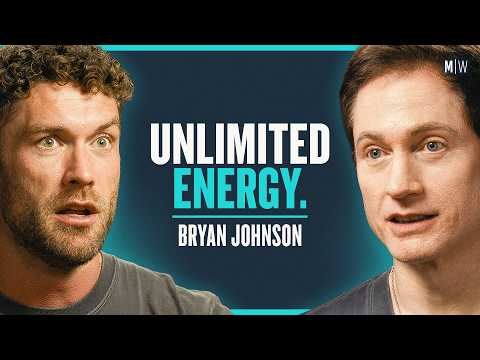
The 2026 Immortality Protocol - Bryan Johnson (4K)
Chris Williamson (host), Bryan Johnson (guest)
In this episode of Modern Wisdom, featuring Chris Williamson and Bryan Johnson, The 2026 Immortality Protocol - Bryan Johnson (4K) explores bryan Johnson reframes longevity as morality, agency, and AI survival Chris Williamson and Bryan Johnson open with a provocative discussion of nighttime erections as a surprisingly strong proxy biomarker for sleep quality, cardiovascular health, and overall physiological function—used deliberately to invert “sleep deprivation as status.”
Bryan Johnson reframes longevity as morality, agency, and AI survival
Chris Williamson and Bryan Johnson open with a provocative discussion of nighttime erections as a surprisingly strong proxy biomarker for sleep quality, cardiovascular health, and overall physiological function—used deliberately to invert “sleep deprivation as status.”
Johnson zooms out to his core thesis: his health project is ultimately a memetic/moral campaign for a new objective function—“Don’t Die”—that he believes society needs to survive the destabilization of AI and the potential for civilizational-scale psychological breakdown.
They cover practical, high-leverage behaviors (sleep regularity, exercise, food discipline, reclaiming agency from addictive tech/food environments) and Johnson’s view that most wellness interventions don’t work compared to basic habit change.
The episode also dives into specific protocols and experiments (sauna detox/microplastics, testicular cooling for fertility markers, HBOT benefits/risks, testosterone basics) and ends with community-building plans and Blueprint’s ambition to scale “autonomous health.”
Key Takeaways
Nighttime erections can function as an aggregate health marker.
Johnson argues nocturnal erections reflect sleep quality, metabolic/cardiovascular function, and hormone health, and are hard to “fake” in the moment—making them a useful, if culturally taboo, signal for systemic health.
Get the full analysis with uListen AI
Status incentives drive behavior; changing health behavior requires changing what’s admired.
He frames his approach as “memetic warfare”: invert the prestige of hustle/sleep deprivation by linking it to low-status outcomes (lower IQ, reduced sexual function), because polite advice rarely competes with status games.
Get the full analysis with uListen AI
His longevity project is subordinated to an AI-era moral goal: “Don’t Die.”
Johnson claims the point of optimizing biology is to help humanity remain coherent and stable through AI acceleration; he proposes “existence as the highest virtue” as a new organizing ideology.
Get the full analysis with uListen AI
Sleep is the top leverage point because it restores willpower and decision-making.
He emphasizes resting heart rate before bed as a daily trackable proxy and recommends earlier meals, hard screen cutoffs, reduced evening light stimulation, a wind-down hour, and noon caffeine cutoff.
Get the full analysis with uListen AI
Regularity may matter as much as (or more than) sleep duration.
He likens circadian timing to a “garbage truck” that must arrive on schedule (glymphatic/cleanup processes); inconsistent sleep patterns can create compounding dysfunction even if you “sleep in” later.
Get the full analysis with uListen AI
Most people overcompensate with gadgets instead of stopping the main harmful behavior.
Johnson says red light, cold plunges, and other add-ons often become moral licensing while the true “therapy” is removing the dominant downside (e. ...
Get the full analysis with uListen AI
Behavior change can be simplified by banning a “time-of-day self.”
His “Evening Bryan is fired” tactic creates a clean rule (no eating between 5–10pm) to prevent rationalizations; he argues ambiguity (“moderation”) often collapses into repeated overconsumption.
Get the full analysis with uListen AI
Sauna appears to be a potent, broad intervention—but with fertility caveats.
He reports toxin reduction after wildfire exposure, major microplastics reductions (blood and semen), improved vascular markers (e. ...
Get the full analysis with uListen AI
HBOT may be highly effective but is expensive, time-consuming, and not risk-free.
Johnson calls HBOT his best-performing therapy across many biomarkers (inflammation, microbiome, cognitive markers like p-tau217) while stressing protocol design (20 min on/5 off) and avoiding oxygen toxicity and unsafe chamber setups.
Get the full analysis with uListen AI
Loneliness persists even at high status; low-friction contact can maintain bonds.
The “15-second call” (or quick texts when you think of someone) reduces coordination costs and builds continuity, especially for busy people—framed as an antidote to modern isolation.
Get the full analysis with uListen AI
Notable Quotes
“Men and women have arousal cycles every night... it depends upon your quality of sleep, your metabolic health, your cardiovascular health, your physiological health, and your hormone health.”
— Bryan Johnson
“Sleep deprivation is high status... This frame of the boners makes sleep deprivation low status.”
— Bryan Johnson
“I’m trying to basically do the same thing to death culture... to combat that, you have to take that, which is high status, and make it low status.”
— Bryan Johnson
“When you give birth to super intelligence, existence itself is the highest virtue.”
— Bryan Johnson
“Most things in health and wellness and longevity don’t work... Do less.”
— Bryan Johnson
Questions Answered in This Episode
On nocturnal erections as a biomarker: what evidence supports it as an aggregate proxy, and what are the biggest confounders (age, meds, sleep apnea, alcohol, depression, SSRIs)?
Chris Williamson and Bryan Johnson open with a provocative discussion of nighttime erections as a surprisingly strong proxy biomarker for sleep quality, cardiovascular health, and overall physiological function—used deliberately to invert “sleep deprivation as status.”
Get the full analysis with uListen AI
You describe your strategy as “memetic warfare.” Where is the ethical line between beneficial persuasion and manipulative status engineering?
Johnson zooms out to his core thesis: his health project is ultimately a memetic/moral campaign for a new objective function—“Don’t Die”—that he believes society needs to survive the destabilization of AI and the potential for civilizational-scale psychological breakdown.
Get the full analysis with uListen AI
You warn of “civilizational-scale psychosis” as AI accelerates. What specific leading indicators would convince you it’s happening (beyond antidepressant use/loneliness)?
They cover practical, high-leverage behaviors (sleep regularity, exercise, food discipline, reclaiming agency from addictive tech/food environments) and Johnson’s view that most wellness interventions don’t work compared to basic habit change.
Get the full analysis with uListen AI
Your sleep heuristic centers on lowering resting heart rate before bed. What are the top three interventions that most reliably lower it for people with normal lives (kids, shift work, social dinners)?
The episode also dives into specific protocols and experiments (sauna detox/microplastics, testicular cooling for fertility markers, HBOT benefits/risks, testosterone basics) and ends with community-building plans and Blueprint’s ambition to scale “autonomous health.”
Get the full analysis with uListen AI
You claim sleep regularity may be as harmful as short sleep when inconsistent. Which studies or datasets most strongly support that, and what’s the minimum acceptable variability (e.g., ±30 minutes)?
Get the full analysis with uListen AI
Transcript Preview
Sorry to report, I have a new boner record, three hours, forty-nine minutes.
[laughing]
The Fellowship of the Ring is three hours, forty-eight minutes.
Is that a good thing? I mean, uh, I guess, uh, from w- whose perspective? [chuckles]
Pick. Well, yeah, uh, your perspective. Is it good for you?
Yeah. I mean, it-- yeah, it's, it's, uh, substantially better than an elite eighteen-year-old.
What would an elite boner eighteen-year-old be?
Around two hours and forty-five minutes-ish.
What refers to elite? Like vasodilation, like g- g-
Yeah, like take an eighteen-year-old in peak condition.
Okay.
And let's say, what would their nighttime erections be? They'd probably hover somewhere around like high two or two, nearly three hours. Uh, that'd be elite level.
Okay.
And so it just crushes that level. So yeah, I mean, from a, like, a pure biological capacity-
Mm-hmm.
... yeah, it's pretty, it's pretty good.
Okay. What were you doing with it, the three hours and forty-nine minutes?
[laughing] So this is-- it's like, kind of like it's news to people-
Mm-hmm
... as I've been sharing this, that, I mean, people, men are generally familiar with the idea that when you are twelve, thirteen, fourteen, you start having boners, and they happen a lot. You know, like in class, you don't even ask for it.
Gust of wind.
[chuckles] Yeah, gust of wind. Literally anything, and you can't do anything about it.
Oh, hey, whoa!
Like, I-- I mean, do you remember, like, I would walk in between classes, and it's like, you got a boner.
Where's it gonna go?
Where's it gonna go?
Tuck it into the waistband, fold it on the-
Exactly. Pull it up. Exactly.
Yeah.
Put a little book cover in front of it, but like, you can't control it, you can't really stop it. And then as you age, those things naturally go down, so people kind of forget about it as a phenomena. But men and women have arousal cycles every night, three to five erections every night. Men get erect, women have their clitoris engorge. And so it's this natural process. The body says, like: I want to keep my sexual function li- alive and vibrant, and it pulses it every night. And so it depends upon your quality of sleep, your, uh, metabolic health, your cardiovascular health, your physiological health, and your hormone health.
Mm.
And so if those things are not in place, it doesn't happen. And so if someone's bragging about four hours of sleep a night and, like, they feel fine, they're doing great, they have no boners.
Ah!
And so, and so this is-
You might have survived with the sleep, but your erection wasn't there.
This is why I started talking about these things. You know, we were, like, measuring a whole bunch of stuff, but I was really... Right now, sleep deprivation is high status, right? If you can basically flex and say, "I only need to sleep four hours a night. I'm amazing. I work eighteen hours a day," people are like, "Oh, my God, what an amazing person, and we admire you so much." And so it has this really weird high status. So this frame of the boners makes sleep deprivation low status.
Install uListen to search the full transcript and get AI-powered insights
Get Full TranscriptGet more from every podcast
AI summaries, searchable transcripts, and fact-checking. Free forever.
Add to Chrome