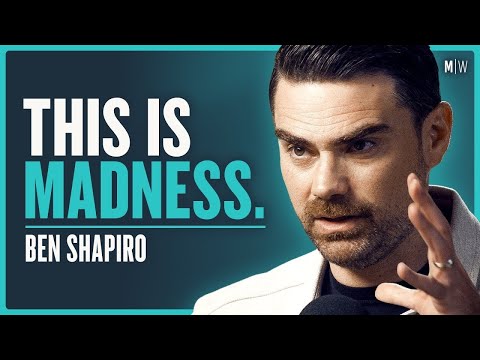
The Divided State Of A Broken America - Ben Shapiro (4K)
Chris Williamson (host), Ben Shapiro (guest)
In this episode of Modern Wisdom, featuring Chris Williamson and Ben Shapiro, The Divided State Of A Broken America - Ben Shapiro (4K) explores ben Shapiro Dissects America’s Political Chaos, Masculinity, And Meaning Ben Shapiro joins Chris Williamson to unpack the unprecedented 2024 U.S. election, explaining his journey from Trump skeptic to active fundraiser while criticizing both left‑wing radicalism and conspiratorial thinking on the right.
Ben Shapiro Dissects America’s Political Chaos, Masculinity, And Meaning
Ben Shapiro joins Chris Williamson to unpack the unprecedented 2024 U.S. election, explaining his journey from Trump skeptic to active fundraiser while criticizing both left‑wing radicalism and conspiratorial thinking on the right.
He outlines how Obama’s 2012 campaign logic broke American politics, fueling base-only strategies, mutual demonization, and a culture where people vote more against enemies than for ideas.
Beyond horse-race analysis, Shapiro argues that overcentralized federal power and eroding social fabric drive polarization, and that family, subsidiarity, and personal responsibility are the real antidotes.
The conversation widens into masculinity, bullying, marriage, fatherhood, social media, and institutional credibility, with Shapiro stressing evidence over conspiracy, long-term virtue over short-term outrage, and the need to lower the political temperature.
Key Takeaways
Shapiro supports Trump’s policies, not his personality, and sees 2024 as a high‑stakes but not apocalyptic election.
He refused to vote for Trump in 2016 due to character concerns and policy uncertainty, backed him in 2020 after seeing policies he liked (courts, foreign policy, taxes), and is now fundraising because he views Biden/Harris as much worse—while still criticizing Trump’s undisciplined messaging and Ukraine ambiguity.
Get the full analysis with uListen AI
Obama’s 2012 campaign normalized base-only politics and mythologized coalitions, distorting both parties’ thinking.
Shapiro argues 2012 was the real turning point: Democrats concluded demographic coalitions were unbeatable, Republicans concluded Trump was a ‘wizard’ when he later won, and both sides embraced narratives (Russians, rigging) that avoided confronting a fundamentally 50/50 electorate hungry for sanity.
Get the full analysis with uListen AI
Conspiratorial thinking is attractive but corrosive; demand specifics and evidence, not unfalsifiable shadows.
He distinguishes between concrete, provable coordination (e. ...
Get the full analysis with uListen AI
America’s polarization stems partly from overcentralized federal power; more local autonomy could ease conflict.
Shapiro contends when Washington controls everything, every election feels existential and citizens wish the ‘other side’ to suffer; a subsidiarity model—more power to states and communities—lets differing values coexist and lowers the stakes of national politics.
Get the full analysis with uListen AI
Family life and adversity are crucial for individual resilience and for defusing ego and bitterness.
Drawing on his own severe bullying, early academic acceleration, and later marriage and fatherhood, he argues that hardship can toughen people if alchemized properly, but that remaining single and mission-focused solely on self can freeze a person in a resentful life stage; family gives a larger mission and naturally punctures ego.
Get the full analysis with uListen AI
True masculinity is about building and protecting, not hedonism or aesthetics.
He criticizes a version of ‘masculinity’ centered on lifting, money, cars, and casual sex as merely instrumental goods, arguing that male aggression should be harnessed toward building families, defending communities, and assuming responsibility, in partnership with a complementary—not adversarial—femininity.
Get the full analysis with uListen AI
Institutions damage themselves when they become overtly partisan, shrinking trust in science and media.
Citing Scientific American’s and Nature’s political endorsements, public‑health double standards during BLM protests, and politicized trans medicine, he says these moves don’t change votes but do convince many that ‘science’ is just another political weapon, accelerating a wider crisis of credibility.
Get the full analysis with uListen AI
Notable Quotes
“Everything in politics is reactionary. The right’s worst ideas are often just overreactions to the left’s worst ideas.”
— Ben Shapiro
“If politics is just about beating up the other guy, then you really don’t want to solve the problem.”
— Ben Shapiro
“This is not the last election. Anyone who tells you that is lying to you.”
— Ben Shapiro
“Masculinity is about taking the very male drive to knock things down or build things up, and choosing to build.”
— Ben Shapiro
“Trying to think your way out of overthinking is like trying to sniff your way out of a cocaine addiction.”
— Chris Williamson
Questions Answered in This Episode
If conspiratorial thinking is so seductive, what practical habits can individuals adopt to stay evidence-based without becoming naïve?
Ben Shapiro joins Chris Williamson to unpack the unprecedented 2024 U. ...
Get the full analysis with uListen AI
How far should subsidiarity go—what specific powers would Shapiro actually strip from the federal government and return to states or communities?
He outlines how Obama’s 2012 campaign logic broke American politics, fueling base-only strategies, mutual demonization, and a culture where people vote more against enemies than for ideas.
Get the full analysis with uListen AI
Given his critique of Trump’s undisciplined messaging, what would Shapiro’s ideal communication strategy for a ‘populist but sane’ candidate look like?
Beyond horse-race analysis, Shapiro argues that overcentralized federal power and eroding social fabric drive polarization, and that family, subsidiarity, and personal responsibility are the real antidotes.
Get the full analysis with uListen AI
How can young men distinguish between healthy responsibility-driven masculinity and the more nihilistic, hedonistic versions promoted online?
The conversation widens into masculinity, bullying, marriage, fatherhood, social media, and institutional credibility, with Shapiro stressing evidence over conspiracy, long-term virtue over short-term outrage, and the need to lower the political temperature.
Get the full analysis with uListen AI
What would it realistically take for major scientific and media institutions to regain the kind of public trust Shapiro believes they’ve lost?
Get the full analysis with uListen AI
Transcript Preview
Busy time for you at the moment. Is this more intense than typical election years?
Yeah.
How normal is this?
Uh, th- this one is, is pretty intense. I mean, I'm, I'm personally invested in this election. Like I, I want Trump to win, obviously. I've made that very clear. I'm personally campaigning with six different Senate candidates, like going out and trying to raise money for them and, and get them publicity. Uh, it, it's a really, really important election and so I've, I've been, you know, taking that pretty seriously. Plus, this is a wild ride. I mean, nobody's ever seen an (laughs) election in which one of the nominees completely drops because he dies on stage and is replaced within 24 hours by a completely different human being and everybody acts like that's normal. And then within the space of eight weeks, you have one of the candidates, uh, the subject of two separate assassination attempts. Uh, I, I will say it is kind of weird that, that Donald Trump has been subjected to more assassination attempts in the past eight weeks than Kamala Harris has to one-on-one interviews. Um, I didn't see that one coming, but you know, it's, it's, it's a wild election season for sure.
What do you think is driving that? Why is it so wild?
Uh, uh, I mean, I, I think that part of it is, is just the unique circumstances of the candidates and that the Democrats in a normal election cycle probably wouldn't have nominated Joe Biden in 2020, which meant that they wouldn't have had to deal with a person who is 8,000 years old in 2024. Uh, and also, Donald Trump is a wild character. I mean, the fact is that he's the first person who has run for non-consecutive terms since Grover Cleveland and he's widely perceived as sort of an incumbent figure, despite the fact that he was out of power for four years. And he's Donald Trump, which means that he's eccentric and he says wild things, and, and you get a lot of internet memes, and, and all that's very entertaining. Well, one of the things that's kind of frustrating for those of us who watch politics professionally or who are very into public policy is that there's kind of the bread and circuses aspect of all these elections. And then there are the very real policy consequences of who gets elected, and that's, that's a completely different thing that seems to get ignored in all of the hubbub about who performed better in a debate or who is jabbering about eating cats and dogs or, or any of that sort of thing.
What's the arc that you went through from being not keen on Trump 2016, kind of keen on Trump 2020, to now...
Fundraising for him, yeah. (laughs)
Yeah. Can you explain that to me?
Sure. So 2016, I looked at both candidates and I said, "Both of these people are not fit to be presidents of the United States." I'm not gonna vote for Hillary Clinton, obviously. I think she's wrong on everything politically. I think that she's corrupt. Uh, I'm not voting for her. And Donald Trump, you know, I had no idea what his policies were going to be. He seemed to take every single side of every single issue in 2016. Was he pro-free trade or anti-free trade? Was he, uh, more hawkish on foreign policy or isolationist on foreign policy? Where was he on social policy? Was he sort of socially liberal or was he pro-life? Like where was he on anything? And nobody kinda knew. And so and you combine that with, you know, his various sort of eccentricities, uh, and some of the things that he said, which I really radically disapproved of, and I was just like, "I'm sitting this election out. I don't like either of these people." Now, I also had the luxury of living in California where my vote literally counts for nothing. If I'd been living in Ohio or a swing state, I assume I would've voted for Trump. 2020, I got to see what I was right about with regard to Trump and what I was wrong about with regard to Trump. Uh, I had assumed that he was gonna govern a lot more liberal than he did. He governed in ways that I thought were, were much better for my point of view than I thought they were going to be. Obviously, he appointed Supreme Court justices that I liked. I thought that his, his Middle Eastern policy was excellent. Uh, I thought that his peace through strength general policy was really good. I liked his tax cuts. There are a lot of things he did that I liked. There were some things I didn't like, his spending policies for example. But by 2020, I hadn't changed my mind about Donald Trump in terms of his character, but in terms of his policy, I changed my mind because, you know, I saw that he had done a lot of things that there was no guarantee he would. Now I'd seen his record and so I voted for him in 2020. In 2024, I didn't support Trump in the primaries. If I had been voting in the primaries, it didn't actually reach Florida because Trump cleaned up. Um, but I would say that I've been much more likely to vote for Ron DeSantis in, in the primaries than, than Donald Trump. It became very quickly apparent that Trump was going to be the nominee, and then it was a question of Trump versus Joe Biden, and I think Joe Biden has been a horrifically bad president. And so it became clear to me that it wasn't just enough for me to actually vote for Trump or support Trump, you know, verbally, that I actually wanted to get involved in the campaign, because I think that the consequences of, of Trump losing to either Joe Biden or Kamala Harris now would have been quite disastrous. So, uh, what I would say is that my feelings about Trump on sort of a personal level haven't changed radically on, on him as a character. Uh, they've changed somewhat on him in terms of the policies that he implemented. My opinions about sort of the sanity of the left have changed fairly radically since, since 2016. Uh, I, I think that the left has, uh, th- that, that sort of meme that Elon likes to tweet out where it shows how he was sort of in the center and then the entire center just moved to the left and so he ended up on the right, I think that that's, that's fairly, that's fairly realistic about how far the left has moved.
Install uListen to search the full transcript and get AI-powered insights
Get Full TranscriptGet more from every podcast
AI summaries, searchable transcripts, and fact-checking. Free forever.
Add to Chrome