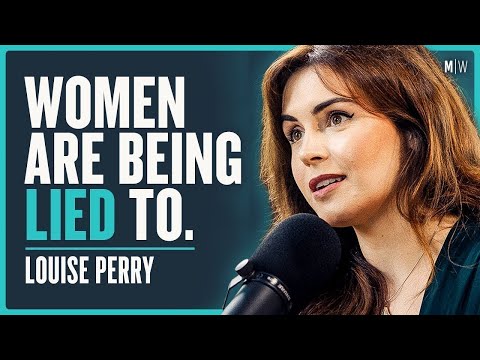
Why So Many Women Feel Lost in Their 30's - Louise Perry
Chris Williamson (host), Louise Perry (guest)
In this episode of Modern Wisdom, featuring Chris Williamson and Louise Perry, Why So Many Women Feel Lost in Their 30's - Louise Perry explores onlyFans, Fertility, And Why Modern Women Feel So Unmoored Chris Williamson and Louise Perry explore how modern sexual culture, particularly OnlyFans and extreme online sex work, collides with women’s long‑term desires for marriage, children, and stability.
OnlyFans, Fertility, And Why Modern Women Feel So Unmoored
Chris Williamson and Louise Perry explore how modern sexual culture, particularly OnlyFans and extreme online sex work, collides with women’s long‑term desires for marriage, children, and stability.
They argue that digital sex work brings lifelong reputational costs, fragile mental health, and poor financial outcomes for most women, while often masking loneliness and self‑harm rather than empowerment.
The conversation broadens into falling marriage and birth rates, how delayed marriage and male underperformance undermine family formation, and why low‑fertility societies become structurally hostile to parents.
They close by examining personality traits like agency and neuroticism, the limits of ‘trad’ lifestyle experiments, and how future societies may be shaped by the people who still choose to have children.
Key Takeaways
OnlyFans is a permanent, negative signal in the marriage market.
Perry likens an OnlyFans history to a criminal record: it’s searchable, long‑lasting, and significantly reduces a woman’s pool of potential long‑term partners, while most creators earn very little compared with the reputational risk they take.
Get the full analysis with uListen AI
Sex work often reflects vulnerability and self‑harm more than empowerment.
Using examples like Lily Phillips, Perry argues many women in explicit online work are lonely, feel ‘good for only one thing,’ and use sexual exposure as a way to cope with low self‑worth rather than as a freely chosen, optimal career path.
Get the full analysis with uListen AI
The ‘easy money’ of sex work rarely translates into lasting security.
Even high‑earning creators face taxes, short earning windows, impulsive spending driven by emotional distress, and the psychological sense that their money is ‘dirty,’ making it unlikely that a few intense years will truly set them up for life.
Get the full analysis with uListen AI
Falling birthrates are driven mainly by late or non‑existent marriage.
Drawing on Lyman Stone’s work, Perry notes that married people usually do want kids; the core issue is that men struggle to signal reliability and provision early enough, so women delay or forgo marrying and miss most of their fertile window.
Get the full analysis with uListen AI
Modern systems are built for highly agentic elites, not average people.
Institutions and advice are often designed by exceptionally willful, self‑directed individuals, then applied to a population that is more passive and mimetic, leading to unrealistic expectations about self‑control, health, and life design.
Get the full analysis with uListen AI
Low‑fertility cultures become subtly hostile to parents and children.
In societies where few people have kids, infrastructure, norms, and public attitudes (e. ...
Get the full analysis with uListen AI
Future societies will be shaped by those who combine tech and fertility.
Perry suggests highly traditional, high‑fertility groups (e. ...
Get the full analysis with uListen AI
Notable Quotes
“OnlyFans is to the marriage market as a criminal record is to the jobs market.”
— Louise Perry
“I strongly concluded from that, that actually she's doing this more as a kind of self-harm than anything else.”
— Louise Perry (on Lily Phillips)
“Observable metrics and hidden metrics are two things that people often make the wrong trades for.”
— Chris Williamson
“What’s being selected for now are people who can form cultures that are pro‑natal… one way or another we’re going through an almighty bottleneck.”
— Louise Perry
“Actual trad life does not look like the sort of Instagram trad life… unilateral trad life is hardcore and most people are not suited to it.”
— Louise Perry
Questions Answered in This Episode
How should society balance individual sexual autonomy with the long‑term harms Perry describes for women who enter OnlyFans or prostitution?
Chris Williamson and Louise Perry explore how modern sexual culture, particularly OnlyFans and extreme online sex work, collides with women’s long‑term desires for marriage, children, and stability.
Get the full analysis with uListen AI
If male ‘signaling’ of reliability is central to fertility, what concrete institutions or norms could be rebuilt to help young men demonstrate husband potential earlier?
They argue that digital sex work brings lifelong reputational costs, fragile mental health, and poor financial outcomes for most women, while often masking loneliness and self‑harm rather than empowerment.
Get the full analysis with uListen AI
To what extent do we underestimate the role of personality traits like agency and neuroticism in who becomes a parent and who doesn’t?
The conversation broadens into falling marriage and birth rates, how delayed marriage and male underperformance undermine family formation, and why low‑fertility societies become structurally hostile to parents.
Get the full analysis with uListen AI
How can communities realistically recreate multi‑generational or ‘trad’ support structures without the genetic ties and geographic stability that made them work historically?
They close by examining personality traits like agency and neuroticism, the limits of ‘trad’ lifestyle experiments, and how future societies may be shaped by the people who still choose to have children.
Get the full analysis with uListen AI
If ideologies that discourage having children are self‑limiting, what kinds of values and cultural narratives are likely to dominate in two or three generations?
Get the full analysis with uListen AI
Transcript Preview
Bonnie Blue might be pregnant. Good news?
(laughs) No, very bad news. I mean, I'm- I- I- I would bet money that she is not pregnant. I would bet money also that Lily Phillips is not pregnant. Like, what are the chances that the two of them are pregnant at exactly the same time? Come on. I also just hope they're not.
It's a lot of men. It's a lot of sperm.
(laughs) Yes. I did see someone on Twitter saying that actually the most reliable contraception in the world, like, the Mirena coil has a one in a thousand failure rate. (laughs)
(laughs) So, one in 57 actually breaks it.
Yeah. So, you know-
Wow.
... I guess it's plausible. Um, but, uh, I really hope it's not true. I mean, it- I... Yeah. I, I think it would be very likely that social services would get involved, in all seriousness.
Wow. That's interesting.
Mm-hmm.
And I totally didn't, I totally didn't think about that. Why would they get involved?
Because it's very common for children to be taken away from mums if they are, um, in prostitution. And the thing is that, I think what, what social services are normally worried about is children being exposed to punters. Like, if they're coming into the home. Which isn't happening with Bonnie Blue or Lily Phillips. But it's like they... I mean, they do, like, work from home, in the sense of doing camming from home.
Mm-hmm.
And like, it's... I think it would be very, very difficult for them to protect children completely.
Yeah. It's perilously similar. And you know, the word sex worker was reclaimed by OnlyFans and online models and stuff like that, and it kind of... Sex worker, I guess, 20 years ago would've been girls that were out on the curb at sort of the dark hours of the night and guys driving past. And now it covers a whole range of sins, m- many of which are digital and totally parasocial, and totally solo. Uh, but something tells me... Actually, yeah, that social services might, if you want to expand the definition of sex worker to include this sort of stuff, then perhaps social services have got something to say about that.
Yeah. I mean, I think they'd at least have to think about it, you know. Like, I've... I don't... I mean, I... Yeah. I really hope it's not true because imagine the psychological toll on a child who knew that they'd been brought into the world in those circumstances, right? And I, I mean, Lily Phillips is single. Lily Phillips doesn't have a boyfriend. So, if she were pregnant-
Does Bonnie Blue?
Yeah, I think she does. I mean-
I guess if you've had a sample-
Yeah.
... of a thousand guys, you've got to be one good one in there. Or maybe not.
Install uListen to search the full transcript and get AI-powered insights
Get Full TranscriptGet more from every podcast
AI summaries, searchable transcripts, and fact-checking. Free forever.
Add to Chrome