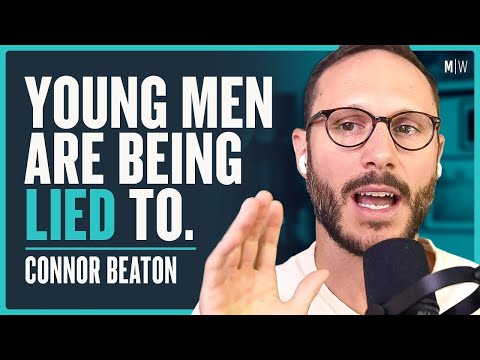
Advice To Men Who Are Struggling - Connor Beaton
Chris Williamson (host), Connor Beaton (guest)
In this episode of Modern Wisdom, featuring Chris Williamson and Connor Beaton, Advice To Men Who Are Struggling - Connor Beaton explores men’s Silent Struggle: Why Suppression Masquerades As Strength And Fails Connor Beaton and Chris Williamson explore the unspoken rule that men must not talk about their struggles, linking emotional suppression to rock-bottom crises, addiction, and quiet despair.
Men’s Silent Struggle: Why Suppression Masquerades As Strength And Fails
Connor Beaton and Chris Williamson explore the unspoken rule that men must not talk about their struggles, linking emotional suppression to rock-bottom crises, addiction, and quiet despair.
They unpack how war trauma, status competition, fatherlessness, and a female-framed therapeutic culture have shaped modern masculinity and discouraged men from seeking meaningful support.
The conversation challenges the simplistic advice that men just need to be ‘more vulnerable,’ arguing instead for male-specific spaces, mentorship, and concrete tools for building competence and resilience.
They close with practical guidance on confronting one’s shadow, finding trustworthy male communities, and methodically replacing numbing habits with constructive behaviors.
Key Takeaways
Suppressing emotions erodes real strength over time.
When men equate strength with pushing down anger, grief, and fear, they form an internal ‘part’ that actively works against them, often leading to addictions, burnout, or suicidal ideation rather than resilience.
Get the full analysis with uListen AI
Men need depth in male friendships, not just banter.
Most male relationships are “a mile wide and an inch deep,” so men casually joke about serious problems but receive no real support; deliberately cultivating a few honest, challenge-and-support friendships radically improves psychological robustness.
Get the full analysis with uListen AI
Vulnerability alone won’t fix men’s problems without structure and tools.
Telling men to ‘just open up’ is incomplete and often dangerous; many men who die by suicide were already in therapy, showing that men also need action-oriented strategies, boundaries, and male-appropriate frameworks, not only talk.
Get the full analysis with uListen AI
Fatherlessness and weak male role models breed over-pleasing and confusion.
Without a dad or strong men to push against and imitate, boys orient around maternal approval and female validation, often becoming ‘nice guys’ who avoid assertiveness, struggle with boundaries, and later repeat this pattern in romantic relationships.
Get the full analysis with uListen AI
Status competition between men is constant yet mostly unconscious.
Men continuously size each other up in the background but can’t safely acknowledge it because talking about status is low-status; this hidden rivalry makes it harder to reveal weaknesses and ask other men for help.
Get the full analysis with uListen AI
Cultural narratives about masculinity are confusing and often female-framed.
From therapy models that treat men as ‘defective women’ to public messaging that condemns traditional masculinity while privately desiring dominance in the bedroom, men receive contradictory instructions that undermine clarity and self-trust.
Get the full analysis with uListen AI
Practical change starts with confession, community, and habit replacement.
Men progress by honestly admitting what they least want to say, finding trustworthy groups or mentors to witness it, and systematically swapping numbing behaviors (weed, porn, junk food, games) for generative habits that build competence and self-respect.
Get the full analysis with uListen AI
Notable Quotes
“The first rule of men is that you don't talk about what it's like to be a man, specifically a man who is suffering or struggling.”
— Connor Beaton
“Seeking strength through suppression is such a lovely frame... when that modality becomes our way of living, it ends up becoming a toxin instead of a tonic.”
— Chris Williamson
“We are so culturally and socially almost inept at being able to identify a man who's really struggling.”
— Connor Beaton
“If one sex loses, both sexes lose.”
— Chris Williamson
“We are not meant to deal with our grief, our anger, or our psychological hardship in isolation.”
— Connor Beaton
Questions Answered in This Episode
How can men safely identify the ‘right’ people and settings to open up to without risking social or relational backlash?
Connor Beaton and Chris Williamson explore the unspoken rule that men must not talk about their struggles, linking emotional suppression to rock-bottom crises, addiction, and quiet despair.
Get the full analysis with uListen AI
What would a genuinely male-oriented therapeutic or support model look like in practice, and how would it differ from current mainstream therapy?
They unpack how war trauma, status competition, fatherlessness, and a female-framed therapeutic culture have shaped modern masculinity and discouraged men from seeking meaningful support.
Get the full analysis with uListen AI
In what concrete ways can fathers and older men reintroduce healthy initiation and mentorship into boys’ lives today?
The conversation challenges the simplistic advice that men just need to be ‘more vulnerable,’ arguing instead for male-specific spaces, mentorship, and concrete tools for building competence and resilience.
Get the full analysis with uListen AI
How can couples navigate the paradox where women often desire more dominance in the bedroom while society scrutinizes male assertiveness and aggression?
They close with practical guidance on confronting one’s shadow, finding trustworthy male communities, and methodically replacing numbing habits with constructive behaviors.
Get the full analysis with uListen AI
What realistic first steps can an isolated man take if he has no strong male friendships or role models and feels ashamed to seek them?
Get the full analysis with uListen AI
Transcript Preview
What is the one rule of men?
(laughs) The one rule of men is, uh, very similar to the one rule of Fight Club, right? You know, everybody's kind of seen Fight Club. It's like a, a tour de force on masculinity in many ways. Um, but the first rule of Fight Club is you don't talk about Fight Club. And the first rule of men, the one rule of men, is that you don't talk about what it's like to be a man, specifically a man who is suffering or struggling. So if you're having a hard time, the rule is don't talk about it. If you're going through, you know, the, the wringer, your wife's left you, you know, your pickup truck's broke down-
(laughs)
(laughs) ... your, your kids are having a hard time, you're having a hard time at work, you hate your job, um, generally the rule is don't talk about it. And so I think that that's one of the main things that we see a lot of, I see a lot of men battling against. You know, they've sort of been compressed underneath this rule for a long time. I know this was what I went through for a very long time. I grew up in what I call the Texas of Canada. You know, we have big trucks, we got oil, we got guns and cowboys, but it's minus 30 six months out of the year, right? So, um, little, little bit different on, on that front. But (clears throat) I think that one rule is the thing that a lot of men really struggle to get out from underneath, and what it leads to is some type of rock bottom. And I think a lot of men are convinced, uh, again, at least this is, this is my experience, this is the li- the path that I sort of fell down, um, convinced that things aren't actually going to change until they bottom out, because there's nowhere else to go when your version of strength is, "I have to suppress. I have to push things down, my anger, my anxiety, my sadness, my grief, you know, from having the woman that I love leave me," or whatever it is. When you have to suppress and you've been told that if you can push things down long enough, if you can avoid things for long enough, that you will somehow be stronger for it, it, it creates a very strong part of you that is actively working against you. And so we can talk about that in a sec, but that's the one rule of men. And, and man, I love Fight Club. I just gotta say it's, it's such a good movie in so, so many ways.
Seeking strength through suppression is such a lovely frame, I think, and it so nicely encapsulates what men are doing. And it's the seeking part as well, you know? It, it's, it's grasping for it. It's, it's almost like a wistfully hoping that it's going to appear.
Install uListen to search the full transcript and get AI-powered insights
Get Full TranscriptGet more from every podcast
AI summaries, searchable transcripts, and fact-checking. Free forever.
Add to Chrome